Micron Tops Undervalued Large Caps by PEG, Nvidia Ranks Third

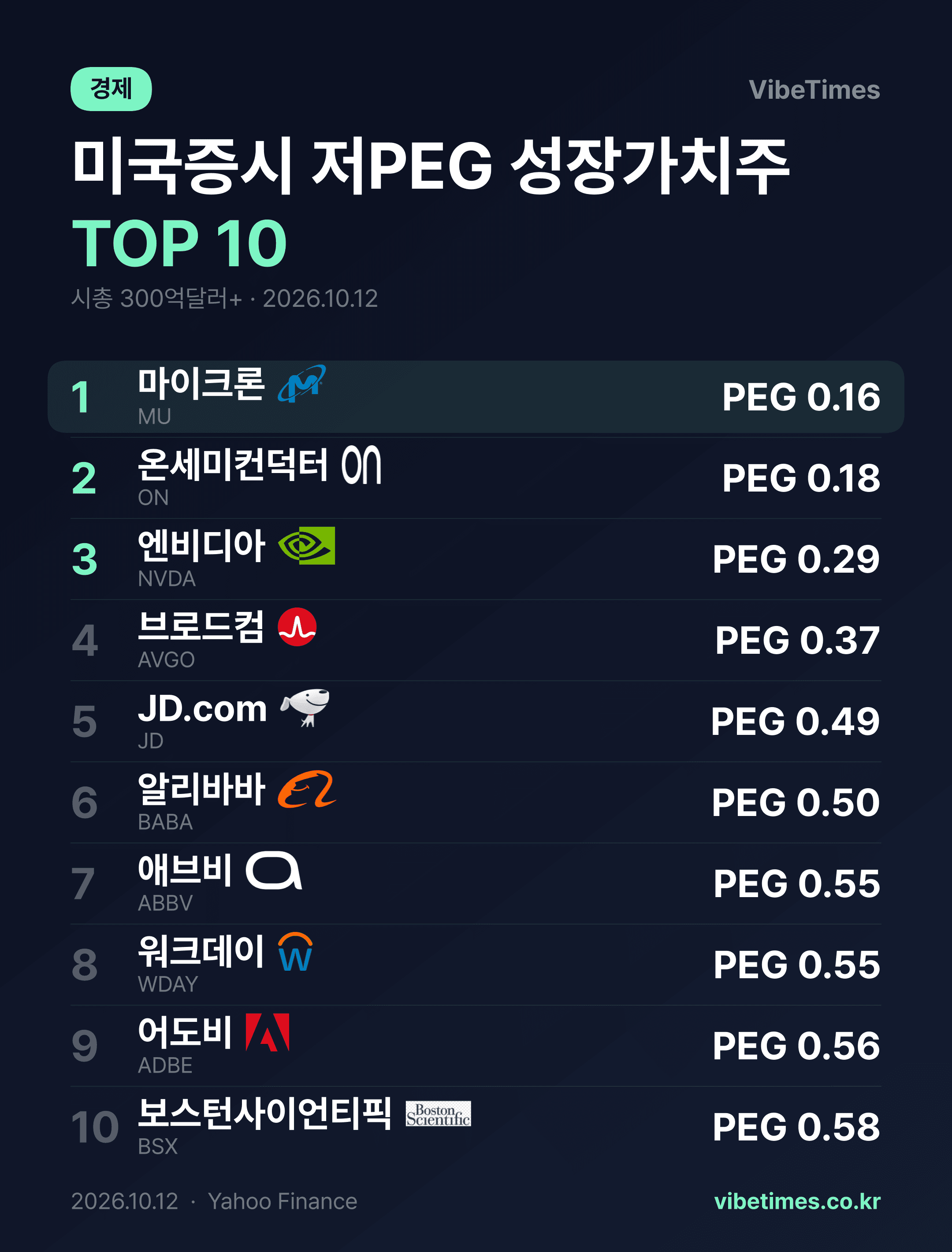
Semiconductors have swept the rankings of undervalued growth stocks.
An analysis of the top 10 US stocks combining growth and value with the lowest price/earnings-to-growth (PEG) ratios as of October 12, 2026, shows semiconductor-related shares taking four spots. Micron ranked first at 0.16, ON Semiconductor second at 0.18, Nvidia third at 0.29, and Broadcom fourth at 0.37. With all of the top four being chipmakers, the ranking suggests the market is going beyond a simple hunt for bargains and entering a reevaluation phase driven by artificial intelligence (AI) demand.
What Is PEG and Why Below 1 Matters
PEG is calculated by dividing the price-to-earnings ratio (PER) by expected future growth. On PER alone, growth stocks always look expensive, but factoring in the pace of growth changes the picture. A PEG below 1 is conventionally read as a stock being cheap relative to its growth. All ten stocks on this list have PEG ratios under 0.6, implying their expected earnings growth has yet to be fully reflected in current share prices.
Micron's 0.16: Reading the Number
For top-ranked Micron, the PEG of 0.16, alongside a PER of 13.9, signals that while the market expects annual earnings growth of roughly 80% over the next few years, it has barely priced this in. It is unusual for a large cap with a market capitalization of $1.17 trillion to post such a figure, defying the conventional wisdom that bigger companies struggle to sustain high growth rates. It suggests that surging high-bandwidth memory (HBM) demand, fueled by AI data center investment, is reshaping the profit structure of memory chipmakers.
Nvidia presents a contrast. Its PER of 29.1 may look burdensome, but a PEG of 0.29 means its expected growth more than offsets that. The key point is that the largest company on the list, with a market cap of $5.57 trillion, is still being valued as a growth stock. Broadcom's PER of 46.0 is hardly low either, but its PEG of 0.37 implies that profit acceleration from its expanding custom AI chip business is outpacing market expectations.
Quiet Reevaluation of Chinese Platforms and Health Care
A different trend emerges in the middle of the rankings. JD.com posted a PEG of 0.49 with a PER of 18.8, while Alibaba came in at a PEG of 0.50 and a PER of 25.6. The two Chinese e-commerce leaders landing side by side in fifth and sixth place is evidence of compressed valuations, where low PERs coexist with growth expectations. Chinese consumer sentiment and regulatory risks remain variables, but the numbers themselves point to discounted prices relative to growth.
In pharmaceuticals and biotech, AbbVie and Boston Scientific posted PEG ratios of 0.55 and 0.58, respectively. Notably, AbbVie carries the list's highest PER at 77.0, yet still falls into undervalued territory once growth is factored in, reflecting expectations that new drug revenue is ramping up steeply enough to offset its high PER. In software, Workday (PEG 0.55) and Adobe (PEG 0.56) made the list, with Adobe standing out for having the lowest PER on the list at 13.5, making it cheap even in absolute terms.
Implications and Outlook
The biggest takeaway from these rankings is that the dichotomy between growth and value is breaking down. AI semiconductors are being reclassified from "expensive growth stocks" to "cheap growth stocks." Meanwhile, ON Semiconductor, the smallest company on the list at a $30.9 billion market cap, climbing to second place despite a PER of 51.2 is interpreted as reflecting expectations for a recovery in automotive and industrial power semiconductors.
Of course, because PEG depends on projected growth rates, the undervaluation verdict wobbles whenever consensus estimates are cut. Micron carries the risk of the memory price cycle, while Nvidia faces the possibility of slowing AI capital expenditure. Still, with four semiconductor firms dominating the upper ranks, whether these companies confirm their earnings in the upcoming reporting season is expected to determine the direction of valuations across the entire US market. Numbers may not lie, but recalculating those numbers is always the market's job.