Before the robot, the elderly must press the power button before reading the manual

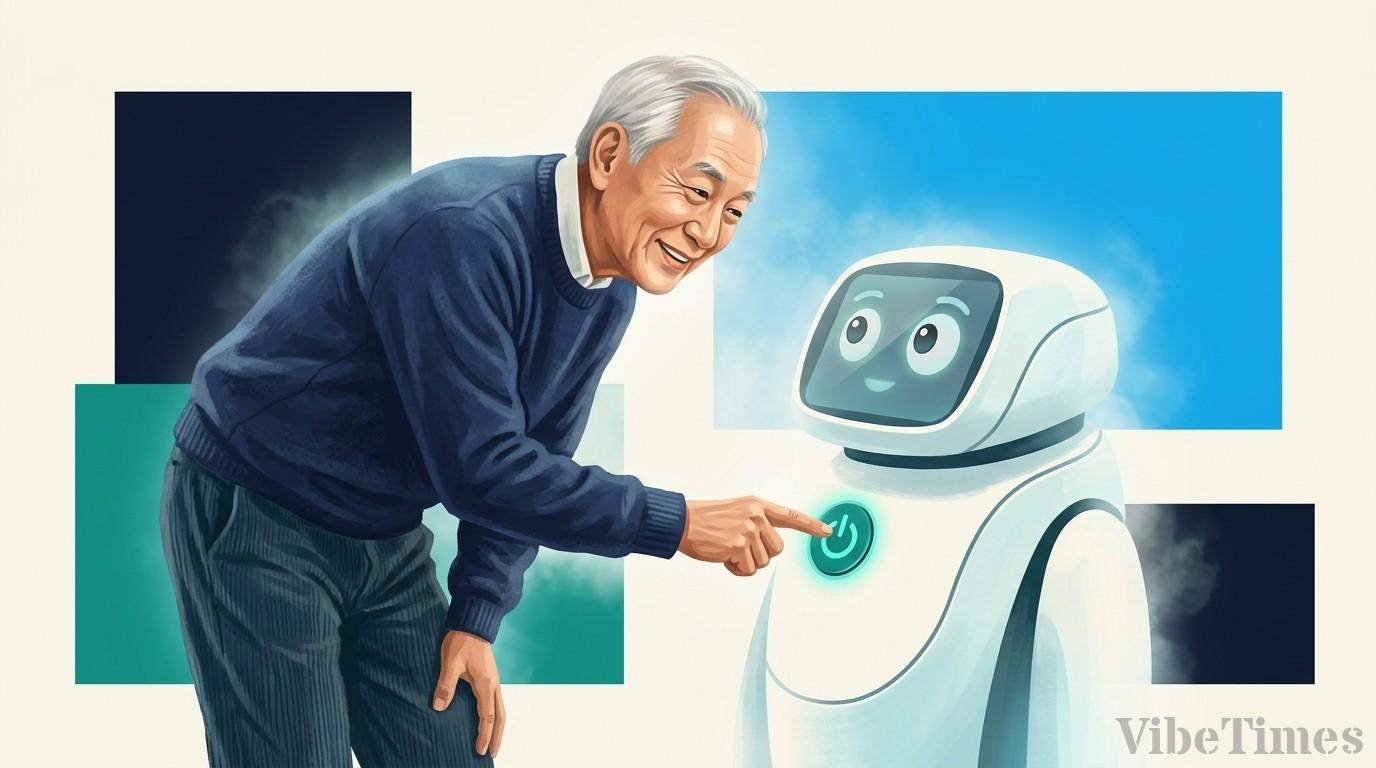
A robot should be switched on by an older person's own hands. Choi Hong-gyu, an EBS research fellow with a PhD in media studies, argued in a column published on the 15th about the direction of senior AI education that older adults should be the ones to turn robots on themselves. He pointed out that senior AI education usually begins with easing fears, but a reduced fear does not automatically make people move their hands. In an era when embodied AI like robots is entering homes, he explained, the first thing education should cultivate is not knowledge but self-efficacy—the belief that "I can do this too."
There is experimental evidence supporting his claim that it is not a guide but the experience of succeeding that builds self-efficacy. According to a paper published by a Canadian research team in March 2026, 18 older adults were divided into two groups and asked to assemble exercise equipment under different forms of guidance. One group received help from a voice assistant developed by the research team—which read out assembly steps and parts when users spoke preset commands and included a screen for checking assembly progress—while the other was guided through voice calls playing pre-recorded human voices on request. The guidance content was identical in both conditions, and the older adults did the assembly themselves.
As a result, all 18 participants who completed the assembly showed gains in both assembly self-efficacy and general self-efficacy—the sense of being able to cope with everyday difficulties—with no difference in scores between the two guidance methods. The difference emerged a month later. The voice assistant group maintained their heightened assembly self-efficacy after a month, while the voice call group saw their improved scores decline again. General self-efficacy was not sustained after a month in either group. The research team attributed the rise in self-efficacy to the successful experience of assembling the equipment themselves, and interpreted the one-month difference as reflecting how older adults felt they had directed the assembly on their own when the guide was not a human.
Choi reads the source of self-efficacy in these results: what builds it is not the identity of the guide but the successful experience of seeing a task through to the end. However, since a single success failed to sustain general self-efficacy, he stressed that the first success should not be a one-off. Self-efficacy, he argues, endures when success is felt as one's own.
In the age of physical AI, this point carries even more weight. Apps on a screen have a back button, but a robot on the floor leaves failure behind as a physical object—it sputters to a halt, as it were, if assembled incorrectly. The machines that will accompany older adults in the future must be taken out of the box, assembled, and connected to power, meaning the first hurdle lies in installation, before operation. The research team noted that robots are difficult to set up and cannot be used if not properly assembled.
Choi Hong-gyu urged that in senior education, rather than explaining first and letting hands follow, older adults should use their hands first while explanations come alongside as support. Guides, he said, should stay by their side with words alone, not do the task for them, and should let older adults complete even a small task from start to finish with their own hands. The first question to ask seniors, he added, should not be "Do you know how to use it?" but "Would you like to try?"
