Elderly Population Reaches 20.3% While Fertility Rate Edges Up to 0.799

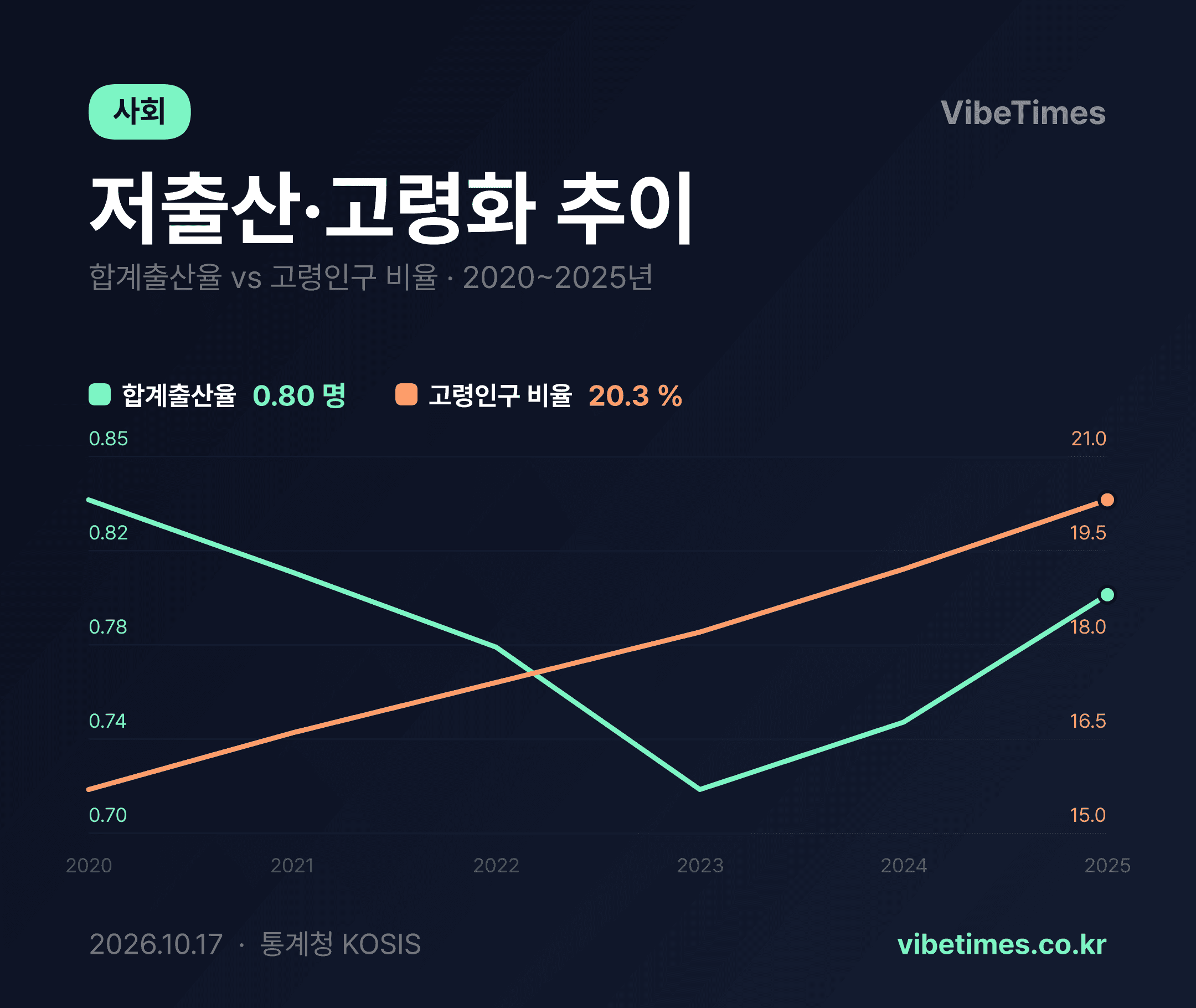
More than one in five South Koreans—20.3 percent of the population—is now aged 65 or older. Of the total population of 51,117,378 as of 2025, the elderly share has surpassed the 20 percent mark for the first time, while the total fertility rate rebounded for a second consecutive year to 0.799 children per woman. A dual structure of a shrinking population and a growing elderly cohort has become the new baseline for the Korean economy.
The Meaning and Limits of the Fertility Rebound
The total fertility rate fell for four straight years, from 0.837 in 2020 to 0.721 in 2023, before turning upward to 0.748 in 2024 and 0.799 in 2025. That is a rise of 0.078 in two years, which translates into tens of thousands of additional births annually.
Still, it is too early to read the figures optimistically. The 0.799 rate in 2025 remains below the 2020 level of 0.837 and falls well short of half the replacement level of 2.1. Only data from the next two to three years will show whether the rebound is a temporary bounce or a structural turning point. It also matters that the rebound is occurring while the population of childbearing age itself is shrinking. As the number of women of childbearing age declines, birth counts could fall again even if the fertility rate holds steady.
Aging Is Outpacing the Fertility Rebound
The elderly population ratio rose from 15.7 percent in 2020 to 20.3 percent in 2025, a 4.6 percentage-point increase in five years, or an average of 0.9 points per year. By Statistics Korea's definition, this means South Korea completed its transition into a 'super-aged society' (20 percent or more) in 2025. Aging did not pause even as the fertility rate rose for two consecutive years.
The difference in direction between these two trends is key. Rising fertility is a slow-moving variable that affects the working-age population 10 to 20 years down the road, while aging is a fast-moving one that hits pensions, health care, and labor markets immediately. This creates an asymmetry in which fiscal burdens and pressure on the tax base intensify in the short term, while the demographic replenishment effect only appears over the long term.
Shifts in Income Structure and the Consumer Market
Households in the top income quintile recorded average monthly gross income of 11,150,363 won (second quarter of 2026), meaning the top tier's monthly income has surpassed 11 million won. Given that the gap with lower income brackets is even wider, South Korea is in a period where demographic aging and income polarization are converging.
As the elderly share grows, the consumption basket changes as well. Demand for medical care, nursing, and senior housing expands structurally, while demand for durable goods and new housing contracts. The high incomes of the top 20 percent support the spending power of wealthy older households, but translating that into overall domestic demand requires income gains among lower tiers as well.
Outlook: Where the Two Indicators Collide
The key point to watch is whether the fertility rate stalls in the 0.8 range or climbs toward 0.9. The elderly population ratio is expected to keep rising through the 2030s, when the baby boom generation has fully moved into the 65-and-over bracket, making 2025's 20.3 percent merely a starting point. Even if the fertility rebound takes hold, it will take considerable time to reverse the decline in the total population.
Ultimately, a dual strategy is unavoidable: short-term fiscal and labor policies must be designed around aging, while long-term population policy must focus on sustaining the rebound. The pace at which the gap between the two indicators narrows will determine South Korea's potential growth rate.