An annual salary of 30 million won means take-home pay of just 2.2 million won a month

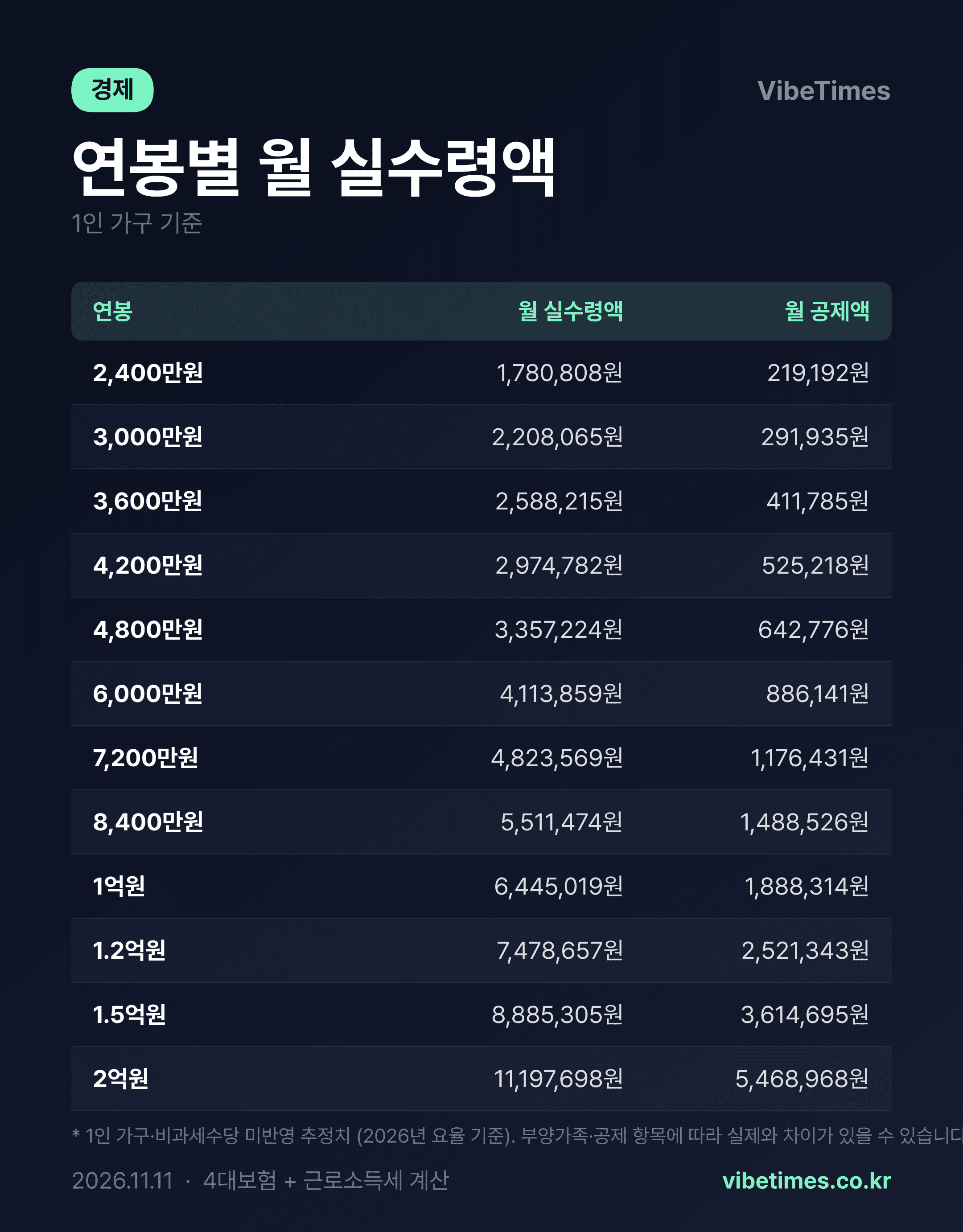
Even with an annual salary of 30 million won, the money arriving in your bank account each month is barely 2.2 million won. From a nominal monthly wage of 2.5 million won, 235,102 won in social insurance premiums and 56,833 won in taxes including income tax are deducted, leaving take-home pay of 2,208,065 won. That works out to roughly 11.7% of the paycheck taken in deductions.
At low salaries, insurance premiums outweigh taxes
With an annual salary of 24 million won, the picture is even starker. Monthly take-home pay is 1,780,808 won, of which taxes are a mere 31,111 won. Meanwhile, social insurance premiums total 188,082 won — more than six times the tax bill. This shows that at lower income levels, the income tax burden is small, so most deductions are determined by social insurance rates such as national pension and health insurance.
As salaries rise, this ratio flips. At an annual salary of 60 million won, monthly take-home pay is 4,113,859 won, with 470,204 won in social insurance and 415,938 won in taxes — the gap between the two narrows to the 50,000-won range. By an annual salary of 84 million won, taxes of 858,591 won overtake social insurance premiums of 629,935 won. This is the result of premium growth flattening out once the national pension contribution ceiling is reached, while income tax climbs steeply under the progressive tax structure.
The reality of a 100-million-won salary: 6.44 million won a month
For earners commonly described as making "100 million won a year," monthly take-home pay is 6,445,019 won. From a nominal monthly salary of 8.33 million won, about 1.88 million won is deducted each month. Converted into a deduction rate, that comes to 22.6% — nearly double the 11.7% burden at an annual salary of 30 million won.
The gap widens further at higher incomes. At an annual salary of 200 million won, monthly take-home pay is 11,197,698 won — a 32.8% cut from the nominal monthly salary of 16.66 million won. Taxes alone amount to 4.36 million won a month. Even in the 150-million-won bracket, 2,715,036 won in taxes leaves each month, and the figures confirm the nature of progressive taxation: tax increases outpace gains in take-home pay.
What take-home pay reveals about the labor market
This deduction structure suggests that in wage negotiations or job hunting, terms should be weighed in terms of "after-tax monthly pay" rather than "gross annual salary." For example, the headline gap between annual salaries of 42 million won and 48 million won is 6 million won a year, but on a take-home basis the difference is 380,000 won a month, or 4.59 million won a year. Without tax-saving tools such as retirement pensions or tax-exempt savings, the gap will not widen further.
It is also worth noting that in lower income brackets, social insurance premiums are the real squeeze on household cash flow. At annual salaries of 36 million won or below, insurance premiums, not taxes, account for the bulk of deductions, so whether premium rates rise directly affects take-home pay. Higher income brackets, by contrast, are far more sensitive to changes in income and employment tax policy.
In the end, the same salary increase yields different amounts in hand depending on the bracket. Moving from an annual salary of 120 million won to 150 million won is a headline raise of 30 million won, but the actual take-home gain is only about 1.4 million won a month — roughly 16.87 million won a year. Nearly half the raise goes back in taxes and insurance premiums. As the negotiator's maxim goes, every number deserves to be doubted and recalculated as something with an agenda of its own.
