Micron Tops Undervalued Growth Stocks With PEG of 0.16

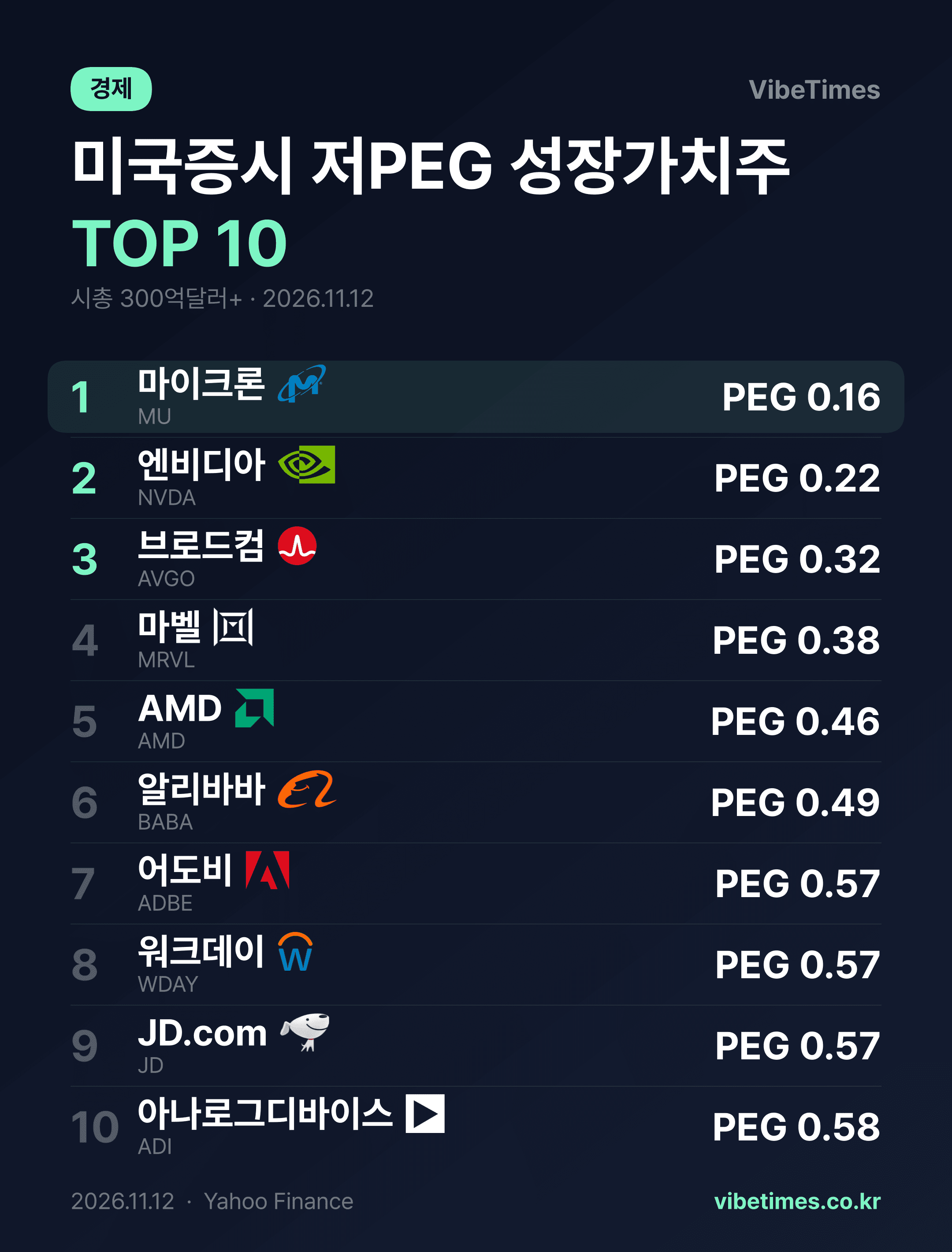
Micron has climbed to the top of the U.S. market's undervalued-growth rankings with a PEG ratio of 0.16. In the tally of the top 10 low-PEG stocks (a metric dividing the price-to-earnings ratio by growth rate) as of November 12, 2026, semiconductor and tech stocks took seven of the ten spots, effectively dominating the list. A PEG below 1 means a stock is trading cheaply relative to its earnings growth rate, a range traditionally viewed as attractive from a value-investing perspective.
A Ranking Dominated by Semiconductors
All of the top five are semiconductor-related companies. Micron ranks as the runaway No. 1 with a PEG of 0.16, a P/E of 9.8, and a market capitalization of $820.4 billion. Second-place Nvidia, with a PEG of 0.22, a P/E of 21.4, and a market cap of $4.08 trillion, is the only mega-cap on the list exceeding $4 trillion. They are followed by Broadcom at PEG 0.32 with a P/E of 42.4, Marvell at PEG 0.38 with a P/E of 50.8, and AMD at PEG 0.46 with a P/E of 110.1.
What stands out is the contrast between Nvidia and AMD. Despite a relatively low headline valuation at a P/E of 21.4, Nvidia's high growth rate compresses its PEG down to 0.22. AMD, by contrast, carries a P/E of 110.1, showing the market still assigns it a steep premium, but its PEG comes in at 0.46 because projected growth is expected to exceed that multiple. Both stocks suggest the market values their growth trajectories more highly than current prices imply.
What Micron's 0.16 Means
Micron's PEG of 0.16 arithmetically means its growth rate is more than six times its P/E. One interpretation is that amid the memory chip upcycle, the pace of earnings improvement has far outstripped what the stock price reflects. Its P/E of 9.8 is the lowest among the top 10, less than half that of Nvidia. Its $820.4 billion market cap is roughly on par with AMD's $845 billion, yet its P/E is about one-ninth of AMD's — clear evidence that the market is pricing the two companies' business momentum very differently.
Of course, the PEG has its limits as a metric that depends on projected growth rates. If growth expectations are revised down, the PEG can collapse just as quickly. Micron's low PEG should not be read as proof of certain undervaluation, but rather as a conditional signal of substantial upside potential should the memory boom persist as expected.
The Non-Semiconductor Names and Takeaways
Outside semiconductors, two Chinese companies made the list. Alibaba ranked sixth at PEG 0.49 with a P/E of 24.9 and a market cap of $255.5 billion, while JD.com placed ninth at PEG 0.57 with a P/E of 19.8 and a market cap of $38.2 billion. Adobe posted a PEG of 0.57 on a P/E of 13.2 — the second-lowest valuation in the top 10 after Micron — while Workday and Analog Devices closed out the list at PEGs of 0.57 and 0.58, respectively.
From an investing standpoint, the ranking offers two takeaways. First, undervaluation opportunities lie not in forgotten laggards the market has already abandoned, but within leaders such as Nvidia and Micron. Second, the fact that the top names all carry PEGs below 0.6 suggests the market as a whole has yet to fully translate AI and semiconductor growth expectations into earnings. The fourth-quarter earnings season, when expectations are tested against actual results, is likely to set the direction. As Benjamin Franklin put it in his metaphor about genius buried in a silver mine, only the earnings will reveal whether this is value yet to be excavated — or simply a shallow vein.
