November 12 Investment Report: AI Value Investing Portfolio +23.1%


Catching Its Breath Amid Semiconductor Strength... AI Value Investing Portfolio Holds 23% Returns
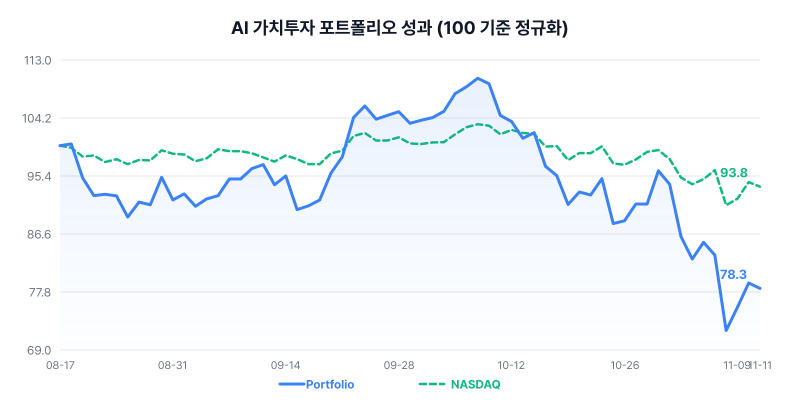
While the U.S. market closed higher, led by semiconductors, the domestic market showed a lukewarm performance. The Philadelphia Semiconductor Index surged 5.66% in a single day, signaling a revival of investor appetite for AI infrastructure, whereas the KOSPI rose only modestly and the KOSDAQ fell more than 1%. Against this backdrop, the AI Value Investing Portfolio maintained a cumulative return of +23.07%, with total assets at $12,307. Still, the five-day asset trend shows the portfolio started at $13,100 on November 5 and fluctuated since, taking a bit of a breather.
Discipline Maintained Amid Wild Swings
The portfolio's asset curve was turbulent just last week, swinging between $11,303 and $13,100. Micron's double-digit correction over a short period shook the entire portfolio. Yet the strategy's consistency never wavered. Each time the market plunged, cash was deployed to buy undervalued assets — the principle of staggered buying was adhered to throughout — and as a result, assets returned to a recovery trajectory on November 11. The VIX falling more than 10% in a single day also reads as a sign that market fear has, for now, subsided.
Holdings Diagnosis: The Center of Gravity of Undervaluation Lies in Memory and AI Leaders
| Stock | Shares | Purchase Price | Current Price | P/E |
|---|---|---|---|---|
| NVIDIA | 24.00 | $184.21 | $168.89 | 21.4 |
| Micron | 1.50 | $894.69 | $725.11 | 9.8 |
| AMD | 6.15 | $198.62 | $515.21 | 110.1 |
| Amazon | 1.95 | $208.39 | $270.87 | 21.9 |
| Broadcom | 5.67 | $326.03 | $331.98 | 42.4 |
| Intel | 2.80 | $104.56 | $58.13 | - |
| Meta | 0.55 | $653.56 | $641.39 | 21.9 |
| TSMC | 0.44 | $431.81 | $396.48 | 25.7 |
| SOXL | 13.92 | $71.22 | $56.06 | 21.1 |
| TQQQ | 1.13 | $76.34 | $56.56 | 26.0 |
Each holding has its own distinct appeal. Micron trades at a P/E below 10 despite earnings per share topping $74, with a growth-adjusted PEG of just 0.16 — figures that show how much of its growth remains unpriced. As long as HBM demand continues, the thesis of a memory supercycle remains valid. NVIDIA, too, carries a PEG of 0.22, still modest relative to its growth. AMD, on the other hand, looks expensive on the surface with a P/E above 110, but its growth-adjusted PEG is a low 0.46. Having already booked gains exceeding 150%, the more natural interpretation is that AMD has entered a phase of earnings validation rather than carrying a speculative premium. Intel remains loss-making, making earnings-based valuation difficult, and its character is largely that of a thematic rebound play.
Trade Review: The Rhythm of Profit-Taking and Reallocation
| Date | Action | Stock | Shares | Price |
|---|---|---|---|---|
| 2026-11-06 | Buy | Micron | 0.20 | $656.39 |
| 2026-11-06 | Sell | AMD | 0.32 | $404.40 |
| 2026-10-30 | Buy | TSMC | 0.44 | $431.81 |
| 2026-10-30 | Sell | AMD | 0.34 | $566.42 |
| 2026-10-23 | Buy | Micron | 0.47 | $856.49 |
| 2026-10-23 | Sell | NVIDIA | 1.26 | $212.21 |
| 2026-10-23 | Sell | AMD | 0.36 | $507.93 |
| 2026-10-16 | Buy | Micron | 0.31 | $931.24 |
| 2026-10-16 | Sell | NVIDIA | 1.33 | $217.23 |
| 2026-10-09 | Buy | Micron | 0.11 | $1,035.84 |
The trading pattern shows a clear rhythm. Micron was bought in four installments over the past month, with the average cost lowered from $1,036 to $656 per share — a textbook example of turning a plunge into an opportunity through staggered buying. Conversely, surging AMD and NVIDIA, whose weight had exceeded 38%, were periodically trimmed to control single-stock risk. Notably, the NVIDIA sales were not an abandonment of a core position but a rotation, shifting capital to more undervalued assets within the same sector. A cash balance of just $54 also means capital is deployed across holdings rather than sitting idle.
Market Outlook: Caution Within Optimism
Taken together, the indicators point to a coexistence of optimism and caution. The semiconductor index surge and the plunge in the VIX suggest a return of risk appetite, while the won-dollar exchange rate falling to the 1,330-won range signals weakening demand for safe-haven assets. However, with the U.S. 10-year Treasury yield hovering near 5%, valuation pressure on growth stocks remains a live variable. Nasdaq 100 and S&P 500 futures already trading slightly lower also serve as a cautionary signal that the day's rebound may not immediately carry forward. In this market of swinging rates and volatility, sticking to the current strategy — profit-taking on surge days, staggered buying of undervalued names on plunge days — is likely the surest path to avoiding costly mistakes.
※ This report analyzes the simulated operation of the AI Value Investing Portfolio and does not constitute investment advice. Actual investing should be carried out under your own judgment and responsibility.
Want the full portfolio details?
Subscribe to the newsletter below to receive a detailed investment report every day.