10-Year Government Bond Yield Moves From 3.92% to 4.26% Over Four Months

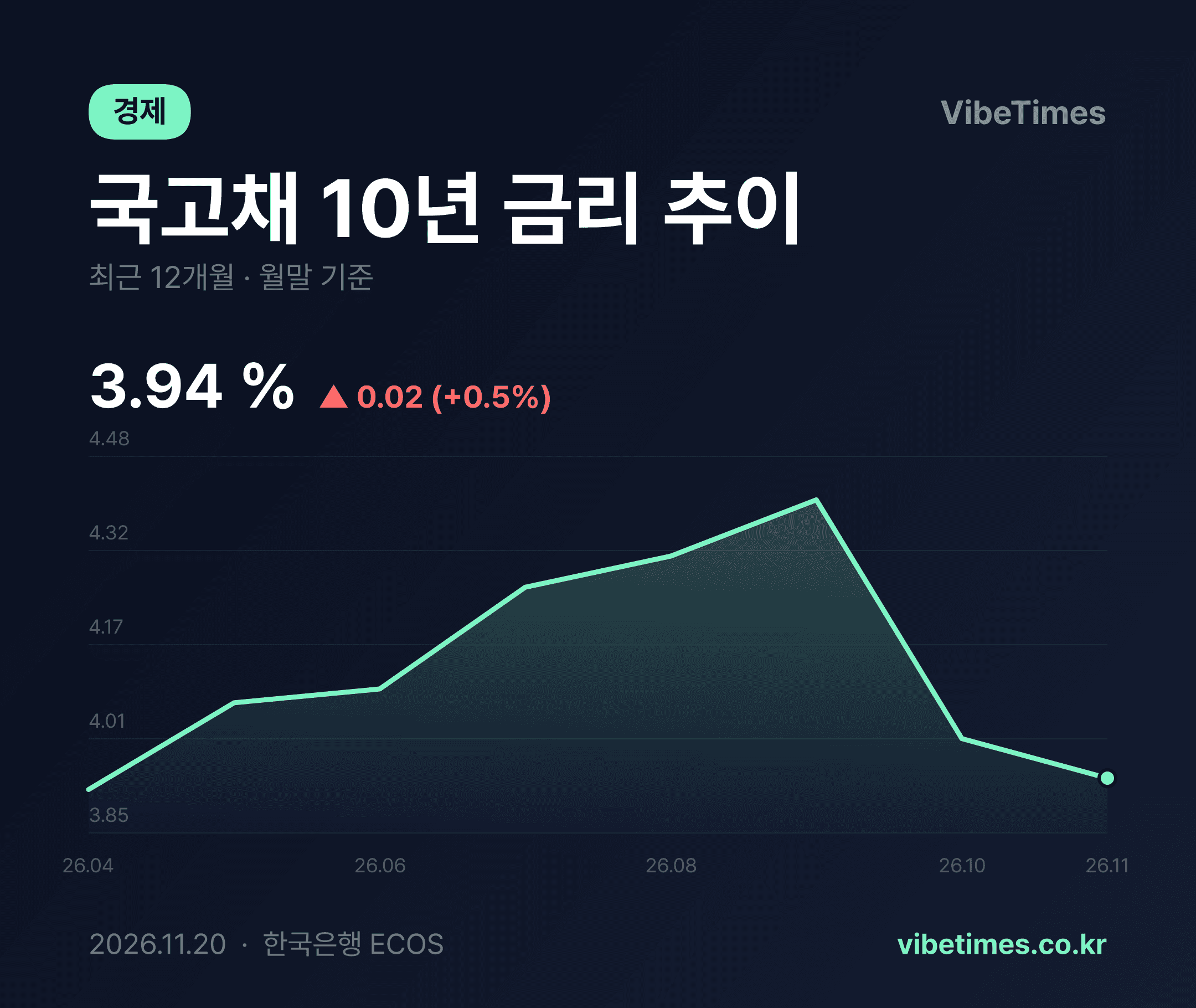
The 10-year government bond yield, after hitting a peak of 4.41%, plunged 0.47 percentage points in just two months, returning to the level seen at the start of the year.
Broke Above 4% in the First Half, Rising for Four Consecutive Months
The 10-year government bond yield, which stood at 3.92% at the end of April 2026, rose for five consecutive months — to 4.07% in May, 4.09% in June, 4.26% in July, 4.31% in August, and 4.41% in September. In particular, a 0.15 percentage-point jump in May alone, which pushed the yield past the 4% mark, was the trigger for this upward phase. This was followed by another sharp rise of 0.17 percentage points in July, bringing the yield to 4.26%.
A rise in government bond yields means the cost for the government to borrow money has increased accordingly. Long-term yields serve as a comprehensive indicator of market expectations for inflation, the direction of monetary policy, and fiscal burdens, so the upward march through September shows that market participants had clearly priced in rising interest rate pressure.
Reversal to Decline in October
The trend changed in October. Based on end-of-month figures, the yield fell to 4.01%, a drop of 0.40 percentage points, and in November it fell further to 3.94%. The cumulative decline over two months was 0.47 percentage points, effectively erasing the 0.49 percentage-point gain accumulated over the five months of the first half. As a result, compared to the end of April, the change amounts to just +0.02 percentage points. After eight months of ups and downs, the yield has essentially returned to where it started.
However, it is worth noting that this was no gradual adjustment. The fact that the entire gain was wiped out in just two months means funds flowed rapidly back into long-term bonds in the bond market. Since bond prices move inversely to yields, the sharp drop in yields is evidence that buying pressure on long-term bonds was concentrated.
Implications for Investment and Markets
The key takeaway from this trend is that yields do not move in a single direction. The sharp reversal from the first-half peak of 4.41% vividly demonstrates how significant interest rate volatility risk can be when investing in longer-maturity bonds. From a retail investor's perspective, this was a period in which buying at the September peak and selling at the April low would have produced dramatically opposite outcomes.
The future direction is likely to be decided at a borderline where the yield may repeatedly enter and exit the 4% range. The current level of 3.94% is slightly above the starting point in April, and whether the downward momentum continues or the yield regains the 4% line will depend on upcoming inflation data and the direction of monetary policy. One thing is clear: the two-month downtrend has shifted market sentiment in favor of bonds, and by the same logic, the appeal of bond-related products will diminish correspondingly if yields rise again in the short term. Over the coming months, the tug-of-war around the 4% line is expected to determine the market's direction.