Amazon Leads in Revenue, Yet Its Net Profit Falls Short of Apple's

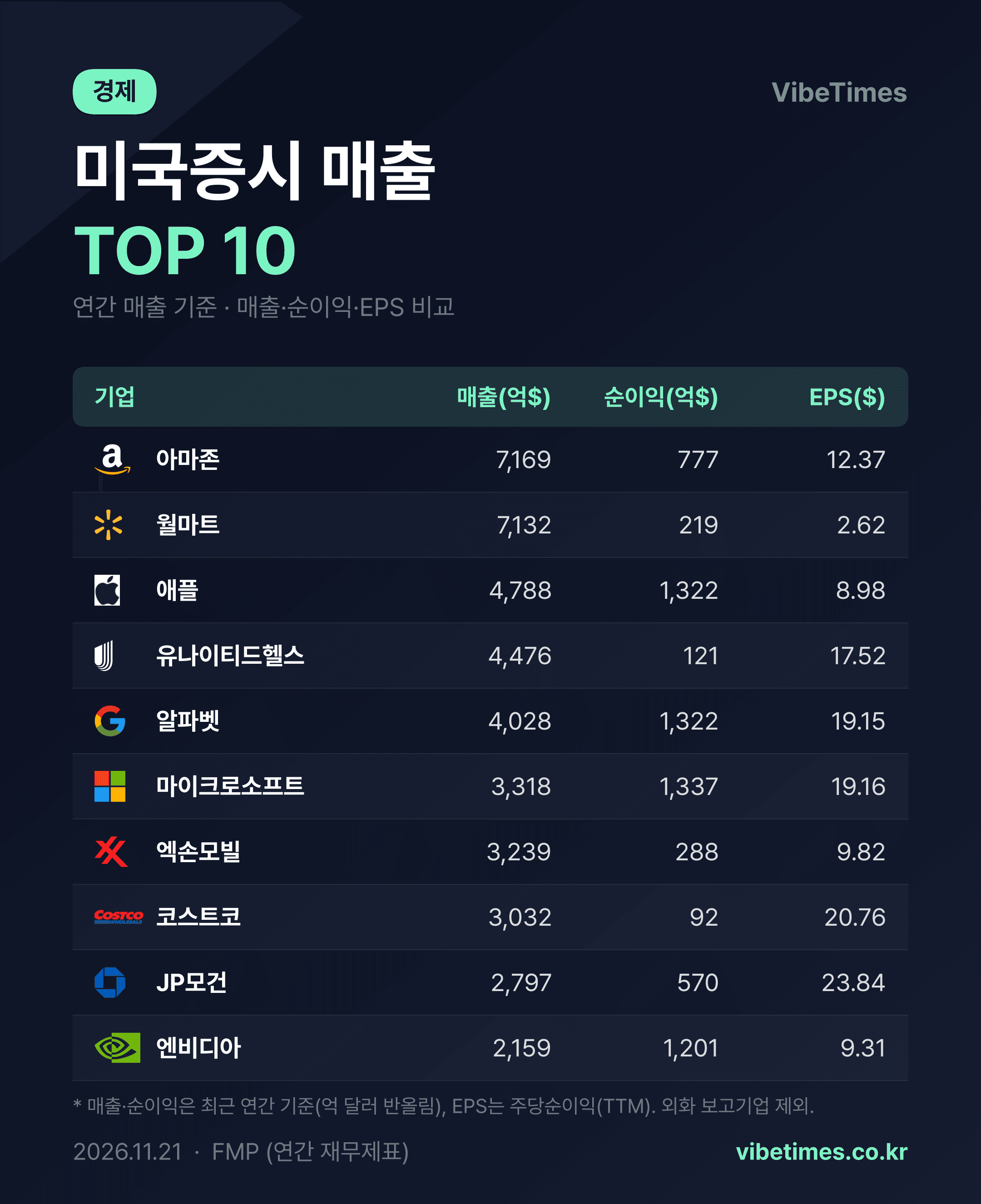
Amazon posted annual revenue of $716.9 billion, ranking first among U.S. listed companies in sales, but its net profit stopped at $77.7 billion. That is roughly 59% of the $132.2 billion Apple earned over the same period—less than one-sixth of its total. At the point where the rankings of scale and profitability diverge so sharply, the differences in the business models of America's top-tier companies come into clear focus.
Two Faces of the Top 10 by Revenue
Among the 10 highest-revenue companies on the U.S. market as of November 2026, Amazon and Walmart stand out with $716.9 billion and $713.2 billion respectively, together forming the exclusive $700-billion club. But when net profit is lined up alongside, the picture changes entirely. Amazon's net profit of $77.7 billion translates to a margin of about 10.8% of revenue, while Walmart's $21.9 billion amounts to a mere 3.1%. The thin-margin structure of retail and e-commerce is reflected directly in the numbers.
By contrast, third-ranked Apple generated revenue of $478.8 billion—about two-thirds of Amazon's—but its net profit of $132.2 billion far exceeds Amazon's. Its net margin reaches 27.6%. This is the result of a premium pricing strategy that combines hardware with services: a structure of selling less and earning more. Alphabet (revenue $402.8 billion, net profit $132.2 billion) at No. 5 and Microsoft (revenue $331.8 billion, net profit $133.7 billion) at No. 6 belong to the same class, posting margins in the 30–40% range.
Market Cap Tells a Different Story Than Revenue
The value the market assigns to these two structures is starkly different. Amazon and Walmart, locked in a battle for the No. 1–2 revenue spots, have market capitalizations of $2.78 trillion and $1 trillion respectively, while Microsoft, sixth in revenue, stands at $3.70 trillion—ahead of Amazon. Nvidia, ranked only 10th in revenue, posted a net profit of $120.1 billion and a market cap of $3.52 trillion, showing the most dramatic gap between revenue rank and market-cap rank. It barely made the top 10 with revenue of $215.9 billion, but its 55.6% margin is the highest among the top 10.
The rankings confirm that investors place greater value on the quality of profit generated per unit of revenue than on annual volume. Apple, Alphabet, and Microsoft, each with net profits of around $130 billion, all command market caps above $3 trillion, while UnitedHealth, with revenue of $447.6 billion, remained at a net profit of $12.1 billion and a market cap of $296.1 billion. Despite its No. 4 revenue scale, the market's assessment remains conservative.
Earnings Per Share Reveal Capital Efficiency
Earnings per share (EPS) reveal yet another dimension. JPMorgan leads the top 10 at $23.84, followed by Costco at $20.76, Microsoft at $19.16, and Alphabet at $19.15. Since companies with fewer shares outstanding post higher per-share earnings from the same net profit, EPS is an indicator that also reflects the efficiency of a company's capital structure. JPMorgan's ability to sustain an $850.4 billion market cap on $57 billion in net profit—ninth in revenue—rests on such shareholder-return structures.
ExxonMobil's numbers illustrate the position of traditional industry. It ranked seventh with revenue of $323.9 billion, but its net profit stopped at $28.8 billion, an 8.9% margin. Given the energy industry's characteristic sensitivity to oil prices, the market appears to cap its valuation at the $648.3 billion level.
The Gap Between Scale and Profit as the Starting Point of Investment Decisions
Taken together, the configuration of the top 10 revenue companies reveals the dual structure of the U.S. economy. A volume economy—represented by Walmart, Costco, and ExxonMobil—coexists with a margin economy exemplified by Apple, Alphabet, Microsoft, and Nvidia. Amazon stands on the boundary between these two worlds. Despite the thin margins of its retail operations, the growing share of high-profit businesses such as cloud computing has produced a 10.8% margin, and the market has recognized this with a valuation of $2.78 trillion.
Andrew Carnegie said success is rare where there is no laughter, but today's rankings tell a somewhat different story: revenue accumulated without profit struggles to win the market's applause. Going forward, shifts in the upper ranks are likely to be determined less by revenue expansion than by the direction of margins. In particular, how quickly Nvidia's revenue climbs into the upper tier, driven by the trajectory of artificial intelligence demand, looks to be the biggest variable in next quarter's rankings.
