Value Investing Strategy Holds 14.78% Return Amid Semiconductor Surge in Investment Report


Semiconductor Storm Sends Stocks Up 6%: Value Investing Strategy Put to the Test
With the Seoul market firmly holding above the 5,000 mark, the KOSPI surged 6.32% from the previous session, taking full command of the market's upward momentum. U.S. markets showed a stark divide, with the Dow gaining while the Nasdaq and Philadelphia Semiconductor Index plummeted 7.88%—yet even amid this turbulence, the 'AI Value Investing Portfolio' maintained a 14.78% return on initial capital, recording total assets of $11,477. It was a day that demonstrated just how sturdy the shield of valuation can be when markets swing wildly.
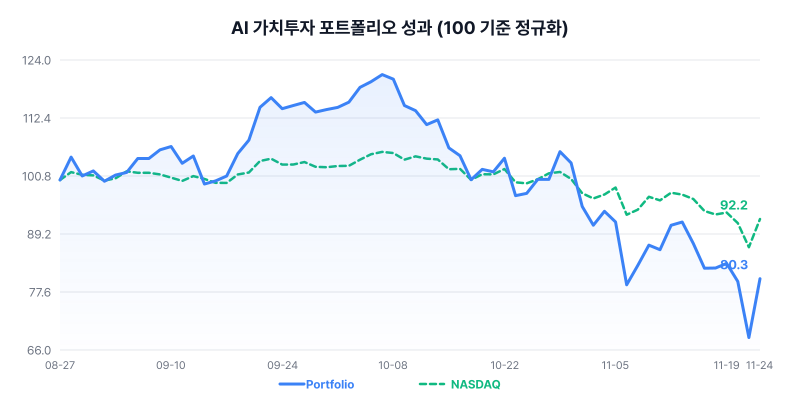
An Uneven Asset Curve, But a Living Return Structure
The portfolio's asset trajectory over the past five days shows the journey has been anything but smooth. After peaking at $11,914 on the 19th, it plunged as much as 17% to $9,795 on the 23rd, as the collapse of the Philadelphia Semiconductor Index hit it squarely. However, assets rebounded to $11,477 the same day, confirming the base for recovery. The direction of the return curve remains intact despite short-term volatility—the result of ongoing management of sector concentration risk through staggered buying and profit-taking.
Holdings Diagnosis: The Shield of Undervaluation and the Sword of Overvaluation
Nvidia, the portfolio's core holding and largest position, has a PEG ratio of just 0.15—still an attractive range relative to its growth rate. Micron, with a stunning $74 in EPS, trades at a PER of 9.5x and PEG of 0.16, sitting squarely in value territory the market has yet to price in. AMD, by contrast, has climbed to a PER of 96.9x, a demanding level relative to its returns, though its PEG of 0.38 suggests the surge is unlikely to be overheated when growth is factored in. Intel remains loss-making and unattractive on a fundamentals basis.
| Stock | Quantity | Purchase Price | Current Price | PER |
|---|---|---|---|---|
| Nvidia | 22.80 shares | $184.21 | $165.05 | 17.7 |
| AMD | 4.97 shares | $198.62 | $453.46 | 96.9 |
| Micron | 2.20 shares | $851.27 | $707.70 | 9.5 |
| Broadcom | 5.67 shares | $326.03 | $313.55 | 40.0 |
| Amazon | 1.95 shares | $208.39 | $255.39 | 20.6 |
| TSMC | 0.44 shares | $431.81 | $363.60 | 23.6 |
| Meta | 0.55 shares | $653.56 | $597.60 | 20.4 |
| Intel | 2.80 shares | $104.56 | $59.66 | - |
| SOXL | 20.10 shares | $63.25 | $43.21 | - |
| TQQQ | 1.13 shares | $76.34 | $49.10 | - |
Trading Review: Putting Buy-Low, Sell-High Principles into Practice
Recent trades follow a classic rebalancing pattern. After AMD surged more than 100%, portions of the position were sold repeatedly to reduce single-stock concentration, with proceeds recycled into Micron—whose PEG is exceptionally low—and SOXL, a leveraged semiconductor product. Notably, buying into the semiconductor sector's plunge on the 20th embodied a contrarian principle of treating pullbacks as opportunities. Meanwhile, trimming but preserving the core Nvidia position through the CEO succession risk episode reflects a balance between principle and flexibility.
| Date | Type | Stock | Quantity | Price |
|---|---|---|---|---|
| 2026-11-20 | Buy | Micron | 0.26 shares | $690.44 |
| 2026-11-20 | Buy | SOXL | 6.18 shares | $45.30 |
| 2026-11-20 | Sell | AMD | 0.88 shares | $489.19 |
| 2026-11-13 | Buy | Micron | 0.44 shares | $798.44 |
| 2026-11-13 | Sell | AMD | 0.31 shares | $585.30 |
| 2026-11-13 | Sell | Nvidia | 1.20 shares | $166.19 |
| 2026-11-06 | Buy | Micron | 0.20 shares | $656.39 |
| 2026-11-06 | Sell | AMD | 0.32 shares | $404.40 |
| 2026-10-30 | Buy | TSMC | 0.44 shares | $431.81 |
| 2026-10-30 | Sell | AMD | 0.34 shares | $566.42 |
Outlook: In a Volatile Phase, Principle Is the Answer
Risk aversion persists, with the VIX hovering in the 26s, and the U.S. 10-year Treasury yield remains stuck near 4.9%, keeping sustained pressure on growth stock valuations. With Nasdaq 100 futures already down around 2%, the short-term correction may continue. On the other hand, the won/dollar exchange rate settling into a stable range around 1,340 and the KOSPI's strength are relative positives. Though the Philadelphia Semiconductor Index has fallen to uncomfortable levels, the HBM demand structure remains intact, and the staggered buying principle stays valid. As long as valuation keeps the lighthouse lit, this portfolio's underlying strength should endure.
※ This report analyzes the simulated performance of the AI Value Investing Portfolio and is not investment advice. Actual investments should be made at the reader's own discretion and responsibility.
Want the full portfolio details?
Subscribe to the newsletter below to receive a detailed investment report every day.