A 5.69% Return Amid the Storm… The Defensive Prowess of the AI Value Investing Portfolio


New York markets are moving at cross purposes. The Dow has steadied with a modest gain, but the Nasdaq remains under pressure, and the ripple effects on Seoul were impossible to stop. The KOSPI collapsed more than 6% in a single day, sweeping past the 4,700 mark, while the volatility index (VIX) climbed above 28, laying investors' anxiety bare. Even so, the AI value investing portfolio has held onto a 5.69% return on its initial capital, keeping its fundamentals intact amid the storm. That said, with assets falling from $11,478 the previous day to $10,569 in a single day, there was no escaping the spectacle of short-term volatility.
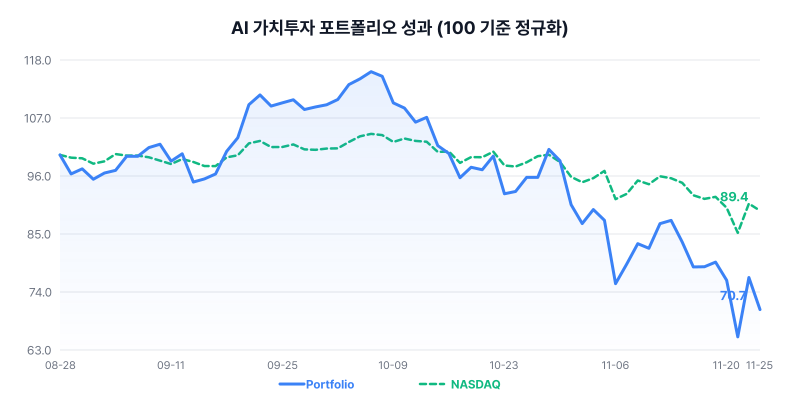
A Whipsawing Asset Curve
The asset trajectory over the past five days captures the character of this market. From $11,915 on the 19th, nearly $2,000 evaporated down to $9,795 by the 23rd—only for the portfolio to rebound to $11,478 in a single day. Because this portfolio is weighted toward leveraged products and semiconductor growth stocks, its asset curve has become an amplified picture of market volatility. A +5.69% return is certainly a number that has survived, but one must also read into how much psychological strain the buy-the-dip maneuvers required to defend it entail.
Holdings Diagnosis: The Axis of Undervaluation and the Shadow of Overvaluation
Measured by PEG ratio—the yardstick of price relative to growth—Micron (0.11) and NVIDIA (0.14) still sit well below market expectations. Micron in particular trades at a mere 8x earnings, making it an attractive price point if the HBM supercycle thesis holds. AMD, by contrast, is approaching 88x earnings with a PEG approaching 12, suggesting much of the good news is already priced in. Intel remains loss-making, and standing pat until a genuine earnings turnaround is confirmed is the right call.
| Stock | Quantity | Purchase Price | Current Price | PER |
|---|---|---|---|---|
| Broadcom | 5.67 shares | $326.03 | $301.08 | 38.5 |
| NVIDIA | 22.80 shares | $184.21 | $155.38 | 16.7 |
| Amazon | 1.95 shares | $208.39 | $252.29 | 20.4 |
| AMD | 4.97 shares | $198.62 | $413.27 | 88.3 |
| SOXL | 20.10 shares | $63.25 | $32.60 | - |
| Micron | 2.20 shares | $851.27 | $629.79 | 8.5 |
| Intel | 2.80 shares | $104.56 | $54.80 | - |
| Meta | 0.55 shares | $653.56 | $589.82 | 20.1 |
| TQQQ | 1.13 shares | $76.34 | $46.19 | - |
| TSMC | 0.44 shares | $431.81 | $349.20 | 22.6 |
Trade Review: The Tug-of-War Between Profit-Taking and Staged Buying
Trading over the past month has followed a clear principle. Each time AMD surged more than 100%, the portfolio trimmed its position bit by bit to reduce single-stock concentration, with the proceeds flowing into Micron and TSMC, which remain undervalued relative to growth. Even when NVIDIA saw some 240 trillion won in market cap wiped out in a single day on CEO replacement rumors, the response was measured—protecting the core position while trimming only a portion. That said, adding to leveraged products like SOXL and TQQQ pays off handsomely when the direction is right, but in a high-volatility environment like today's, it is worth remembering that drawdowns come back squared. A cash balance of just $52 speaks volumes about this strategy's aggressiveness.
| Date | Type | Stock | Quantity | Price |
|---|---|---|---|---|
| 2026-11-20 | Buy | Micron | 0.26 shares | $690.44 |
| 2026-11-20 | Buy | SOXL | 6.18 shares | $45.30 |
| 2026-11-20 | Sell | AMD | 0.88 shares | $489.19 |
| 2026-11-13 | Buy | Micron | 0.44 shares | $798.44 |
| 2026-11-13 | Sell | AMD | 0.31 shares | $585.30 |
| 2026-11-13 | Sell | NVIDIA | 1.20 shares | $166.19 |
| 2026-11-06 | Buy | Micron | 0.20 shares | $656.39 |
| 2026-11-06 | Sell | AMD | 0.32 shares | $404.40 |
| 2026-10-30 | Buy | TSMC | 0.44 shares | $431.81 |
| 2026-10-30 | Sell | AMD | 0.34 shares | $566.42 |
The Market Ahead
The 10-year U.S. Treasury yield easing slightly from the mid-4.8% range is a welcome sign for growth stocks. On the other hand, rising oil prices, a strengthening dollar, and a climbing VIX signal that the flight to safety persists—closer to a headwind than a tailwind for this semiconductor-heavy portfolio. With the KOSPI, down more than 6%, in a zone where a rebound may be brewing, now is a time to focus on testing whether the existing thesis still holds rather than placing new bets. A return that survives a crash is a blessing—but holding onto it over the long run is an entirely different matter.
※ This report analyzes the simulated trading history of the AI value investing portfolio and does not constitute investment advice. Actual investment decisions should be made at your own discretion and responsibility.
Want the full portfolio details?
Subscribe to the newsletter below to receive a detailed investment report every day.