National Assembly Data Analysis: The Average Positions of Ruling and Opposition Lawmakers Were Close

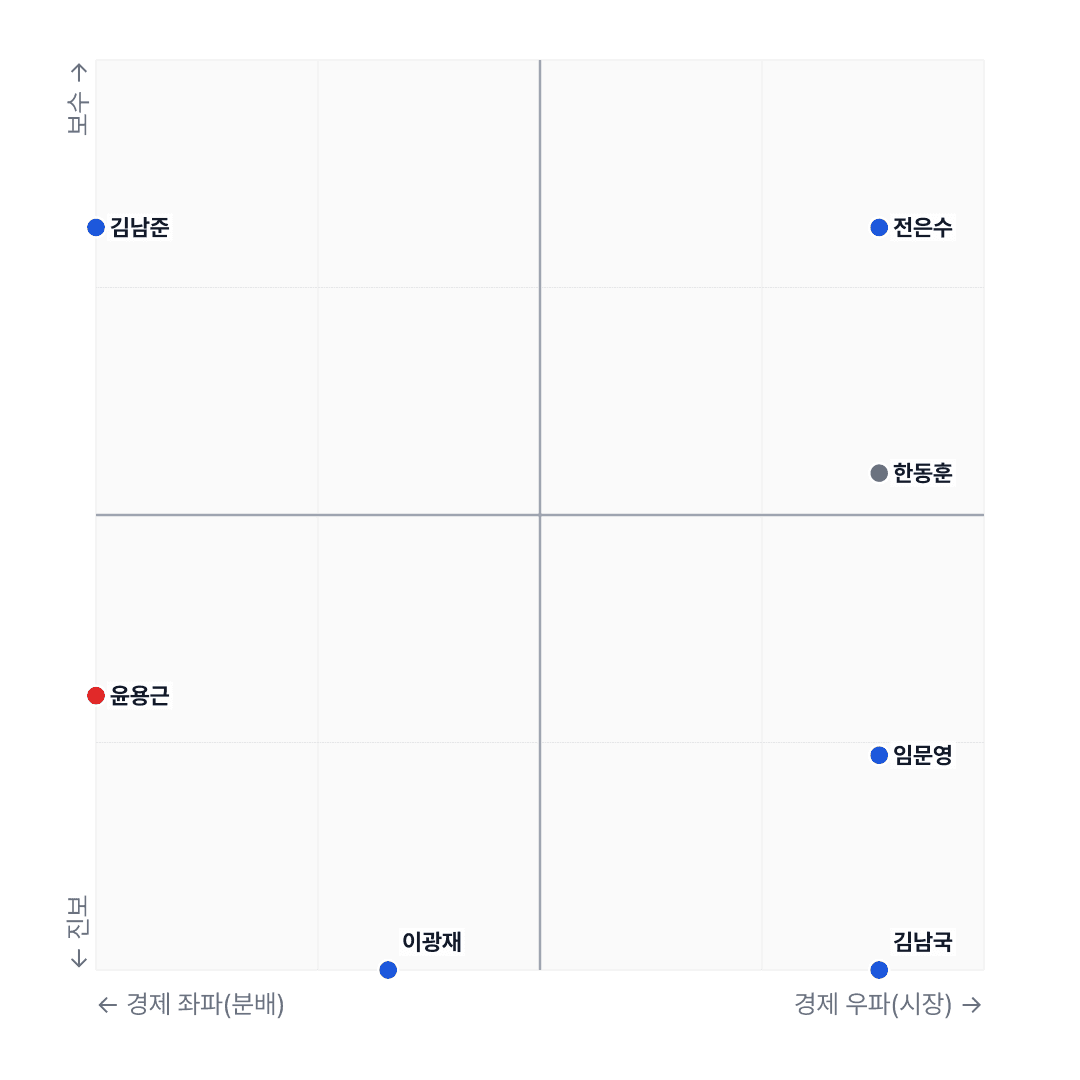
Plotting all 299 members of the National Assembly on a coordinate plane laid bare the political landscape of the 22nd National Assembly. The ideological map, calculated solely from bill sponsorship and voting records, contained several pictures that defy conventional wisdom.
The Two Major Parties Are Closer Than Expected, While the Third Party Is Far Away
The analysis was conducted using two-dimensional coordinates on an economic axis and a social axis. The economic axis captures tendencies on economic policy, such as regulation of conglomerates and welfare expansion, while the social axis measures progressive versus conservative leanings on cultural and value issues. The coordinate values themselves are an internal scale, computed by having an LLM evaluate bill content and take a weighted average, then calibrated so that the average positions of the two major parties sit at the origin. For this reason, relative distances and distributions should be read rather than absolute numbers.
The most striking finding is the distance between the ruling and opposition parties. The average positions of the 160 members of the Democratic Party and the 110 members of the People Power Party were very close on both axes relative to the calibrated origin. The Democratic Party sat only slightly to the left of center on both economic and social issues, and the People Power Party only slightly to the right. Contrary to the common perception that Korean politics is extremely polarized, the average ideological gap between the two parties, as measured by sponsorship and voting, was narrower than expected. Of course, this must be weighed against the fact that the origin was set at the midpoint of the two major parties; the same data can look different depending on where the baseline is placed.
The gap between the two parties' economic leanings was larger than their social leanings. In other words, the ruling and opposition parties were further apart on economic policy than on cultural and value issues. This suggests that conflict on the Assembly floor is concentrated around distribution and regulation.
The Off-Diagonal Zones: 36 Economic-Right, Social-Progressive and 52 Economic-Left, Social-Conservative Lawmakers
The quadrant distribution is the highlight of this analysis. The commonly imagined ruling-versus-opposition divide is one-dimensional, with the economic and social axes overlapping in a single line, but the actual distribution was two-dimensional. Of the 299 members, 116 were economic-left and socially progressive, and 95 were economic-right and socially conservative—meaning roughly half the members aligned on both axes.
The other half challenges conventional wisdom. There were 36 lawmakers with economic-right, socially progressive leanings, and 52 with economic-left, socially conservative leanings. The economic-left, socially conservative group—members with socially conservative values who nonetheless voted for market intervention and welfare expansion—was larger in size. This appears to reflect the character of their constituencies. Lawmakers from particular regions, such as Yeongnam and Honam, often kept their distance from progressive cultural issues while remaining open to government intervention in agricultural support and regional economic policy. On the opposite side, members in the economic-right, socially progressive zone—those who paired market-friendly economic policy with open stances on cultural issues—were mostly based in the Seoul metropolitan area, the analysis found.
The Rebuilding Korea Party Is Furthest Left; Independents Are an Irony
Setting the party averages side by side reveals a hierarchy. On the economic axis, the party furthest left was not the Democratic Party but the Rebuilding Korea Party. The average position of its 12 members was clearly left of the Democratic Party, meaning its share of sponsorship and support for regulation, welfare, and income redistribution bills stood out. The data captured the phenomenon of a numerically weaker third party amplifying its ideological profile in a contest of policy purity.
The positions of the 8 independents are ironic. Though they belong to neither the ruling nor the opposition camp, they averaged slightly left of the Democratic Party's mean. It hints at which direction a party defection or move to independence is connected to on the political spectrum.
The Limits and Uses of a Data Map
What this map captures is behavior—bill sponsorship and voting. The image lawmakers project in speeches to their constituents or media interviews is not reflected here. A legislator who appears progressive to the public may turn out surprisingly market-friendly in voting records, and vice versa. Because the criteria are whether a member signed onto a bill or pressed the yea or nay button, the gap between image and record is both the limitation and the value of this analysis.
Nietzsche pointed out that mysterious explanations are not necessarily shallow ones. The same goes for the ideological terrain of the National Assembly: 299 individual coordinates, differing quadrant by quadrant, deliver far more concrete truth than a single stale explanation like "ruling-opposition conflict." As the legislative behavior of the 22nd National Assembly continues to accumulate, this map will be redrawn—and the direction of that movement may offer an early glimpse of the political winds ahead of the next general election.
Lawmakers Mentioned in This Article
| Lawmaker | Party | Ideological Leaning | Notes |
|---|---|---|---|
| Yun Yong-geun | People Power Party | Economic-left · Social-progressive | Polar extreme representative |
| Kim Nam-jun | Democratic Party | Economic-left · Social-conservative | Polar extreme representative |
| Im Mun-yeong | Democratic Party | Economic-right · Social-progressive | Polar extreme representative |
| Han Dong-hoon | Independent | Economic-right · Social-conservative | Polar extreme representative |
| Kim Nam-guk | Democratic Party | Economic-right · Social-progressive | Polar extreme representative |
| Lee Kwang-jae | Democratic Party | Economic-left · Social-progressive | Polar extreme representative |
| Jeon Eun-su | Democratic Party | Economic-right · Social-conservative | Polar extreme representative |