Trump Re-ups Pressure on South Korea With 25% Tariffs After 15% Deal

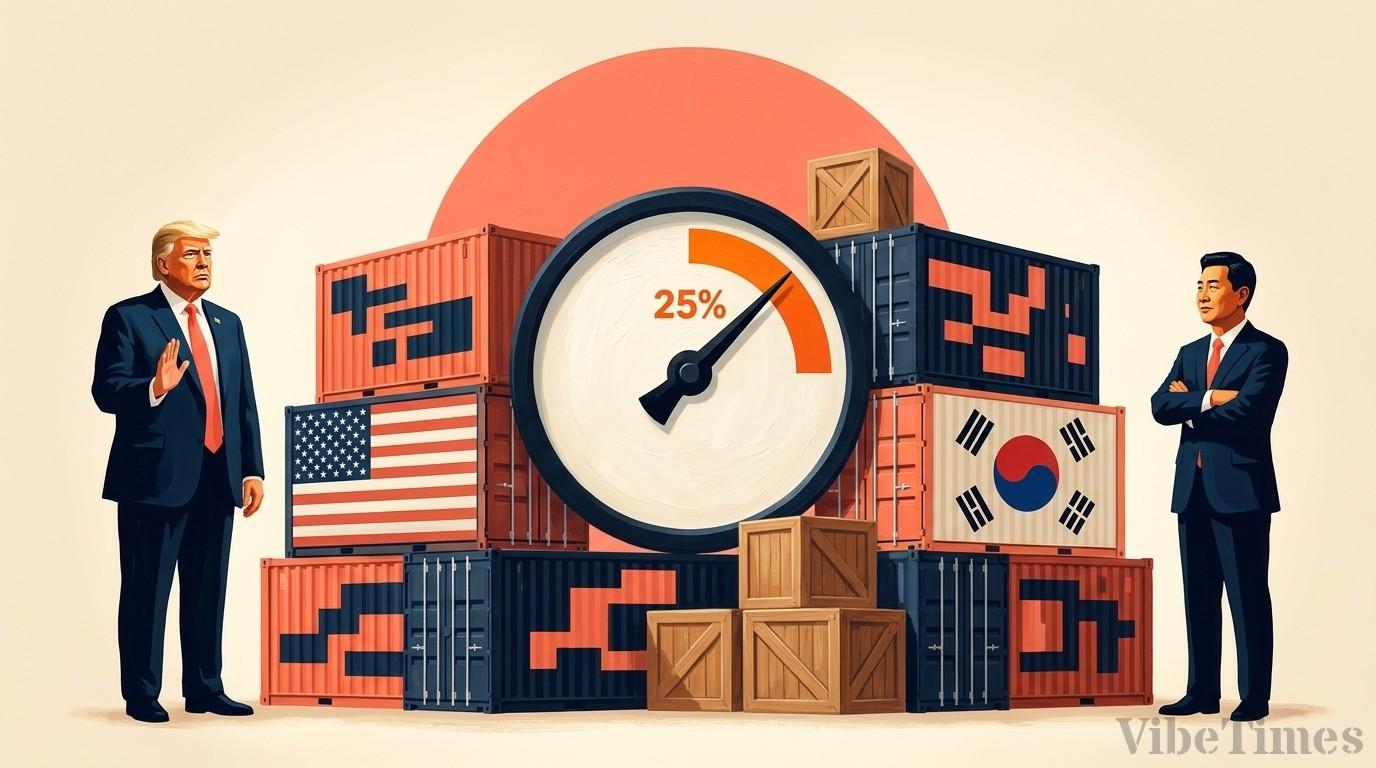
The United States has broken the 15% tariff ceiling set under the U.S.-South Korea trade agreement, opening the way to raising duties to as much as 25%. On Tuesday (local time), the Office of the U.S. Trade Representative (USTR) announced the results of its Section 301 investigation (a procedure allowing the U.S. to investigate unfair trade practices by other countries and set retaliatory tariffs) targeting South Korea and others, proposing that tariffs be raised from 15%. USTR explicitly stated it would consider imposing up to 25% if consultations or implementation of the existing agreement prove unsatisfactory.
USTR argued that South Korea's policies to foster its semiconductor, automotive and petrochemical industries reduce business opportunities for American companies and harm the U.S. economy. In an interview, USTR Ambassador Jamieson Greer said, "South Korea announced a series of plans this summer related to government support and infrastructure." He pointed out that "these are not responding to actual demand," adding, "This is government intervention that increases foreign supply without actually increasing consumption."
The baseline tariff rates presented to South Korea, Taiwan, Japan and the European Union are all 15%. The ceiling tariff rate for South Korea and Taiwan is 25%, five percentage points higher than Japan and the EU (20%). According to U.S. Census Bureau figures, South Korea's goods trade surplus with the U.S. for January-September this year rose 50.8% from a year earlier to $67.3 billion, while Taiwan's grew 81.3% to $171.1 billion. Japan's and the EU's surpluses fell 30.9% and 59.0%, respectively, over the same period.
USTR noted that President Lee Jae-myung views semiconductors as an opportunity for economic development in underdeveloped regions, urging companies such as SK Hynix to continue expanding production capacity while directing the government to provide water, electricity and land. The U.S. side's core argument is that Seoul announced plans in July to create a new semiconductor cluster in the Gwangju-Jeolla region, based on companies' promised 800 trillion won ($580 billion) in investment. USTR also pointed out that the Korea-China free trade agreement and expanded imports of Chinese intermediate goods have contributed to the spread of Chinese-origin oversupply.
Meanwhile, digital regulation has emerged as a separate justification for tariffs. The White House criticized the repeated fines imposed on Coupang as a violation of its pledge to treat U.S. technology companies fairly.
South Korea's Ministry of Trade, Industry and Energy said, "South Korea's industrial policies are based on corporate investment demand, and government support focuses on strengthening companies' core capabilities and building infrastructure." The ministry countered that it does not encourage state-led oversupply. It said it would work to ensure the final tariff settles at the 15% level agreed upon in the U.S.-Korea deal.