Ruling-Opposition Support Gap Stuck at 7 Points for Third Straight Month

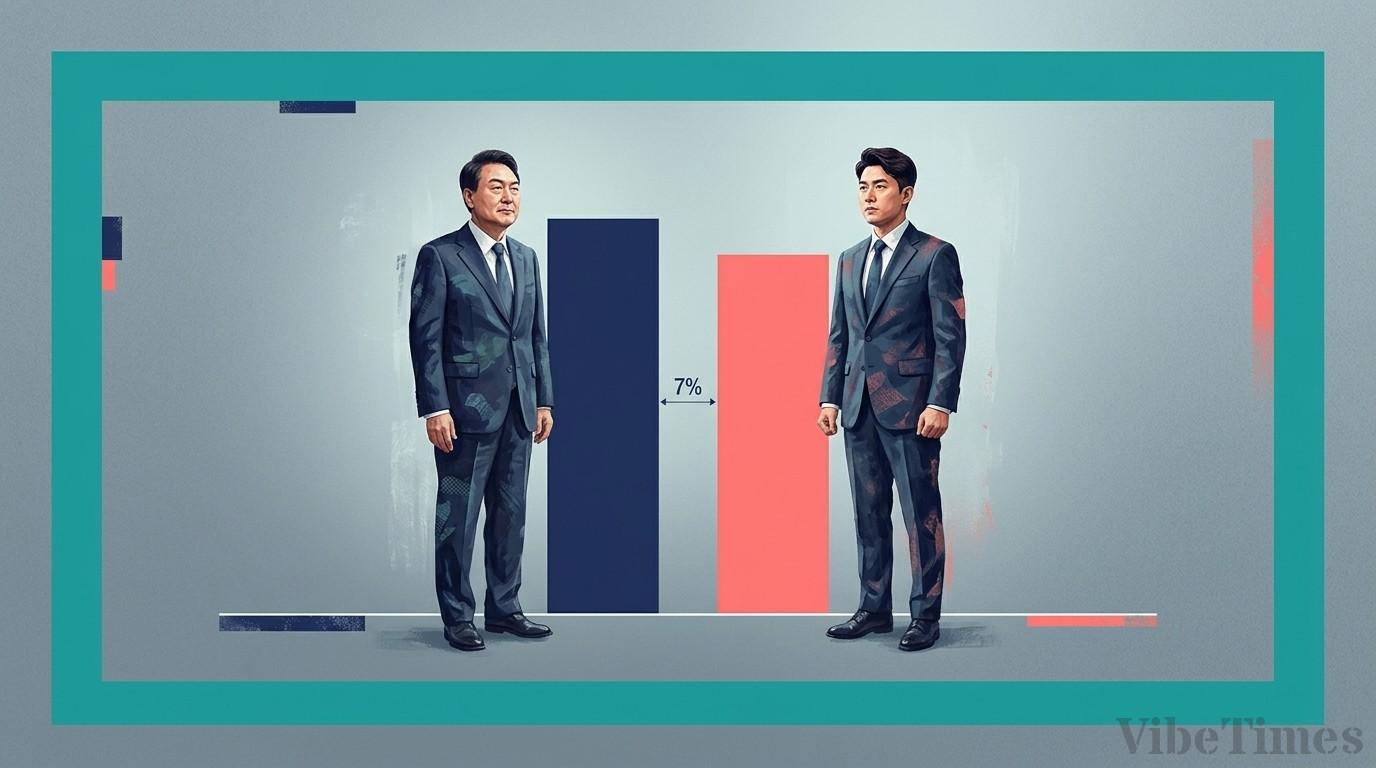
The gap in support ratings between the ruling and opposition parties has remained frozen at around 7 percentage points for the third consecutive month.
According to Media-Scan's aggregation of party support surveys, the Democratic Party recorded 37% and the People Power Party 30%, virtually unchanged from two months ago. The gap, which had widened at times since the launch of the Lee Jae-myung administration, has been trapped in a range that neither narrows nor expands. The ruling party's stagnation below the 40% mark carries several meanings: it signals that the People Power Party has failed to rebound while the Democratic Party has also failed to recover majority-level support.
Why the Stagnation: Real Achievements, Static Support
President Lee Jae-myung's government has notched up no small number of accomplishments. He personally attended the groundbreaking of the GS AI Data Center in Donghae, Gangwon Province, saying it would "become Asia's largest AI core infrastructure and a harbinger of preemptive investment by global companies," and emphasized that "we must stay a step ahead in the AI competition to become a leading nation... we will mobilize every capability." He also declared that "the returns from 50 trillion won in annual R&D must be reclaimed by the state... even if it draws criticism, we must do what has to be done," voicing his intent to return technological gains to the people. From his visit to KIST's Gangneung branch and remarks on fostering the natural-products bio industry, to his message that "the government will stand as one team with scientists in their challenges," his efforts to secure economic growth engines are conspicuous.
Yet the fact that support ratings have failed to respond is the crux of the analysis. Former Prime Minister Kim Min-seok has attributed the decline in approval to the departure of centrist voters and infighting within the party. His reference to "mistakes made in the early period after taking office... resolving intra-party conflict and focusing on livelihoods" extends that diagnosis. One could interpret that a structure in which achievement-driven governance and internal party politics move on separate tracks has failed to hold on to centrist voters' support.
Intra-Party Conflict: A String of Disciplinary Actions and Personnel Controversies
The Democratic Party's internal strife surfaced in concrete incidents. Supreme Council member Choi Min-hee received a heavy two-year suspension of party membership from the party's ethics tribunal over remarks to the effect that "President Lee Jae-myung, when he was party leader, opposed the impeachment of former President Yoon Suk-yeol." With pro-Lee voices rising ahead of the disciplinary action and a spat between Song and Jeong factions adding fuel, tensions between the leadership and the anti-Lee wing were exposed outside the party. The ruling party's 37% ceiling appears not unrelated to this internal attrition.
Friction continued on the personnel front. When the Lee administration nominated Kang Geum-sil as National Intelligence Service chief, the People Power Party objected, while former Prime Minister Kim Min-seok came to her defense, saying "her selection reflects President Lee's will to reform." As the reshuffling of the second-term staff accelerated with the acceptance of resignation letters from three Blue House secretaries, the resignation of Secretary Heo Eun-ah of the conservative party was accepted "for health reasons," but it proved no decisive boon to either side.
The Opposition's Offensive and Its Limits
The People Power Party is maintaining an offensive strategy. Party leader Jang Dong-hyuk urged the immediate resumption of trials, saying "Lee Jae-myung must be impeached first," and the opposition criticized the Lee administration and the Democratic Party for refusing to drop their push to pass a special exemption for the Future Response Fund that would allow major spending items to be changed by up to 30% without National Assembly approval. But the offensive has not translated into a rebound in support — the opposition's dilemma. With the special prosecutor recommendation process under the 'fabricated indictment' special prosecutor law running through the 29th of this month, the investigation and legal phases continue, but they have yet to become a variable that moves voters' hearts.
The 30% figure is stable in that the People Power Party's core base has held, but it is a warning in that it shows no momentum for a rebound. If the party cannot absorb the fallout even from the ruling party's missteps, the 7-point gap is likely to converge toward the status quo.
The Road Ahead: Variables That Could Break the Range
The variables that could redraw the support map boil down to three. First, making economic achievements in AI and R&D tangible to the public: how quickly the Donghae AI Data Center (2.4 GW) translates into actual jobs and regional economic gains could change assessments of the government's record. Second, the special prosecution and trial phases: once investigations kick into gear after the prosecutor recommendations, the intensity of ruling-opposition sparring will rise, heightening the sensitivity of support ratings. Third, the ruling party's ability to settle its internal affairs: if the pro-Lee versus anti-Lee rift widens after Choi Min-hee's disciplinary action, the 37% ceiling could sink lower.
In the end, the essence of this range-bound stalemate is voters' withholding of judgment. As the saying goes that a winner's edge comes not from talent but from attitude — to borrow and bend Ulysses S. Grant's aphorism (via Yuri Whitley) — today's support gap will be decided not by who was born into a more favorable configuration, but by who takes a course of action that changes voters' attitudes going forward. Neither party has yet offered that answer. Three months of standing still proves it.