Investment Report: AI Value Investing Portfolio Smiles With 62.84% Returns Amid Korean Market Crash


AI Value Investing Portfolio Smiles Through Korean Market Crash… Returns +62.84%
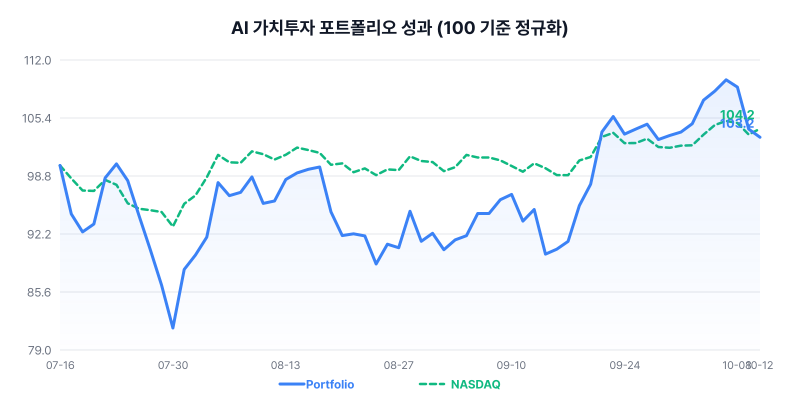
On the morning of the 13th, the KOSPI plunged 348.89 points (-5.46%) in a single day, barely holding the 6,000 level and entering a state of extreme tension. With the KOSPI 200 down more than 6%, downward pressure on the index is clearly concentrated in large-cap stocks. The U.S. market, however, tells a different story. The Dow Jones is up modestly and the S&P 500 is holding steady in flat territory, maintaining relative stability. Amid these divergent trends, the AI value investing portfolio is sustaining a 62.84% return on initial capital. Over the past five days, assets fell roughly 6%, from $17,315 to $16,284 — but this is not the shock of the Korean market; it is the footprint left by a semiconductor sector correction.
Asset Trends: Gauging the Nature of the Plunge
The asset curve peaked on October 7 at $17,315, then shed $1,031 in just two days. But considering the Philadelphia Semiconductor Index's 2.67% decline and weakness in Nasdaq 100 futures, this is not a collapse of the profit structure but a phase in which leveraged and high-beta assets are catching their breath all at once. The VIX remains low at 15.41, and the simultaneous rise in gold prices and Bitcoin signals that risk-on capital has not fully exited — a positive sign.
Holdings Diagnosis: The Key to Undervaluation Is 'Price Relative to Growth'
The portfolio's backbone remains semiconductors. Nvidia, at a share price of $229, trades at 29 times earnings with a PEG of just 0.28, making its price still attractive relative to growth. Micron, with a low 13.8x earnings multiple and a PEG of 0.16, sits in the portfolio's clearest undervaluation zone. With HBM4 supply price increases and the memory supercycle as tailwinds, the correction reads as a buying opportunity. AMD, on the other hand, carries a burdensome 155x earnings multiple, but its PEG of 0.61 suggests expected growth can absorb it. Intel remains loss-making (EPS of -$2.12), with a turnaround the key question.
| Stock | Shares | Purchase Price | Current Price | PER |
|---|---|---|---|---|
| Broadcom | 5.67 shares | $326.03 | $361.54 | 46.2 |
| AMD | 7.17 shares | $198.62 | $608.10 | 155.1 |
| Amazon | 1.95 shares | $208.39 | $262.43 | 21.1 |
| Intel | 2.80 shares | $104.56 | $104.70 | - |
| Meta Platforms | 0.55 shares | $653.56 | $718.67 | 27.1 |
| Nvidia | 26.59 shares | $184.21 | $229.28 | 29.0 |
| SOXL | 13.92 shares | $71.22 | $139.76 | - |
| TQQQ | 1.13 shares | $76.34 | $81.28 | - |
| Micron | 0.52 shares | $997.21 | $1,029.00 | 13.8 |
Trade Review: Trimming Leverage for Individual Undervalued Stocks
Recent trades show a consistent direction. On the 9th, as the semiconductor index tumbled, part of the 3x leveraged SOXL position was sold to lock in profits, with the proceeds used to buy more Micron. This is classic risk management: reducing high-volatility leverage within the same sector and shifting funds into fundamentally undervalued individual stocks. The partial sale of TQQQ was likewise largely about securing cash ahead of a short-term Nasdaq correction. The portfolio's strength lies in refining its structure during the plunge rather than panic-selling.
| Date | Type | Stock | Shares | Price |
|---|---|---|---|---|
| 2026-10-09 | Buy | Micron | 0.11 shares | $1,035.84 |
| 2026-10-09 | Sell | TQQQ | 0.06 shares | $80.23 |
| 2026-10-09 | Sell | SOXL | 0.73 shares | $142.52 |
| 2026-09-18 | Buy | Micron | 0.19 shares | $977.50 |
| 2026-09-18 | Sell | SOXL | 0.77 shares | $114.82 |
| 2026-08-28 | Sell | SOXL | 0.81 shares | $123.05 |
| 2026-08-21 | Buy | Nvidia | 0.84 shares | $216.85 |
| 2026-08-21 | Sell | Meta Platforms | 0.10 shares | $545.83 |
| 2026-08-21 | Sell | Micron | 0.03 shares | $974.33 |
| 2026-08-21 | Sell | SOXL | 0.85 shares | $122.21 |
Outlook: FX and Oil Catching Their Breath, Rates the Wild Card
The won-dollar exchange rate is stabilizing in the 1,341-won range, and WTI and Brent crude are down 1.6–1.8%, easing inflationary pressure somewhat. However, the U.S. 10-year Treasury yield holding near its high of 5.24% remains a burden for high-multiple growth stocks. If stable oil prices suppress upward pressure on rates, the semiconductor-led rally could resume. The KOSPI crash was largely a Korean market-specific phenomenon, and the prevailing view is that this portfolio's concentrated AI and semiconductor supercycle thesis remains valid for now. In volatile times, the key strategy remains direction over speed — maintaining a structure centered on undervalued individual stocks.
※ This report analyzes the simulated performance of the AI Value Investing Portfolio and does not constitute investment advice. Actual investment decisions should be made at your own discretion and responsibility.
Want the full portfolio details?
Subscribe to our newsletter below to receive detailed investment reports daily.