October 25 Investment Report: AI Value Investing Portfolio +38.5%


[Daily Market Insight] Markets Shaken by Surging Oil Prices, But Semiconductor Valuations Still Shine
U.S. markets were subdued overnight, with the Dow Jones falling 1.23%. WTI crude oil surged 3.8%, bringing inflation pressures back into focus, while the 10-year U.S. Treasury yield climbed to just shy of 5%, weighing on growth stocks. In contrast, the KOSPI held the 5,550 level, showing foreign inflows continuing to favor semiconductors. Amid these divergent trends, the AI Value Investing Portfolio maintained solid performance relative to the market, posting a cumulative return of +38.53% and total assets of $13,853.
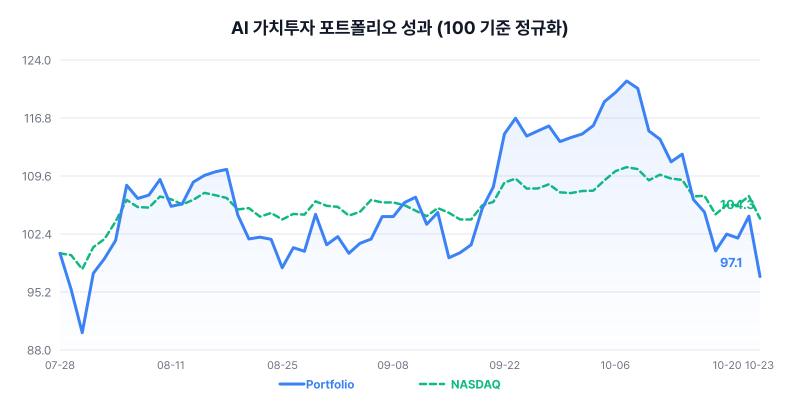
That said, the short-term phase calls for a breather. The asset trajectory shows the portfolio rebounded from $14,308 on the 19th to $14,923 on the 22nd, then shed nearly $1,700 in a single day on the 23rd. A daily loss of roughly 7% stems from the portfolio's structural characteristic of heavy exposure to semiconductor and AI-related stocks. With leveraged products and high-beta names in the mix, wide swings on down days are simply part of the deal—especially with the VIX rising to 19.45, signaling growing volatility.
Looking at holdings, the portfolio's backbone still rests on the thesis of undervaluation relative to growth. Nvidia, at $212, carries a PEG ratio of just 0.27—still low. Micron, despite the pullback, trades at a low trailing P/E of 11.5x with a PEG of 0.16, underpinning the memory supercycle narrative. AMD has surged +155% from its purchase price, pushing its trailing P/E to a demanding 129x, but the position has been retained on the judgment that its high growth rate offsets the valuation. Intel, meanwhile, is struggling, posting a loss (EPS of -$2.12) with the stock trading nearly 18% below its purchase price. A rebound hinges on how it navigates headwinds such as its failure to overtake Samsung in HBM.
Sell NVDA and AMD, Buy MU — A 'Position Sizing + Reallocation' Strategy
Recent trades reflect a clear philosophy. On the 23rd, the portfolio sold portions of Nvidia and AMD to raise cash, then added to Micron. This was risk management in response to Nvidia's single-stock weight exceeding 38%, while simultaneously rotating funds toward a more undervalued name within the same sector. Trimming the Nasdaq leveraged fund TQQQ and the 3x semiconductor fund SOXL follows the same logic: easing leverage overheating and shifting the center of gravity toward individual stocks' valuation appeal. That said, with the cash balance bottoming out at around $50, the portfolio's capacity for additional buying during downturns is limited—a notable weakness.
| Stock | Quantity | Purchase Price | Current Price | P/E |
|---|---|---|---|---|
| Nvidia | 24.00 shares | $184.21 | $212.21 | 26.8 |
| Micron | 1.30 shares | $930.96 | $856.49 | 11.5 |
| AMD | 6.82 shares | $198.62 | $507.93 | 129.6 |
| Broadcom | 5.67 shares | $326.03 | $323.24 | 43.2 |
| Amazon | 1.95 shares | $208.39 | $250.38 | 20.1 |
| Meta | 0.55 shares | $653.56 | $648.85 | 22.1 |
| Intel | 2.80 shares | $104.56 | $85.49 | Loss-making |
| SOXL | 13.92 shares | $71.22 | $82.11 | - |
| TQQQ | 1.13 shares | $76.34 | $66.42 | - |
| Date | Type | Stock | Quantity | Price |
|---|---|---|---|---|
| 2026-10-23 | Buy | Micron | 0.47 shares | $856.49 |
| 2026-10-23 | Sell | Nvidia | 1.26 shares | $212.21 |
| 2026-10-23 | Sell | AMD | 0.36 shares | $507.93 |
| 2026-10-16 | Buy | Micron | 0.31 shares | $931.24 |
| 2026-10-16 | Sell | Nvidia | 1.33 shares | $217.23 |
| 2026-10-09 | Buy | Micron | 0.11 shares | $1035.84 |
| 2026-10-09 | Sell | SOXL | 0.73 shares | $142.52 |
| 2026-10-09 | Sell | TQQQ | 0.06 shares | $80.23 |
The outlook is cautious. In a phase where oil prices and rates are rising simultaneously, both Dow-type cyclical stocks and growth stocks face pressure. Still, the Philadelphia Semiconductor Index posting a rebound on the day (+0.44%) suggests sentiment around AI infrastructure investment remains alive. The won-dollar exchange rate holding steady in the 1,325-won range is also a tailwind for Korean semiconductor earnings. If yields break above 5%, reducing leverage exposure may be needed again—but the valuation-focused reallocation to date remains a valid defensive strategy in a rising-volatility environment.
※ This report is an analysis of the simulated performance of the AI Value Investing Portfolio and does not constitute investment advice. Actual investment decisions should be made at your own judgment and responsibility.
Want the full portfolio details?
Subscribe to the newsletter below to receive a detailed investment report every day.