Investment Report Hits +49% Cumulative Return Even Amid Semiconductor Crash


+49% Despite the Semiconductor Plunge… A Retrospective on the AI Value Investing Portfolio's Buying the Dip
As the Philadelphia Semiconductor Index plummeted 4.89% and dragged the Nasdaq down with it, the domestic market opened lower as well, with the KOSPI down in the 2% range and the KOSDAQ in the 4% range. Oil prices surged more than 4% on a Brent basis, reviving inflation concerns, and even gold and Bitcoin pulled back — a classic 'risk-off correction' phase. Yet even against this headwind, the AI Value Investing Portfolio has posted a cumulative return of +49.23%, maintaining total assets of $14,923. The result reflects both resilience in a crashing market and the successful discovery of undervalued stocks.
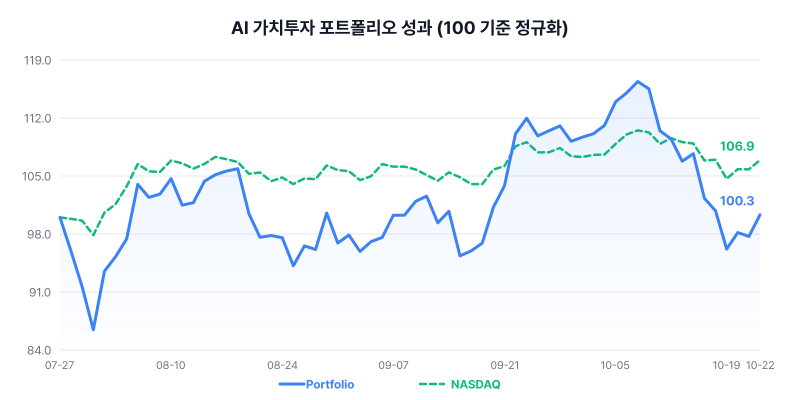
Asset Curve Trends Upward Through the Correction
Looking at the portfolio's asset flow over the past five days, it started at $14,995 on October 16, dipped to $14,308 by the 19th, then rebounded for two consecutive days on the 21st and 22nd to reclaim its peak. Even while the broader market wobbled, the valuation appeal of the semiconductor-heavy holdings helped fill in the losses. That said, with a cash balance of zero and a fully invested stance, the portfolio's swings relative to the index could widen during periods of heightened volatility — a lingering concern.
Holdings Diagnosis: Stocks With 'No Reason to Be Cheap' Are Holding Up
The portfolio's core remains semiconductors. NVIDIA's share price has lagged well behind its earnings growth pace, with a PEG ratio — a valuation measure relative to growth — of just 0.27, making the pullback read as an opportunity. Micron, despite its stock price exceeding $900, still trades at an intrinsic multiple of around 12x given its earnings scale, suggesting the memory supercycle benefits have yet to be fully priced in. Broadcom, too, carries a low growth-adjusted burden at a PEG of 0.33. On the other hand, Intel remains in the red, meaning its investment thesis still rests on recovery expectations, and TQQQ, a 3x leveraged Nasdaq ETF, now trades below its purchase price, making volatility management the key issue.
| Stock | Quantity | Purchase Price | Current Price | PER |
|---|---|---|---|---|
| Broadcom | 5.67 shares | $326.03 | $337.80 | 43.1 |
| AMD | 7.17 shares | $198.62 | $552.72 | 141.0 |
| Amazon | 1.95 shares | $208.39 | $262.37 | 21.1 |
| Intel | 2.80 shares | $104.56 | $92.96 | - |
| Meta | 0.55 shares | $653.56 | $697.52 | 23.8 |
| SOXL | 13.92 shares | $71.22 | $103.24 | - |
| TQQQ | 1.13 shares | $76.34 | $72.61 | - |
| NVIDIA | 25.26 shares | $184.21 | $221.97 | 28.1 |
| Micron | 0.83 shares | $972.67 | $913.67 | 12.3 |
Trading Retrospective: Staggered Buys in a Crash and a Portfolio Rebalancing
The core of recent trading has been 'taking profits on NVIDIA and rotating funds into Micron.' On the 16th, the portfolio sold part of its NVIDIA position to unwind overheating after a single-stock weight had swelled to 38%, using the proceeds to add to Micron, which sat in an extremely undervalued zone with a PEG of 0.16. The portfolio had accumulated Micron in two staggered purchases in September and October, citing the HBM4 supply price hike and the persistence of the memory cycle — a textbook value-investing approach that turned sharp down days into opportunities to accumulate at lower prices. At the same time, it trimmed its exposure to leveraged ETFs, which amplify losses threefold during semiconductor index crashes, reshaping the portfolio around high-quality individual stocks.
| Date | Type | Stock | Quantity | Price |
|---|---|---|---|---|
| 2026-10-16 | Buy | Micron | 0.31 shares | $931.24 |
| 2026-10-16 | Sell | NVIDIA | 1.33 shares | $217.23 |
| 2026-10-09 | Buy | Micron | 0.11 shares | $1,035.84 |
| 2026-10-09 | Sell | TQQQ | 0.06 shares | $80.23 |
| 2026-10-09 | Sell | SOXL | 0.73 shares | $142.52 |
| 2026-09-18 | Buy | Micron | 0.19 shares | $977.50 |
| 2026-09-18 | Sell | SOXL | 0.77 shares | $114.82 |
| 2026-08-28 | Sell | SOXL | 0.81 shares | $123.05 |
Outlook: Volatility Is Rising, but the Thesis Still Holds
With the VIX climbing back above 19 and fear reviving, and Nasdaq 100 futures also down in the 2% range, selling pressure is likely to persist in early Asian trading. However, the U.S. 10-year Treasury yield retreating just short of 5% offers a breather for growth-stock valuations. Whether inflation reignites on the back of surging oil prices is the biggest variable ahead, but the fundamental logic of an HBM-driven memory boom remains intact. The question is whether this portfolio's principle — that a correction is still an opportunity for stocks with solid fundamentals — will prove valid in the next phase. Worth watching.
※ This report analyzes the simulated trading history of the AI Value Investing Portfolio and is not investment advice. Actual investments should be made at your own discretion and responsibility.
Want the full portfolio details?
Subscribe to the newsletter below to receive detailed investment reports every day.