Democrats Lead Bill Sponsorship in 22nd National Assembly, PPP Ranks Second

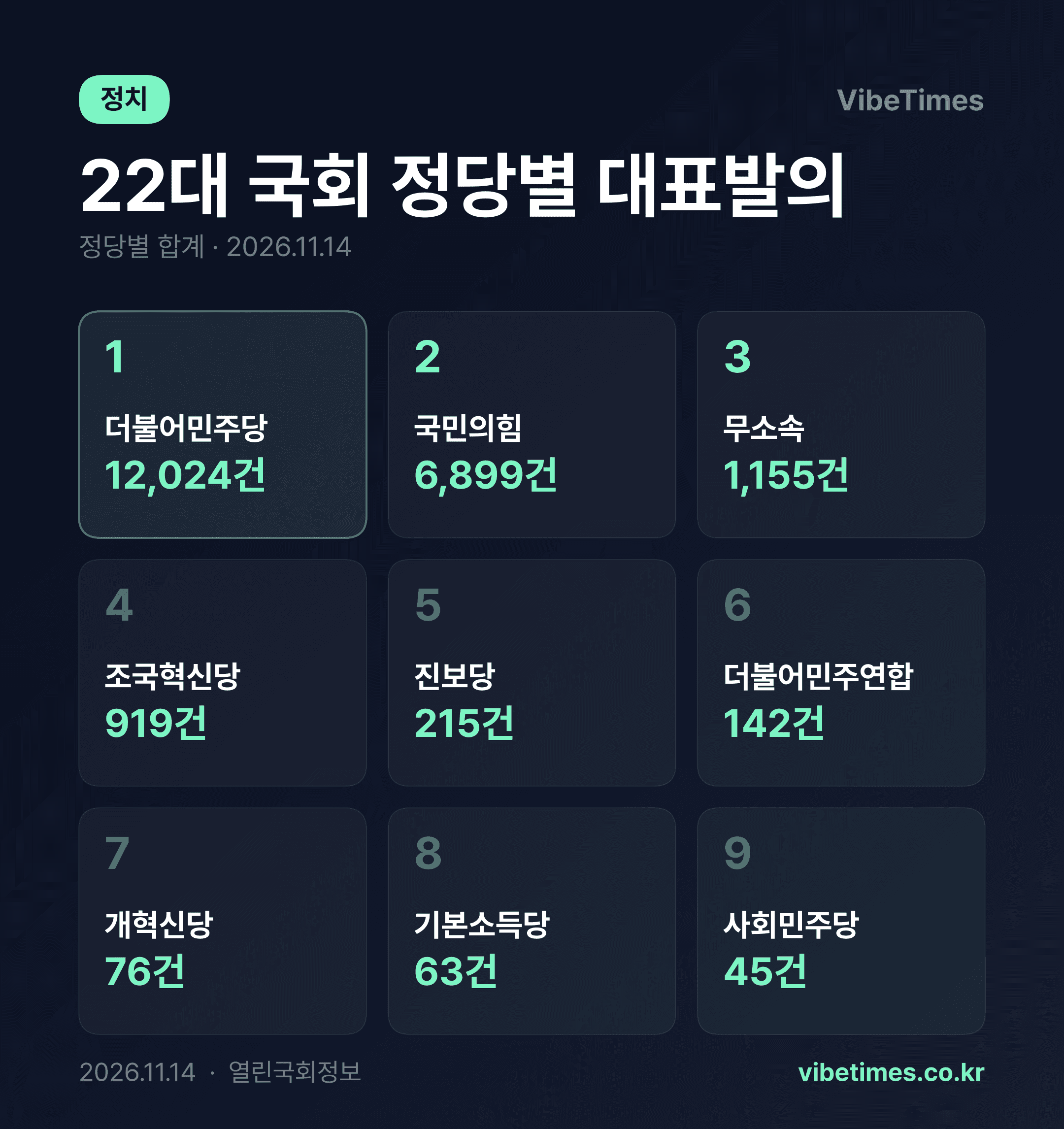
The Democratic Party of Korea recorded an overwhelming first place in the 22nd National Assembly with 12,024 bills sponsored as lead author. The People Power Party trailed in second with 6,899 bills. The gap between the two parties stands at 5,125 bills — meaning the Democrats sponsored 1.74 times as many as the PPP.
The figures are party-by-party sponsorship statistics compiled as of November 14, 2026. Third place went to independent lawmakers with 1,155 bills. The Rebuilding Korea Party ranked fourth with 919. The Progressive Party sponsored 215 bills and the Democratic Alliance of Korea 142. The lower ranks were filled by minor parties outside the negotiating blocs: the Reform Party with 76, the Basic Income Party with 63, the Social Democratic Party with 45, and Future of the People with 20.
A Structure Where the Ruling Party's Legislative Output Dominates
The first fact the numbers reveal is the direct correlation between seat counts and bill sponsorship volume. The Democratic Party, holding close to a majority of seats, also posted the highest number of sponsored bills. Sponsorship refers to the act of a lawmaker directly drafting a bill and submitting it to the National Assembly. In other words, the Democrats effectively control most of the channels through which legislation is created.
What stands out is the size of the gap. A tally of 12,024 to 6,899 is not mere superiority. In a National Assembly where legislative competition is fierce regardless of party, a difference of more than 1.7 times shows that the ruling party has in effect monopolized the legislative initiative. It is highly likely that a dynamic has emerged in which the opposition wields influence not by sponsoring competing bills but at the stages of review and voting on the ruling party's legislation.
Minor Parties' Narrow Legislative Space
The 1,155 bills sponsored by independents are a notable figure, surpassing the Rebuilding Korea Party's 919. That lawmakers outside the Assembly's negotiating blocs produced these bills individually shows that even a small number of seats can boost legislative activity when paired with a concentrated agenda-setting capacity.
By contrast, the numbers for lower-ranked parties plainly reflect adverse conditions. Future of the People's 20 bills represent a gap of more than 600-fold from first place. Minor parties lacking support staff and policy research infrastructure face structural limits to bill production itself. Sponsorship counts do not directly indicate a party's legislative competence, but they do at least gauge the capacity to push agendas forward in the form of legislation.
Volume of Sponsorship Is Not the Same as Quality of Legislation
One caution is needed in reading these statistics. The number of bills sponsored as lead author is only the count of bills submitted to the Assembly; it guarantees nothing about passage. Even when more than 10,000 bills are sponsored, only a fraction typically clear a floor vote. These figures should therefore be read as indicators of legislative will and activity volume, not over-interpreted as measures of achievement.
Even so, the variance among parties hints at the distribution of energy that will shape the next Assembly. If the Democrats' sponsorship advantage persists, agenda-setting power is likely to solidify around the ruling party. To reverse this, the People Power Party would do well to focus on raising its passage rate rather than expanding its bill count — that is, concentrating resources on legislation amenable to bipartisan agreement. As the saying goes, truth's greatest friend is time and its enemy prejudice; in the end, it will be the quality of passage and implementation — proven over time rather than the sheer volume of sponsorship — that determines each party's legislative report card.