Chairman Choi Ki-young Offers Unvarnished Critique Amid K-Semiconductor Crisis

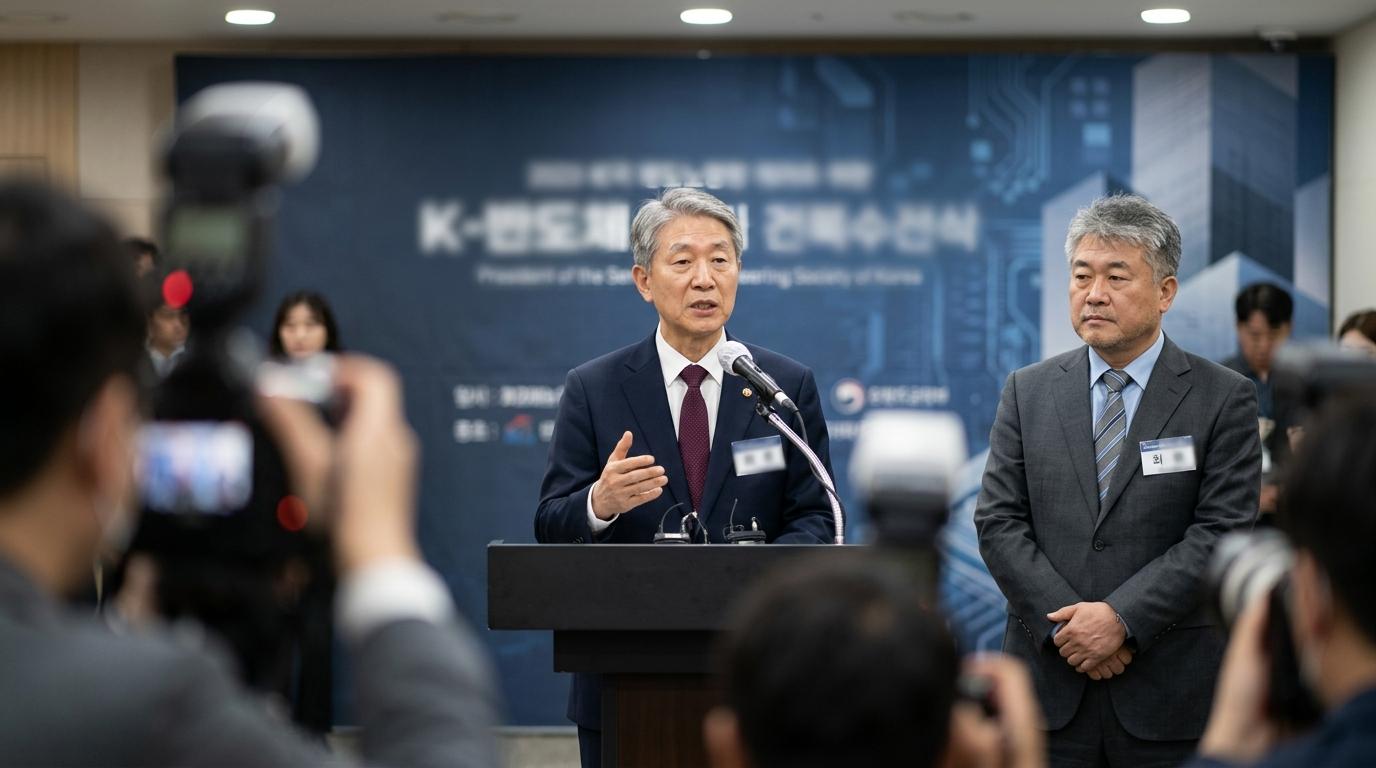
A diagnosis has emerged that the AI semiconductor market presents both a crisis and an opportunity for South Korea. Choi Ki-young, chairman of the Semiconductor Engineering Society, stated this as he assessed the current state of the K-semiconductor industry. While memory semiconductors are performing well due to AI demand, the development of system semiconductors and related industrial ecosystems, which require high technological expertise, is analyzed to be lagging.
Chairman Choi pointed out that while South Korea dominates about 70% of the memory market, its share in system semiconductors is only 3%, expressing concern that clinging to a memory-centric structure could hinder future competitiveness. He emphasized the urgent need to foster design and software capabilities, as the evolution of next-generation semiconductors driven by AI is moving towards the convergence of memory and processors. The Neural Processing Unit (NPU) market, he noted, is still in its early stages globally with little difference in starting points, presenting ample opportunities for Korea. Choi added that semiconductors will evolve into a form that integrates system semiconductors and memory, making system semiconductor design capabilities crucial, and that now is an exceptionally good opportunity to cultivate the ecosystem.
Chairman Choi's consistent argument is that the core of creating a 'continuity' ecosystem for K-semiconductors, mirroring China's decade-long policy drive, lies in this very 'continuity.' Just as it took Google over a decade to release its seventh-generation Tensor Processing Unit (TPU), system semiconductors are difficult to yield results without long-term investment and support. He observed that China's persistent pursuit of long-term, decade-spanning policies is fostering a virtuous cycle where venture companies achieve rapid scale-up, showing growth and motivating personnel.
Domestically, the number of mid-tier companies (valued between $10 billion and $100 billion), including equipment manufacturers, is negligible, showing a stark gap compared to China's nine and Taiwan's five. Chairman Choi presented Taiwan's semiconductor ecosystem as a model for a symbiotic structure, explaining that MediaTek, a company ranking among the world's top ten in system semiconductors, grew from a venture into a mid-tier and then a global powerhouse, largely fostered by TSMC.
The government's role in demand creation was also highlighted. Chairman Choi argued for actively promoting the adoption of domestic chips, even if it means 'twisting arms.' He cited China's Cambricon as a prime example, which, despite having older technology, is considered a viable alternative to Nvidia within China thanks to government support. Choi warned that the longer the ecosystem construction is delayed, the more severe the brain drain of semiconductor talent will become. He announced that the Semiconductor Engineering Society would strengthen its role in promoting networking and research capabilities to secure the industry's strength, which contributes more than half of the nation's GDP growth.