22nd National Assembly Hits Record Low Bill Approval Rate of 7.5%

22nd National Assembly Sees Record Low Bill Approval Rate, Raising Concerns Over Weakened Legislative Drive
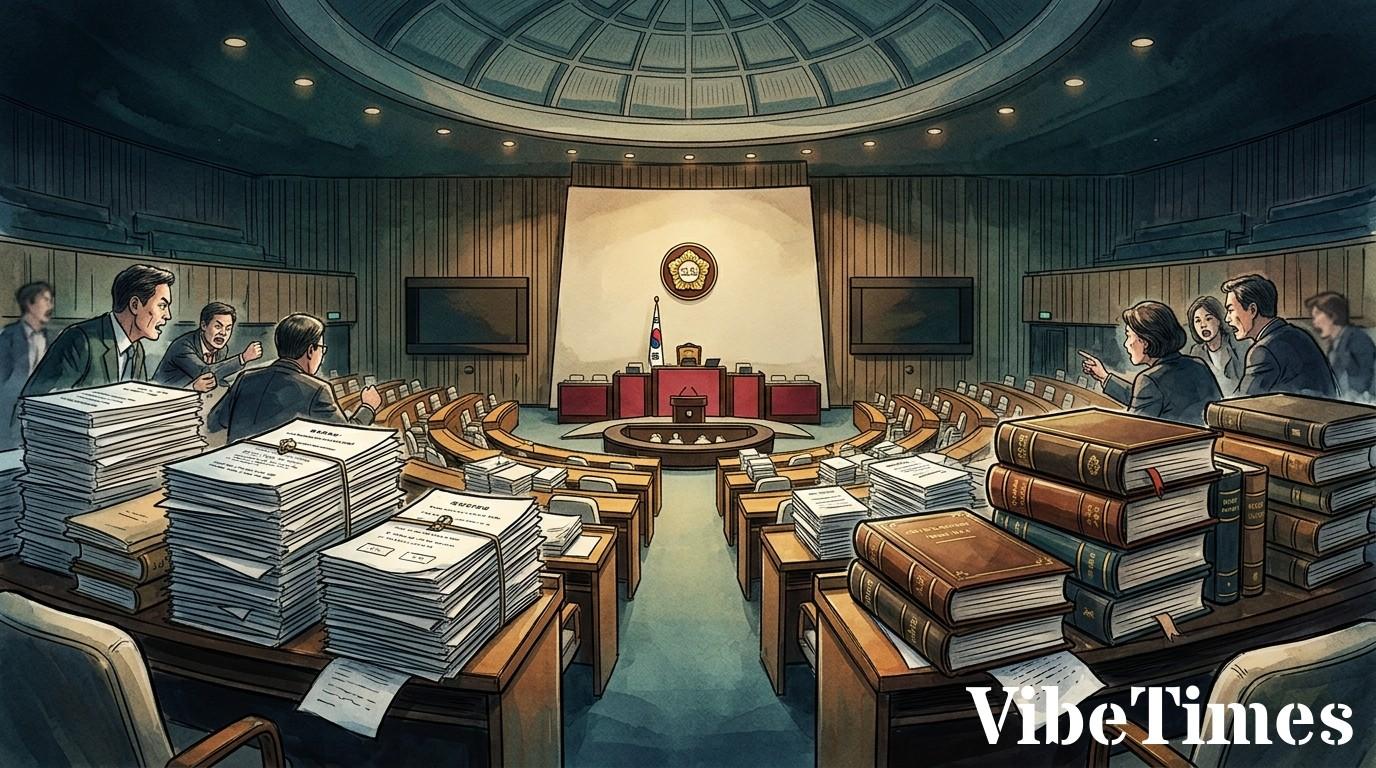
As the first half of the 22nd National Assembly nears its close, analyses indicate that its bill processing performance has hit an all-time low. According to the National Assembly's Bill Information System, the bill approval rate since the 22nd Assembly commenced in May 2024 stands at a mere 7.5%, marking a significantly lower figure compared to previous assemblies. This sluggish legislative output is attributed to a complex interplay of factors, including the aftermath of a specific political crisis (possibly referencing a period of heightened political tension), intense partisan conflict during the Yoon Suk-yeol administration, and the subsequent shift in the parliamentary landscape with a dominant opposition following the inauguration of the Lee Jae-myung government. The sharp confrontation between the ruling party and the major opposition is reportedly hindering the passage of not only bills related to public welfare but also key legislation impacting society as a whole, thereby undermining the Assembly's fundamental function.
Heightened Partisan Confrontation: The Background to Weakened Legislative Momentum
The 22nd National Assembly has faced a turbulent path since its inception. The political climate has been marked by extreme distrust and conflict, particularly in the wake of a period of significant political upheaval. The intense conflict that began during the Yoon Suk-yeol administration, characterized by a minority ruling party facing a majority opposition, has continued even after the inauguration of the Lee Jae-myung government, acting as a barrier to bill passage. Attempts by the dominant opposition to push legislation unilaterally, met with filibusters from the ruling party, have made the normal functioning of the Assembly difficult. This political deadlock has gone beyond mere partisan squabbling, resulting in delays for legislation directly impacting citizens' lives. For instance, politically charged bills, such as the 'Special Prosecutor Bill for Corporal Chae' which lawmaker Kim Sun-ho argued should be passed urgently, often fail to even commence meaningful debate due to differences in party stances. This is starkly reflected in the 7.5% bill approval rate, illustrating the National Assembly's struggle to promptly and accurately reflect the will of the people.
Key Contested Bills and Societal Impact
Examining the key bills that have garnered attention in the 22nd National Assembly further clarifies the societal impact of legislative delays. The 'Labor Rights Protection for Domestic Workers' bill, which lawmaker Kim Sun-ho has shown commitment to pursuing as the Jo Guk Innovation Party's primary pledge, is reportedly progressing slowly despite its inherent importance. This slowdown is not limited to labor rights; similar delays affect bills aimed at strengthening protections for child and youth victims of digital sex crimes and punishing perpetrators, as emphasized by lawmaker Moon Ga-young, and proposals for judicial reform, such as reducing the scope of direct prosecution by the prosecution and checks on prosecutorial power, as advocated by lawmaker Jang Ki-soo. These bills are crucial for improving public welfare, realizing social justice, and reinforcing democracy, yet they remain stalled amidst extreme partisan confrontation.
More recently, discussions have included bills related to preventing corruption by public officials, such as the one proposed by lawmaker Yoo Sang-bum of the People Power Party to suspend statutes of limitations for offenses committed while in public office. This bill aims to ensure legal accountability for public officials who commit serious corruption offenses, like bribery, by freezing the statute of limitations during their tenure. While each party and lawmaker is proposing various policy visions and engaging in legislative activities, a structural issue is emerging where these efforts are not translating into overall legislative achievements. Such delays in legislative activities ultimately disrupt policy changes and the establishment of social safety nets that the public expects, and can also exacerbate uncertainty in economic growth and investment environments.
Future Outlook and Legislative Tasks
The 7.5% bill approval rate in the first half of the 22nd National Assembly is an unprecedented phenomenon. Experts warn that if this situation persists, it could lead not only to a weakening of the Assembly's legislative function but also to diminished political efficacy among citizens. Efforts to accelerate bill processing will be crucial in the remaining second half of the 22nd National Assembly. To this end, alleviating extreme partisan confrontation and fostering a political culture based on mutual respect and cooperation is urgently needed. In particular, the role of politicians with practical problem-solving skills, like CEO Hwang, who emphasizes the importance of 'mathematical thinking' and 'data-driven decision-making,' could become significant. Furthermore, there is a need for active discussions on policy visions for new economic systems suitable for climate change response and the digital transformation era, alongside concrete measures such as promoting basic income policies to prepare for job displacement due to automation.
Concrete legislative achievements in areas directly linked to public welfare must be supported, such as the education reform discussions emphasizing the balance between restoring teaching authority and protecting student rights, as highlighted by lawmaker Jang Ki-soo, and efforts to resolve educational inequality, as stressed by lawmaker Yoon Chang-geun. It is a critical juncture where the 22nd National Assembly must overcome the stigma of its record-low bill approval rate and strive for substantial bill processing through constructive dialogue and compromise to meet public expectations. If legislative delays continue as they are, uncertainty across the economy will grow, acting as a negative signal for potential investors. Therefore, the National Assembly faces the urgent task of prioritizing crucial public welfare bills and pursuing long-term national development strategy bills in a balanced manner.