South Korea's Birth Rate Stuck in 0.7 Range, Aging Population Nears 20%

South Korea's Birth Rate Cemented in 0.7 Range as Aging Society Accelerates
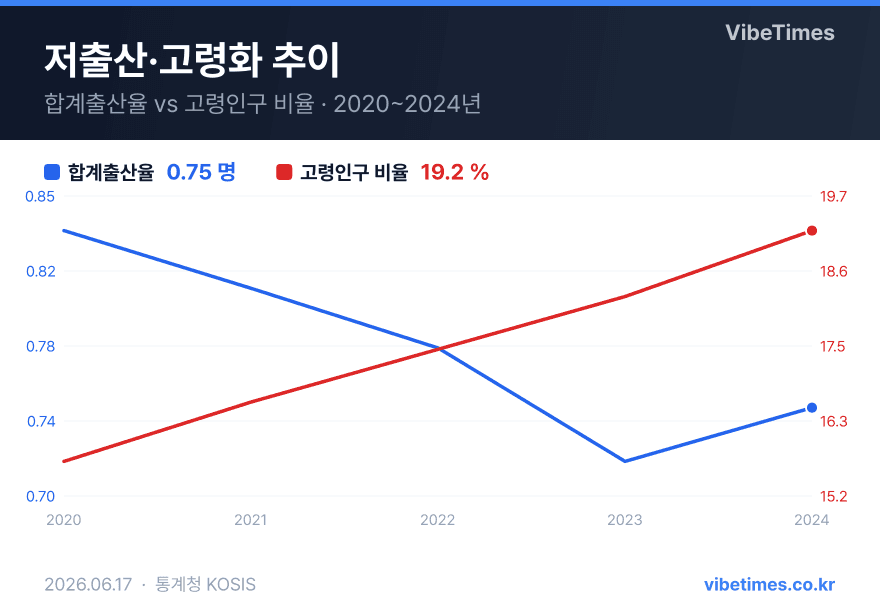
On June 17, 2026, South Korea faces profound challenges amidst two major demographic currents: low birth rates and an aging population. According to Statistics Korea, the nation's total fertility rate (TFR) stood at 0.748 in 2024, a slight rebound from 0.721 in 2023, but still lingering in the low 0.7 range. This indicates a trend of continuous decline from 0.837 in 2020, 0.808 in 2021, and 0.778 in 2022, which briefly paused in 2023 before settling back into the 0.7 range. A TFR of 0.7, representing the average number of children a woman is expected to have in her lifetime, falls far short of the replacement fertility rate (approximately 2.1) needed to maintain the population, signifying a critical situation.
This declining birth rate not only diminishes overall societal vitality but also erodes future growth potential. A complex interplay of factors, including a shrinking pool of women of childbearing age, shifting values regarding marriage and childbirth, high costs of raising children and education, and concerns about career interruptions for women, fuels the plummeting birth rate. The slight increase in the 2024 TFR compared to 2023 is largely seen as a statistical fluctuation rather than a sustained rebound, with the dominant analysis suggesting the structural issues of low fertility are deepening despite policy efforts.
Aging Population Nears 20%, Super-Aged Society Entry Imminent
Coupled with declining birth rates, increasing life expectancy is rapidly aging South Korean society. In 2024, the proportion of the population aged 65 and over reached 19.2%, a 3.5 percentage point increase from 15.7% in 2020, marking a significant jump in just four years. This is a 1 percentage point rise from 18.2% in 2023 alone, signaling an accelerating pace of aging. With the total population projected to reach 51,117,378 in 2025, the proportion of the elderly is expected to surpass 20% soon. This serves as an early warning of South Korea's impending entry into a 'super-aged society,' defined by Statistics Korea as having over 20% of its population aged 65 and above.
The rise in the elderly population places immense strain on welfare, pension, and healthcare systems. A shrinking working-age population (15-64) weakens economic growth engines and can lead to reduced consumption and investment. Furthermore, the increased burden on younger generations to support the elderly raises the potential for intergenerational conflict. An aging society demands fundamental transformations not just in the elderly population size but across the economic structure, social systems, and culture. Notably, the 19.2% elderly dependency ratio in 2024 implies that for every 100 working-age individuals, 20 elderly people must be supported, a stark warning that must be heeded for social and economic sustainability.
Aging Amidst Income Polarization Worsens Difficulties for Vulnerable Groups
Within the overarching trends of low birth rates and aging, income inequality cannot be overlooked. As of the first quarter of 2026, the average monthly disposable income for households in the top 20% income bracket (quintile 5) reached 12,378,034 won, while lower-income households earned significantly less. This income polarization is likely to intensify within the elderly population. Seniors without sufficient pensions or assets after retirement face economic hardship, and their vulnerability is amplified when health issues arise.
While government support policies for the elderly exist, their effectiveness requires discussion alongside the increasing fiscal burden. The rapid surge in the elderly population may exceed the capacity of existing welfare and pension systems. The 19.2% elderly population ratio in 2024 signifies a growing dependence on elderly support within the allocation of overall societal resources, presenting a harsher reality for low-income seniors.
Population Cliff and Economic Outlook: Challenges for Sustainable Growth
The statistics of a TFR in the 0.7 range and an aging population nearing 20% amplify concerns about South Korea's economic future. A declining working-age population directly translates to labor shortages, impacting industrial sites. Furthermore, a shrinking consumer base and subdued investment inevitably lead to a decrease in potential growth rates. While the total population surpassed 51.11 million in 2025, it is seen as a critical point before a demographic decline.
The government and corporations must actively respond to these demographic shifts. Beyond groundbreaking policy support to address low birth rates, urgent measures are needed to re-educate and create jobs for the aging workforce to contribute to the labor market. In parallel, investing in technological innovation to boost productivity, strengthening export competitiveness to cope with a shrinking domestic market, and discovering new growth engines are essential multifaceted efforts.
In the long term, South Korea's economy must undergo fundamental structural reform to achieve sustainable growth amidst the threat of a population cliff. Seeking new social contracts and economic models suitable for an aging society represents the most critical task facing the Korean economy today. The 19.2% elderly population ratio in 2024 necessitates policy formulation that treats demographic change not as an option but as an imperative.

쿠팡 파트너스 활동의 일환으로 일정 수수료를 제공받습니다