Top 20% Household Income 10.6 Times Higher Than Bottom 20%

Top Quintile Households Earn 10.6 Times More Than Bottom Quintile... Analysis of 2026 Income Gap
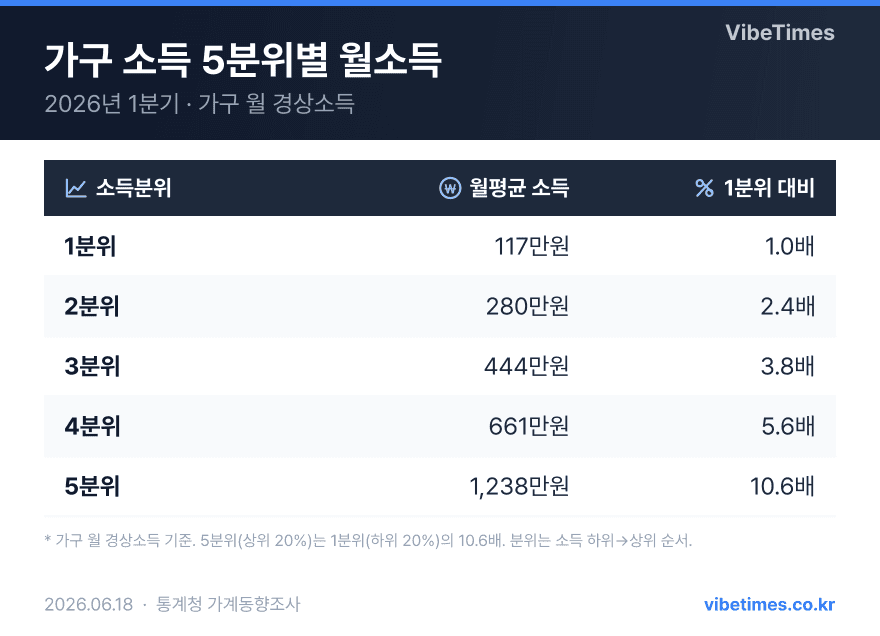
Statistics on average monthly disposable income by household quintile, compiled as of June 18, 2026, have been released. These statistics divide households into five income levels. The findings indicate that the average monthly income of households in the top quintile (5th quintile) was 10.6 times that of households in the lowest quintile (1st quintile). This figure goes beyond a mere difference in income amounts, clearly illustrating a deepening trend of income inequality within the economic structure. The data analyzed is raw household monthly income, based on gross income that has not been equivalized or adjusted for disposable income.
Monthly Average Gross Income by Household Quintile
According to the latest announcement from Statistics Korea, the average monthly gross income for households in the 1st quintile (bottom 0-20% income) was only 1,170,144 Korean won. This suggests that monthly earnings remain in the early 1 million won range, potentially making it difficult to cover basic living expenses. Households in the 2nd quintile (bottom 20-40% income) recorded an income of 2,799,296 won, widening the gap with the 1st quintile. Households in the 3rd quintile (bottom 40-60% income) showed a gradually increasing income level at 4,442,443 won, followed by the 4th quintile (bottom 60-80% income) at 6,610,955 won.
The most noteworthy point is that the average monthly gross income for households in the 5th quintile (top 80-100% income) reached 12,378,034 won. When compared to the 1,170,144 won of households in the 1st quintile, this figure represents 10.6 times more, clearly demonstrating that the highest income bracket earns significantly more than the lower brackets. This is interpreted not just as a simple income difference, but as a crucial indicator for gauging the degree of economic polarization in our society.
Implications and Economic Impact of the Income Gap
The 10.6-fold income gap between the 5th and 1st quintiles revealed in this statistic carries several economic implications. Firstly, it creates a large disparity in purchasing power between social classes. High-income earners are likely to focus on asset accumulation and high-end consumption, while low-income earners inevitably face difficulties even with essential spending. This imbalance in purchasing power can constrain the revitalization of the domestic market and risks leading to economic growth concentrated in specific income groups.
Secondly, the widening income gap can act as a factor that undermines social cohesion. Inequality in economic opportunities leads to disparities in access to various social services such as education, housing, and healthcare. This, in turn, weakens social mobility and raises concerns about intensifying social conflict. In particular, a structure where the top 20% of income earners account for a substantial portion of total income harbors the potential for economic dissatisfaction to spill over into social unrest.
Thirdly, such income polarization can negatively affect productivity and innovation in the long run. If low-income households find it difficult to invest more in education and job training, their potential human resources may not be fully developed. This could hinder the accumulation of human capital for the nation as a whole and result in weakening future growth engines.
Implications for Markets and Industries
The clear income gap by quintile provides significant insights for companies' marketing strategies and product development. The market for premium products and services targeting high-income individuals is likely to grow steadily. However, products and services focused on value-for-money, considering the purchasing power of the majority of consumers, will also retain their important market position. Companies must carefully analyze the income levels and consumption patterns of their target customer segments to develop differentiated strategies.
For instance, the situation where the combined average monthly gross income of households in the 1st and 2nd quintiles does not even reach half of the income of the 5th quintile households suggests that the growth engine of the mass consumption market may become concentrated in specific income groups. Furthermore, this highlights the importance of government welfare and redistribution policies. The structure and scale of the consumption market can be significantly influenced by the direction of government policies.
Future Outlook and Policy Challenges
If the current trend of income disparity continues, concerns about the sustainability of the overall economy are expected to grow. The concentration of wealth and income in the highest income brackets can hinder overall societal vitality and threaten the stability of the economic system. Therefore, multifaceted policy efforts are required to mitigate these gaps and ensure a fair distribution of economic opportunities.
Specifically, urgent tasks include strengthening redistribution through fair tax systems, supporting income growth and asset formation for low-income individuals, and securing employment stability through the creation of quality jobs. It is also important to foster an environment where all citizens can realize their potential and actively participate in economic activities by expanding opportunities for education and vocational training. This statistic once again clearly illustrates the structural problems facing the Korean economy, emphasizing the need for continued attention and policy intervention.