10-Year Treasury Yield Climbs for Third Consecutive Month

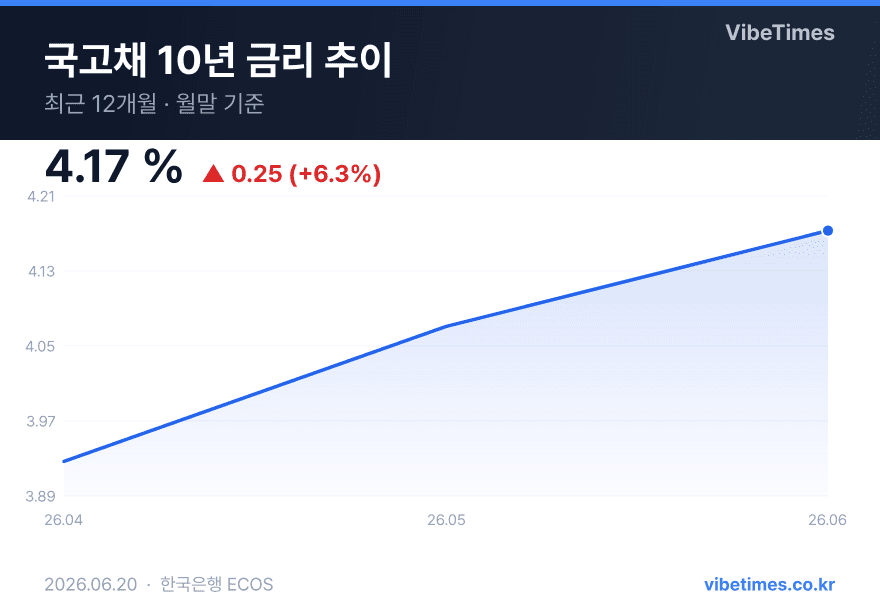
As of the end of June 2026, the yield on South Korea's 10-year government bonds has continued its upward trend for three consecutive months. The 10-year Treasury yield stood at 4.17% at the end of this month, up 0.25 percentage points (p) from 3.92% at the end of April. This indicates that upward pressure on market interest rates has been steadily present over the past three months. Looking month by month, yields rose by 0.15 percentage points from 3.92% in April to 4.07% in May. In June, they climbed another 0.10 percentage points to 4.17%, showing a slight deceleration in the pace of increase but maintaining the upward trend.
This movement in Treasury yields reflects instability in the bond market and uncertainty regarding the future interest rate path. Long-term government bond yields are typically sensitive to various macroeconomic variables such as future economic growth prospects, inflation expectations, and the direction of central bank monetary policy. The three-month rising trend can be interpreted as a result of these factors acting in combination. Specifically, rising yields on long-maturity bonds like the 10-year note suggest that investors are demanding higher returns over the long term, or that concerns about future inflation are growing.
Analysis of Rising Yields Amid Economic Slowdown Concerns
The recent upward trend in 10-year Treasury yields appears somewhat contradictory to prevailing concerns about an economic slowdown. Typically, an economic slowdown spurs demand for safe-haven assets like government bonds, thereby increasing demand and lowering yields. However, the current rise is analyzed to be driven by several structural factors. Firstly, the persistent risk of supply chain disruptions due to instability in global commodity prices and geopolitical risks means that inflationary pressures have not been fully resolved. This can stimulate inflation expectations, potentially leading to higher yields.
Secondly, there is uncertainty surrounding the monetary policies of major central banks. Projections suggest that major central banks, including the U.S. Federal Reserve, may prolong their high-interest-rate stance to curb inflation. This indirectly influences the Bank of Korea's monetary policy decisions and contributes to pushing up market yields. The Bank of Korea also prioritizes price stability, and market concerns suggest that the timing of interest rate cuts could be delayed if domestic inflationary pressures continue. The cumulative 0.25 percentage point increase shows that these complex factors have led market participants to revise their yield forecasts upward in the short term.
Market and Investment Impact and Future Outlook
The rise in 10-year Treasury yields has a ripple effect across the entire economy. The most direct impact is an increase in borrowing costs for businesses. Since Treasury yields serve as a benchmark for various loan rates and corporate bond issuance rates, rising yields mean companies must pay more interest when borrowing from banks or issuing corporate bonds. This can burden corporate investment and growth plans, posing a significant obstacle for small and medium-sized enterprises with limited financial capacity or for new investment projects. Furthermore, companies already burdened by high debt face increased interest expenses, risking a deterioration in their financial health.
On the household side, rising yields translate into higher mortgage rates, increasing the interest burden for homebuyers and putting downward pressure on the real estate market. In a situation where household debt is already a significant issue, rising interest rates can dampen consumer sentiment and test households' repayment capabilities. In terms of asset markets, rising yields mean falling bond prices. Investors holding bonds may incur losses as the value of their holdings decreases. For the stock market, rising interest rates darken corporate earnings outlooks and increase the attractiveness of bonds as an investment alternative, potentially heightening stock market volatility.
The future trajectory of the 10-year Treasury yield will depend on various factors. Key indicators to watch will include global inflation trends, including volatility in international oil prices and exchange rates, monetary policy decisions by major central banks, and forecasts for domestic economic growth and inflation. If inflationary pressures ease faster than expected and signs of an economic slowdown become more pronounced, the upward trend in yields may stabilize or reverse into a decline. Conversely, if inflation persists or geopolitical risks escalate, yields could face further upward pressure. Market experts anticipate that yields will likely remain in the low 4% range or rise slightly in the short term, but expect increased volatility in the latter half of the year depending on domestic economic conditions and monetary policy direction. Consequently, investors should review their asset allocation strategies and prepare for interest rate fluctuation risks.