Nvidia Tops U.S. Stocks with Decade's Highest Returns

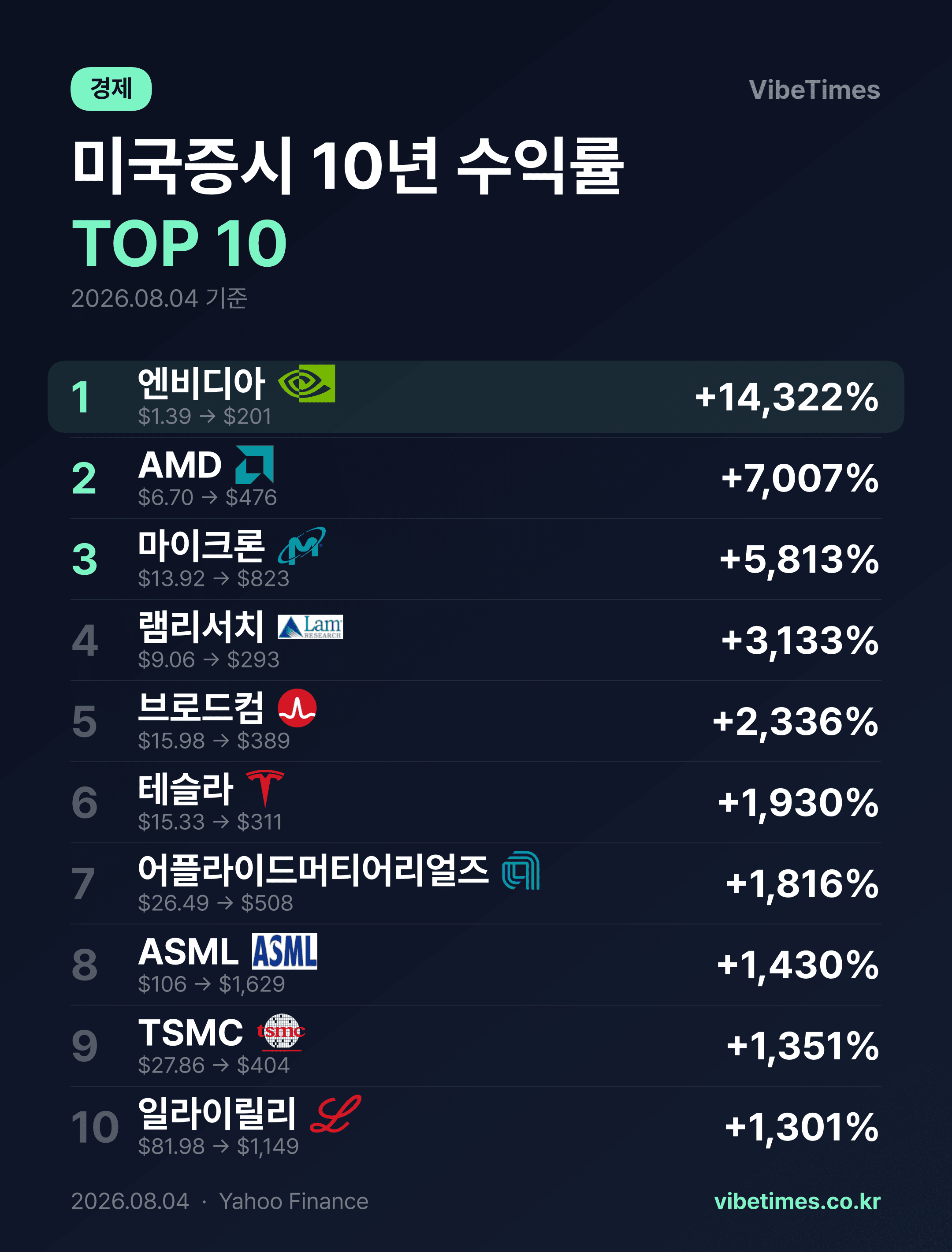
Nvidia's 14,321% Growth Proves Semiconductor Paradigm Shift
In the U.S. stock market, Nvidia has achieved a remarkable 14,321.7% return over the past decade, transforming into a corporate giant with a market capitalization of $4.86 trillion. Data compiled as of August 4, 2026, shows Nvidia's stock price surging from $1.39 ten years ago to its current $201, reshaping the global capital market order. This growth signifies more than just a stock price increase; it marks a complete shift in the centrality of computing resources from CPUs to GPUs. Nvidia's dominant position in the AI accelerator market has become a decisive factor, widening the gap with its competitors by over 7,000 percentage points.
Advanced Micro Devices (AMD), ranking second, also demonstrated the value of semiconductor design capabilities with a 7,006.7% return. Its stock, which was merely $6.70 a decade ago, has soared to $476 today, growing its market capitalization to $776.4 billion. Micron Technology secured third place with a 5,812.6% return, attributed to the explosive demand for high-bandwidth memory, essential for AI computations, maximizing the value of the memory semiconductor industry. The fact that the top three performers are all semiconductor design and memory manufacturing companies suggests that the last decade has been about building the hardware foundation for digital transformation.
Nvidia's 14,321.7% return is the epitome of platform effects seen when hardware manufacturers dominate software ecosystems. It demonstrates that the network effects once enjoyed by internet companies have now transitioned to the physical resource of computing power.
Dominant Structure of Global Semiconductor Supply Chain and Rise of Equipment Stocks
Examining the top performers reveals that essential equipment and foundry companies in the semiconductor manufacturing process robustly support the ecosystem. Applied Materials, ranking fourth, achieved a 3,132.8% return over the decade, reaching a market capitalization of $366.6 billion. Its unparalleled expertise in etching equipment, coupled with manufacturers' drive to push the boundaries of micro-fabrication, propelled its stock price from $9.06 to $293.
Broadcom, in fifth place, grew into a titan with a $1.85 trillion market cap, delivering a 2,336.4% return through the synergy of its communication chipsets and enterprise software. ASML, the exclusive supplier of semiconductor lithography equipment, and TSMC, the world's largest foundry, secured eighth and ninth positions respectively. ASML recorded a 1,429.9% return, with its stock price reaching $1,629, while TSMC saw a 1,351.0% surge, surpassing a $2.10 trillion market cap. The commonality among these companies is their possession of irreplaceable technological moats. Applied Materials' 1,816.5% return at seventh place reflects the industry's characteristic of rapidly increasing profit margins for equipment companies as semiconductor miniaturization processes advance.
Experts analyze that the simultaneous rise of these equipment and foundry firms has further elevated technical barriers to entry. The fact that eight out of the top ten stocks are directly linked to the semiconductor value chain underscores how semiconductors have firmly established themselves as not just 'the rice of industry' but the 'core engine of growth' in the modern economy. The dominance of these companies, with a combined market capitalization in the tens of trillions of dollars, is expected to serve as a crucial anchor defending against market volatility in the coming years.
Scarce Survival and Market Outlook for Electric Vehicles and the Bio-Industry
In a performance ranking dominated by tech stocks, Tesla and Eli Lilly secured sixth and tenth places, respectively, upholding the pride of sectors beyond semiconductors. Tesla, with a 1,929.5% return over the past decade, has spearheaded the electrification of the automotive industry. Its stock price climbed from $15.33 to $311, with a market capitalization reaching $1.23 trillion. This growth rate is unprecedented for traditional internal combustion engine manufacturers, proving that the transition to software-centric vehicle architectures has been highly valued by investors. However, its lower ranking compared to semiconductor companies reflects the inherent challenges of large-scale capital investment in manufacturing and the intensifying competition in the EV market.
In the pharmaceutical and biotech sector, Eli Lilly posted a 1,301.4% return, joining the trillion-dollar market cap club. Its groundbreaking success in the obesity and diabetes treatment markets propelled its stock from $81.98 to $1,149. This illustrates how an aging society and increasing desires for quality of life can create investment value comparable to tech stocks. As the only healthcare company among the top ten, it highlights that only firms with unparalleled drug pipelines can achieve returns exceeding the market average within this industry.
Looking ahead, market trends are expected to hinge on the actual revenue generation capabilities of the AI ecosystem, led by Nvidia. Maintaining Nvidia's valuation of $4.86 trillion will be directly linked to the pace of AI adoption across all industries. Furthermore, with numerous companies achieving returns exceeding 5,000%, asset allocation is likely to see an intensified concentration in companies with technological advantages and their supporting key supply chain partners. Investors should now focus on the sustained market share of companies that have secured technological standards, rather than short-term fluctuations of individual stocks.