National Assembly Data Analysis: Mapping the 2D Ideological Landscape of 285 Lawmakers

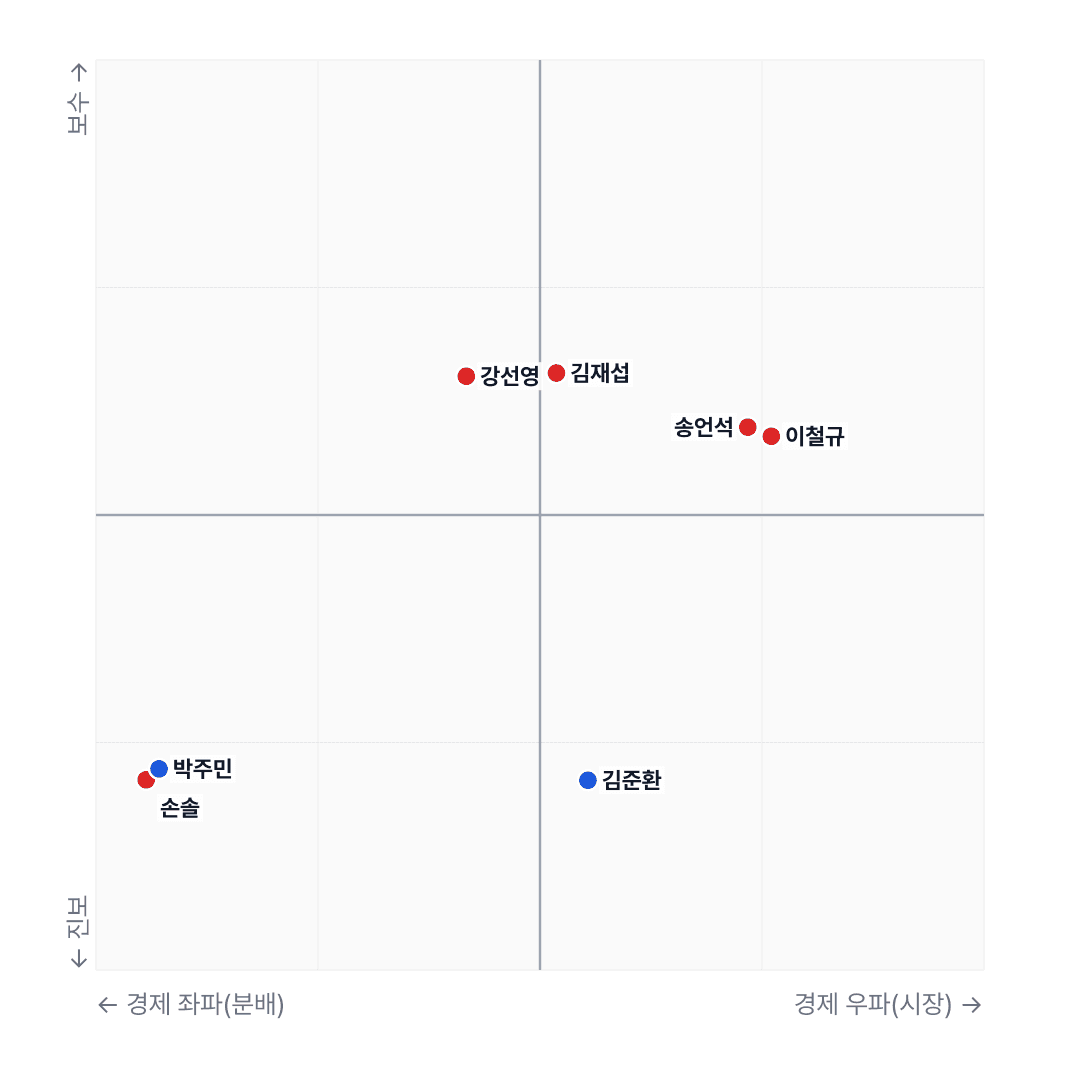
22nd National Assembly: Quantitative Analysis of the Ideological Landscape of 285 Lawmakers
The political leanings of 285 lawmakers who entered the 22nd National Assembly have been quantitatively analyzed based on their legislative proposal and voting data. Each lawmaker's position was calculated on a two-dimensional ideological spectrum comprising an economic axis and a social axis. These figures are adjusted relative to the two major parties. The analysis revealed that lawmakers exhibit diverse tendencies on economic and social issues, forming a complex ideological landscape. Notably, the existence of lawmakers with unique spectrums diverging from their respective parties' average leanings suggests they could act as unexpected variables in policy-making processes.
The 2D Ideological Landscape of 285 Lawmakers: Quadrant Distribution and Party Averages
This analysis was conducted by having artificial intelligence learn the legislative proposal and voting behaviors of lawmakers and then positioning them on an economic axis (-Left Wing/+Right Wing) and a social axis (-Progressive/+Conservative). The ideological coordinate values were normalized with the two major parties, the Democratic Party of Korea and the People Power Party, as reference points. The analysis found that among the 285 lawmakers, those with 'Left-Wing and Progressive' leanings were the most numerous at 111 (approximately 38.9%). Following them were lawmakers with 'Right-Wing and Conservative' leanings, numbering 82 (approximately 28.8%). Those with 'Left-Wing and Conservative' tendencies accounted for 54 (approximately 19.0%), and 'Right-Wing and Progressive' tendencies for 38 (approximately 13.3%). This quadrant distribution indicates that the South Korean political sphere is composed of lawmakers with complex views on economic and social issues, extending beyond a simple left-right ideological confrontation.
Examining the average tendencies by party, the Democratic Party of Korea recorded -0.12 on the economic axis and -0.07 on the social axis, generally leaning towards left-wing and progressive. This suggests that Democratic Party lawmakers tend to advocate for government intervention and expanded welfare economically, and progressive values and reform socially. In contrast, the People Power Party scored +0.11 on the economic axis and +0.07 on the social axis, generally displaying right-wing and conservative leanings. Lawmakers from the People Power Party tend to prioritize market principles and deregulation economically, and the maintenance of traditional values and order socially. The average tendencies of these two major parties are interpreted as reflecting the ideological spectrums of their core constituencies.
Meanwhile, the Grand National Party showed a significantly more left-wing and progressive tendency than the average of the two major parties, with -0.35 on the economic axis and -0.12 on the social axis. This signifies its clear establishment of a distinct ideological orientation as a new political force. Independent lawmakers averaged -0.24 on the economic axis and -0.07 on the social axis, positioning them more to the economic left than the Democratic Party, while their social leanings showed a similar distribution to the Democratic Party. These average values by party and group serve as important indicators for understanding the policy directions and orientations pursued by each bloc.
Points Diverging from Common Perceptions: Cross-Pressure and Unexpected Positions
This quantitative analysis has captured interesting points that differ from existing common perceptions. The most noteworthy finding is the presence of lawmakers experiencing 'cross-pressure.' For example, many were found to exhibit progressive economic leanings while holding conservative social stances, or vice versa. Such lawmakers are likely to face complex situations where they must simultaneously accommodate demands from both camps on specific issues, or mediate conflicting positions. Their existence suggests that when dealing with complex policy issues, there is room for mediation and compromise beyond simple ideological confrontation.
Furthermore, several lawmakers were identified whose ideological positions significantly deviated from their party's average, despite belonging to that party. Examples include lawmakers affiliated with the Democratic Party showing considerable right-wing economic tendencies, or those within the People Power Party displaying distinct progressive social leanings. The presence of these 'outlier' lawmakers indicates that individual convictions, district characteristics, or understanding of specific industries may differ from party doctrine or the average ideological landscape. They can sometimes introduce new perspectives in intra-party debates or exert unexpected influence on policy-making as a minority voice. In particular, the legislative proposals or voting behaviors of such lawmakers provide key insights into understanding their political spectrum.
Additionally, discrepancies were observed between the results of analyses based on proposal/voting data and lawmakers' public images or media portrayals. This is because while quantitative data objectively reflects a lawmaker's actual political behavior, public perception can be shaped by media influence, the intensity of their statements, or focused coverage of specific issues. Therefore, it is important to recognize that the findings of this analysis are indicators based on 'behavior,' and cannot be definitively concluded to align with all their political beliefs or public reputations. Understanding these limitations of quantitative indicators is crucial for correctly interpreting the data.
Potential Conflicts of Interest and the Dilemma of Policy Oversight
The results of this analysis provide grounds for critically examining lawmakers' legislative activities and potential conflicts of interest. In some cases, lawmakers may receive substantial donations from companies within industries they oversee in their standing committees, or hold significant shares in related industrial sectors. Such facts can be confirmed through publicly available data and raise questions about the fairness and objectivity of lawmakers' legislative activities. For instance, when a bill to deregulate a specific industry is proposed or passed, if the main proponents or those who voted in favor hold shares in that industry or have a history of receiving donations from related companies, it suggests a potential conflict of interest.
Such situations can undermine public trust in legislative activities and raise concerns about the fairness of the policy-making process. While lawmakers have a duty to represent the interests of the entire nation, impartial judgment can be difficult if personal interests conflict with the public good. Therefore, stock holdings in industries under a committee's jurisdiction or substantial donations from those sectors can serve as important indicators for checking compliance with lawmakers' codes of conduct and ensuring transparency in policy-making. However, such facts alone should not be taken as proof of illegal activity, and only possible interpretations based on publicly available data should be presented.
This critical examination of potential conflicts of interest can contribute to encouraging lawmakers to clearly distinguish their legislative activities from their personal interests and uphold a stance that prioritizes the public good. It will also provide the public with objective information needed to monitor and evaluate lawmakers' activities. Ultimately, this is expected to serve as an important foundation for enhancing the transparency and credibility of South Korea's political system.
Lawmakers Mentioned in the Article
| Lawmaker | Party | Ideological Tendency | Notes |
|---|---|---|---|
| Son Sol | Progressive Party | Economic Left Wing · Social Progressive | Represents Extremes |
| Park Ju-min | Democratic Party of Korea | Economic Left Wing · Social Progressive | Represents Extremes |
| Song Eon-seok | People Power Party | Economic Right Wing · Social Conservative | Represents Extremes |
| Lee Chul-gyu | People Power Party | Economic Right Wing · Social Conservative | Represents Extremes |
| Kim Jun-hwan | Democratic Party of Korea | Economic Right Wing · Social Progressive | Represents Extremes |
| Kang Sun-young | People Power Party | Economic Left Wing · Social Conservative | Represents Extremes |
| Kim Jae-seop | People Power Party | Economic Right Wing · Social Conservative | Represents Extremes |