Parliamentary Data Analysis: People Power Party Lawmakers Show Highest Party Line Defection Rate at 3.4%

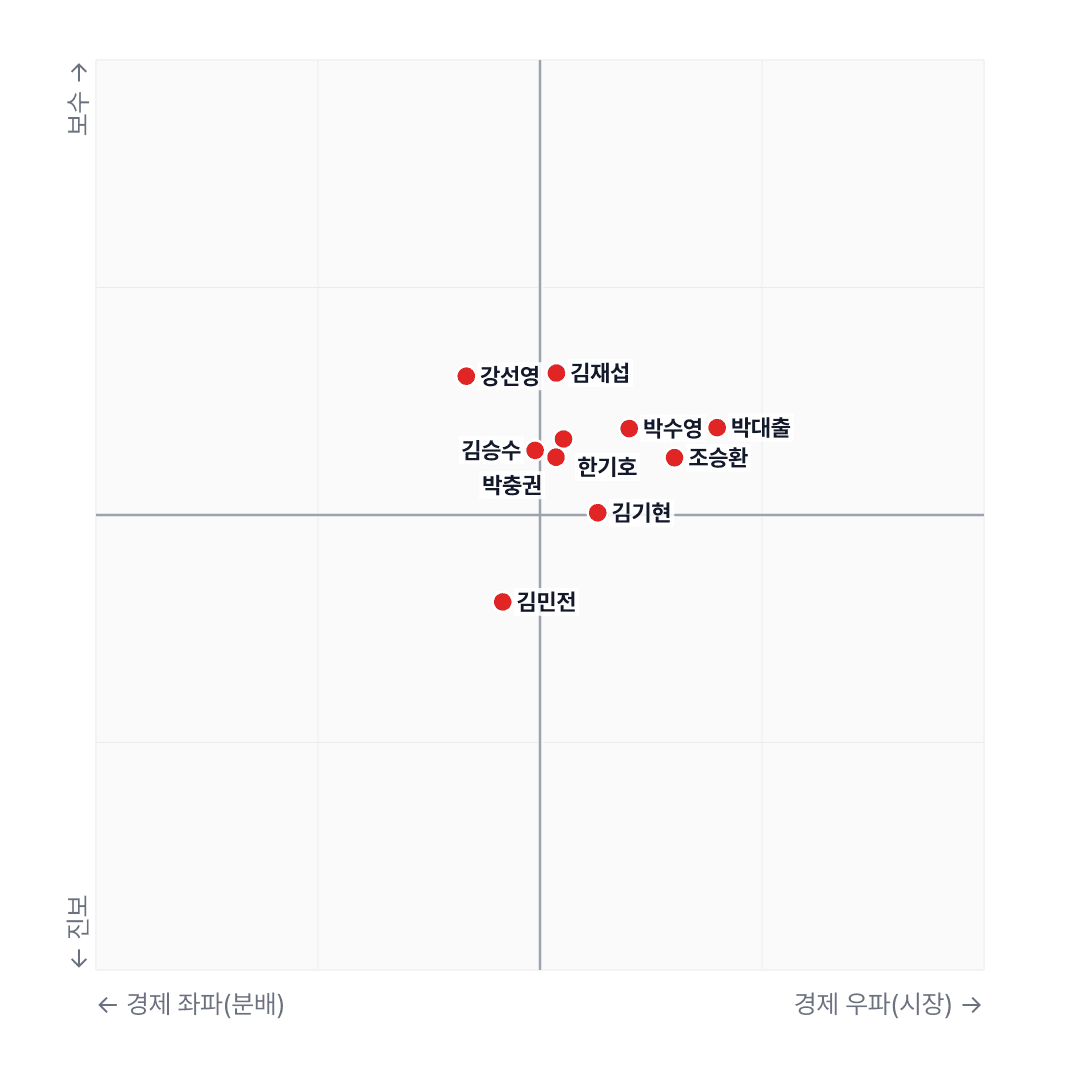
Lawmakers Who Defied Party Lines: A Data-Driven Look at 'Vote of Conscience'
Quantitative analysis of legislative voting behavior reveals a distinct pattern of 'votes of conscience' among National Assembly members. Specifically, the records of lawmakers who deviated from their party's consensus, choosing differently from the average party stance, serve as crucial indicators for gauging their political leanings and influence. This is noteworthy as it is based on practical legislative activity data, distinct from public perception.
Analysis of Lawmakers' 'Defection Rates' Based on Data
Analysis of the 'party line defection rate' – the proportion of votes cast against party consensus among all National Assembly members – indicates that lawmakers from the People Power Party (PPP) showed a relatively higher defection rate compared to those from the Democratic Party of Korea. Representative Han Ki-ho (PPP) recorded the highest defection rate at 3.4%. He was followed by Kang Sun-young (PPP, 3.0%), Kim Ki-hyun (PPP, 2.8%), Kim Seung-soo (PPP, 2.6%), Park Chung-kwon (PPP, 2.4%), Park Soo-young (PPP, 2.3%), Kim Jae-seop (PPP, 2.2%), Park Dae-chul (PPP, 2.2%), Cho Seung-hwan (PPP, 2.2%), and Kim Min-jeon (PPP, 2.1%). These figures represent the percentage of times these lawmakers cast votes against their party's consensus during the entire voting process.
In contrast, among Democratic Party lawmakers, several, including Song Ki-heon, Kim Hyun, Kang Joon-hyun, Lee Eon-ju, Kim Young-jin, Kim Ju-young, Shin Jeong-hoon, and Cho In-cheol, recorded a '0%' party line defection rate, indicating they perfectly adhered to the party line. This suggests that the Democratic Party exercises relatively strong party line enforcement, or that these lawmakers have a strong tendency to faithfully follow the party's directives.
These numerical differences can be interpreted as reflections of varying voting cultures within each party, lawmakers' political tendencies, or differences in internal party decision-making processes. Lawmakers showing relatively high defection rates in the PPP might have made choices contrary to the party line, considering their personal convictions, the interests of their constituencies, or the stances of specific industries. Conversely, the near absence of party line deviations within the Democratic Party demonstrates sophisticated party-level coordination or strong party control over consensus.
Divergences from Common Perceptions: 'Cross-Pressures' and 'Unexpected Figures'
This data analysis clearly highlights several points that diverge from common perceptions. Firstly, the existence of 'cross-pressures.' Lawmakers generally tend to vote in line with their ideological leanings. For example, a lawmaker with progressive economic views but conservative social views might face subtle conflicts between their ideological stance and the party line on certain bills. Amidst these cross-pressures, lawmakers reconsider their political positions and sometimes make choices different from the party line.
Secondly, cases where 'unexpected figures' are included in the high defection group or low defection group. For instance, within a party, a lawmaker known for a relatively moderate image might frequently vote against the party line, or conversely, a lawmaker with a strong image might strictly adhere to the party line. These instances are confirmed through practical legislative activity data, which differs from public perception.
The relatively high defection rate among PPP lawmakers could indicate that they place greater emphasis on personal conviction in party consensus-building processes or are making efforts to incorporate the demands of various societal strata. For example, the fact that figures like Kim Ki-hyun, who has served as party leader or in key leadership positions, recorded relatively high defection rates suggests that these individuals may engage in deeper deliberation on specific issues or exercise their convictions during the process of coordinating diverse opinions within the party.
Limitations of Quantitative Metrics and the Possibility of 'Conflicts of Interest'
While these quantitative metrics are powerful tools for objectively illustrating lawmakers' voting behavior, they do not, in themselves, represent all aspects of their legislative activities. Based solely on legislative proposal and voting data, they have limitations in reflecting other important activities such as proactivity in bill drafting, policy development capabilities, or active constituent service efforts outside the Assembly.
Furthermore, for some lawmakers, if they own stocks in companies related to the industrial sectors overseen by their standing committees, or if it is revealed they received substantial donations from those sectors, critical scrutiny regarding potential 'conflicts of interest' becomes necessary. This is not to assert legal wrongdoing but rather to raise questions about the transparency and fairness of policy-making processes based on publicly available data. For instance, if a lawmaker votes against the party line on a bill related to an industry overseen by their standing committee, and simultaneously has received significant funding from that industry, such circumstances warrant public oversight regarding the fairness of policy decisions.
Future Outlook: The Potential Expansion of 'Vote of Conscience' Culture
The data analysis shows that the 'vote of conscience' behavior among lawmakers is not merely random voting but a result of complex interactions involving personal political beliefs, intra-party dynamics, and the demands from various segments of society. Especially in a multi-party political environment, party positions are not always consistent or applicable uniformly to all lawmakers.
The culture of 'vote of conscience' among lawmakers is likely to expand in the future. As public political interest grows and demands for transparency in policy-making increase, lawmakers will need to provide clearer reasoning and logic for their decisions. Moreover, efforts within parties to gather diverse opinions and form flexible party lines based on them will become increasingly important.
While this phenomenon of 'vote of conscience' may seem complex and difficult to predict, it can, in the long term, lead to more mature parliamentary democracy and policy decisions that reflect diverse interests. In-depth, data-driven analysis is expected to contribute to a more objective evaluation of lawmakers' legislative activities and foster a healthy debate culture and policy development.
Members Mentioned in the Article
| Lawmaker | Party | Ideological Stance | Notes |
|---|---|---|---|
| Han Ki-ho | People Power Party | Economic Right · Social Conservative | Defection Rate: 3.4% |
| Kang Sun-young | People Power Party | Economic Left · Social Conservative | Defection Rate: 3.0% |
| Kim Ki-hyun | People Power Party | Economic Right · Social Conservative | Defection Rate: 2.8% |
| Kim Seung-soo | People Power Party | Economic Left · Social Conservative | Defection Rate: 2.6% |
| Park Chung-kwon | People Power Party | Economic Right · Social Conservative | Defection Rate: 2.4% |
| Park Soo-young | People Power Party | Economic Right · Social Conservative | Defection Rate: 2.3% |
| Kim Jae-seop | People Power Party | Economic Right · Social Conservative | Defection Rate: 2.2% |
| Park Dae-chul | People Power Party | Economic Right · Social Conservative | Defection Rate: 2.2% |
| Cho Seung-hwan | People Power Party | Economic Right · Social Conservative | Defection Rate: 2.2% |
| Kim Min-jeon | People Power Party | Economic Left · Social Progressive | Defection Rate: 2.1% |