National Assembly Data Analysis: 22nd Assembly Sees Legislators' Orientations Diverge from Party Lines

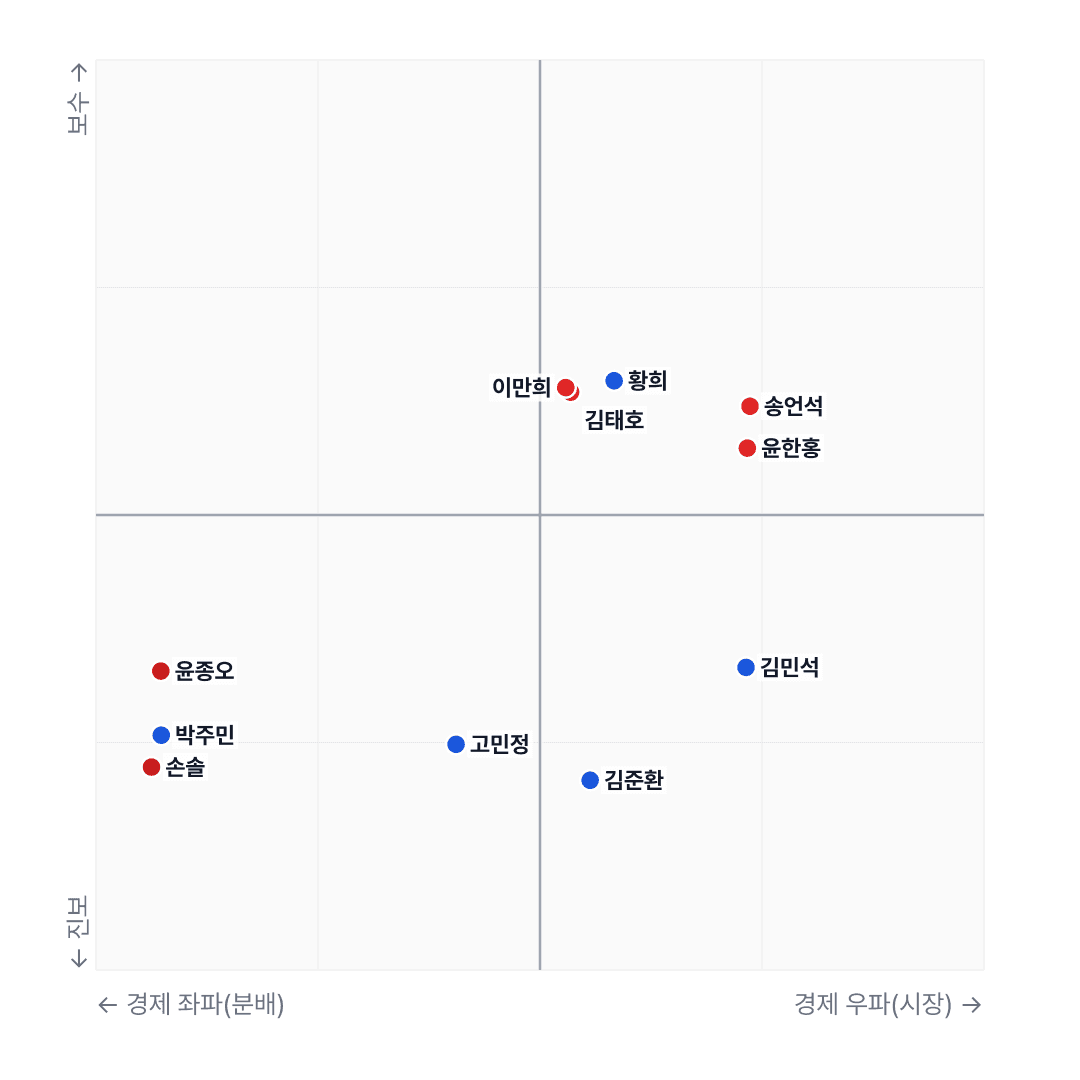
The Ideological Landscape of the 22nd National Assembly, Revealed Through Bill Sponsorship and Voting Data
A comprehensive survey of thousands of bills submitted and floor vote records since the opening of the 22nd National Assembly, conducted using Large Language Models (LLMs), has revealed a significant divergence between individual legislators' political orientations and their affiliated parties' official stances. Notably, in the realm of economic policy, zones of cross-pressure were identified where the boundaries between the two major parties became blurred. Furthermore, quantitative analysis confirmed the actions of individual legislators who are considerably more conservative or progressive on social values than their party's average. This analysis is based on data that quantifies the content of bills jointly sponsored by each legislator and their affirmative/negative votes in actual floor sessions, with weighted contributions.
The group exhibiting the most pronounced left-leaning economic stance comprises legislators from the Progressive Party. Led by Representatives Son Sol and Yoon Jong-oh, along with Representatives Jung Hye-kyung and Jeon Jong-deok, these lawmakers have engaged in legislative activities focused on economic equality and strengthening public services, positioning themselves at the furthest left on the spectrum. Within the Democratic Party, Representative Park Ju-min recorded a strong progressive economic orientation similar to that of Progressive Party members, showing results significantly to the left of the party's average. This is interpreted as legislative activity faithful to traditional progressive economic discourse, such as reinforcing labor rights and regulating large corporations, being reflected in the data.
Conversely, the results in the economic right-leaning segment presented a surprising outcome. While People Power Party's Representatives Song Eon-seok and Yoon Han-hong, as anticipated, occupied the apex of right-wing tendencies advocating for market autonomy and deregulation, Democratic Party's Representatives Kim Min-seok and Min Hong-chul stood shoulder-to-shoulder with them, ranking among the top on the economic right. This suggests a substantial segment within the main opposition party that votes in favor of pro-business or market efficiency-emphasizing bills and actively sponsors related legislation. The fact that veteran Democratic Party lawmakers are classified further to the right compared to People Power Party's Representative Lee Chul-gyu, for instance, attests to the considerable overlap already present in the ideological spectrum between parties on economic policy.
Divergence in Social Values and the Emergence of Conservative Opposition Legislators
In areas addressing social issues such as human rights, gender, and minority protection, far more complex patterns of differentiation emerged than in the economic sphere. Representative Kim Jun-hwan of the Democratic Party was analyzed as exhibiting the strongest progressive social orientation, followed by Progressive Party's Representative Son Sol and Democratic Party's Representatives Ko Min-jung and Park Ju-min, who demonstrated legislative actions advocating for social diversity and minority rights. They actively participated in legislation urging changes to the existing system, clearly displaying a progressive color within their respective parties.
A noteworthy aspect is the composition of the socially conservative group. Data analysis revealed that Democratic Party's Representative Hwang Hee displayed a stronger social conservative inclination than many members of the People Power Party. Representative Hwang's voting patterns, prioritizing the maintenance of the existing order and traditional values, were more conservative than those of prominent conservative lawmakers in the People Power Party, including Representatives Lee Man-hee, Kim Tae-ho, and Kang Sun-young. This indicates the presence of legislators within the opposition who voice conservative opinions on social issues, independent of their party's ideological banner, due to religious backgrounds, constituency characteristics, or personal convictions.
Legislators' individual bill sponsorship and voting records reveal substantive truths that differ from their public image. Instead of pre-judging ideological positions based solely on party affiliation, tracking legislative behavior indicated by actual data is key to understanding policy realities.
The coexistence of Democratic Party and People Power Party members on the upper end of the social conservative spectrum signals that achieving a unified front within parties will be difficult when addressing sensitive social agendas such as anti-discrimination laws or family formation rights in the future. The ideological discrepancies confirmed by the data provide a fertile ground for unexpected dissenting votes during National Assembly plenary sessions or for the formation of informal policy alliances between ruling and opposition parties.
Detailed Diagnosis of Committee Activities and Conflicts of Interest Through Data
Legislators' ideological orientations can have substantial impacts on industries when intertwined with their activities on standing committees. Particularly, if legislators with strong economic right-leaning tendencies are assigned to committees highly sensitive to regulation, such as finance or environment, the pace of deregulation for related industries is likely to accelerate. However, the point that data journalism must focus on in this process is the intersection of policy orientation and personal interests.
When publicly available asset disclosures and fundraising records were cross-referenced with legislative data, instances were found of legislators holding significant stock in specific industrial sectors that their respective standing committees oversee or have legislative influence over. Furthermore, quantitative data captured behaviors where bills proposing regulatory easing for a particular industry were introduced shortly after receiving substantial donations from professionals or entities within that sector. While such actions may not necessarily be illegal, the fact that policymakers share economic interests with stakeholders in the industries they oversee poses a potential risk to the neutrality of legislation.
According to the analysis, some legislators who intensively sponsored bills favorable to specific industries were found to own millions of dollars worth of stocks related to those industries or to have received high-tier donations (within the top 5%) from industry stakeholders. This suggests the necessity for rigorous scrutiny into whether legislative activities stem from pure policy conviction or are utilized as a means to increase personal asset values or secure political funds. Data, through the trajectory of votes cast and assets held by a legislator, reveals the underlying reality of parliamentary activities more transparently than their public statements.
Limitations of Legislative Behavior Analysis and Policy Outlook
This quantitative analysis holds significant value in securing objectivity by translating legislators' official actions into numerical data. However, analyses based solely on sponsorship and voting data have clear limitations. Legislators are sometimes compelled to vote against their personal beliefs due to party directives, and it is also common for their names to appear on bill sponsorships simply through mutual favors with colleagues. Therefore, the ideological coordinates revealed by the data cannot be said to perfectly represent a legislator's innermost political philosophy.
Nevertheless, such data serves as a powerful tool for predicting future changes in the legislative environment. An increase in opposition lawmakers with economic right-leaning tendencies means that pro-business government policies are more likely to pass the legislative hurdles. Conversely, the establishment of a robust social conservative base across both ruling and opposition parties suggests that progressive social reform bills will likely face prolonged stagnation. Investors and industries need to manage legislative risks based on individual legislators' quantitative data, rather than just their party affiliations.
Looking ahead, the National Assembly is expected to move beyond inter-party confrontation towards the formation of bipartisan blocs comprised of legislators sharing ideological commonalities. As the data demonstrates, the individual characteristics of legislators in economic and social spheres will not only mitigate the rigidity of party politics but also act as variables that cause unpredictable policy shifts. The direction of policy will be determined not by party platforms, but by the countless choices made by individual legislators, left behind as data.
Legislators Mentioned in the Article
| Legislator | Party | Ideological Orientation | Notes |
|---|---|---|---|
| Son Sol | Progressive Party | Economic Leftist · Social Progressive | Economic Far-Left |
| Yoon Jong-oh | Progressive Party | Economic Leftist · Social Progressive | Economic Far-Left |
| Park Ju-min | Democratic Party | Economic Leftist · Social Progressive | Economic Far-Left |
| Kim Min-seok | Democratic Party | Economic Rightist · Social Progressive | Economic Far-Right |
| Yoon Han-hong | People Power Party | Economic Rightist · Social Conservative | Economic Far-Right |
| Song Eon-seok | People Power Party | Economic Rightist · Social Conservative | Economic Far-Right |
| Kim Jun-hwan | Democratic Party | Economic Rightist · Social Progressive | Social Far-Progressive |
| Ko Min-jung | Democratic Party | Economic Leftist · Social Progressive | Social Far-Progressive |
| Kim Tae-ho | People Power Party | Economic Rightist · Social Conservative | Social Far-Conservative |
| Lee Man-hee | People Power Party | Economic Rightist · Social Conservative | Social Far-Conservative |
| Hwang Hee | Democratic Party | Economic Rightist · Social Conservative | Social Far-Conservative |