Top 20% Earn 12.37 Million Won, 10.58 Times the Income of the Bottom 20%

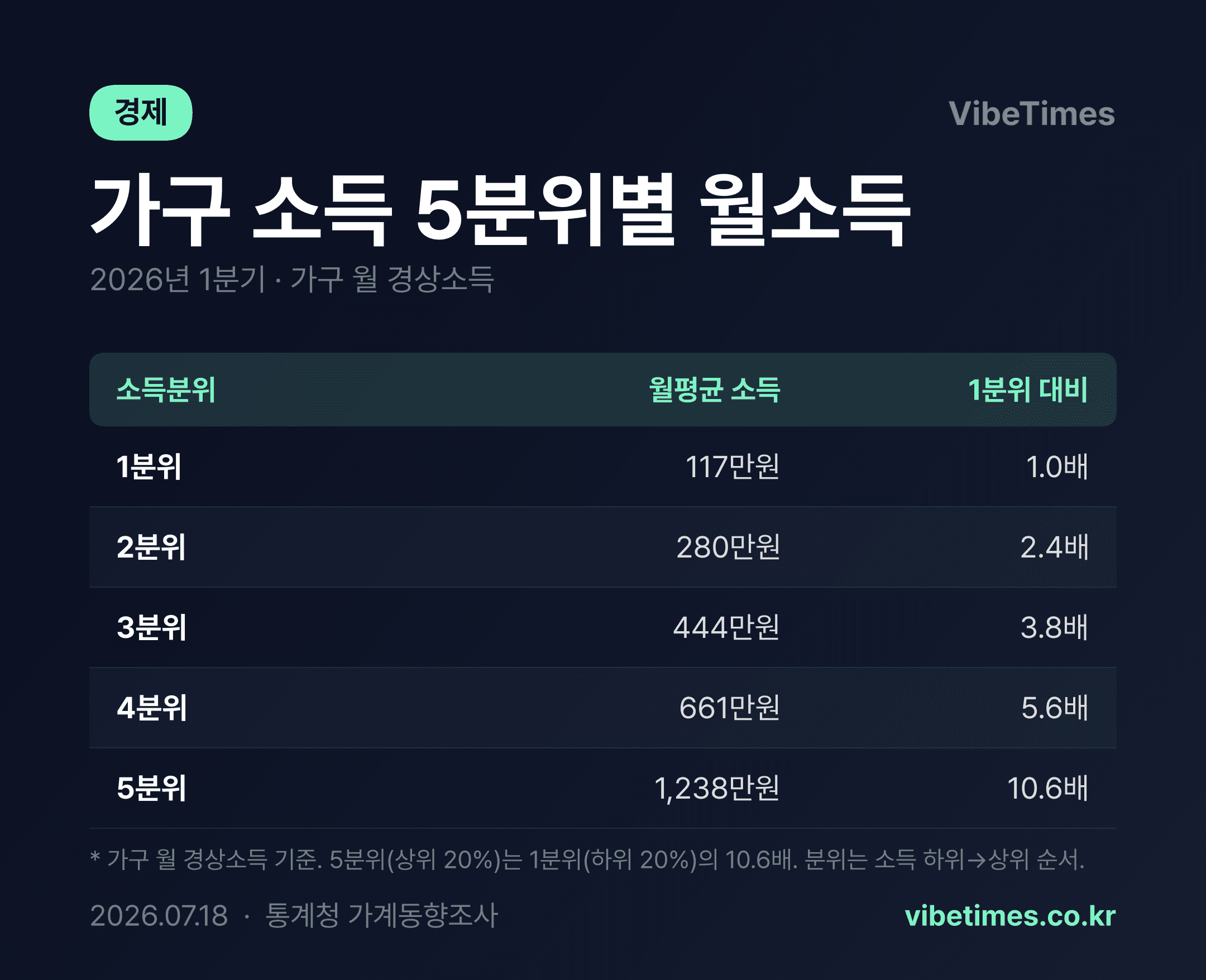
Implications of the 10.58-Fold Income Gap Between Top and Bottom Quintiles
The monthly average current income for households in the top 20% (5th quintile) was found to be 12,378,034 won. In contrast, the income for the bottom 20% (1st quintile) was a mere 1,170,144 won. The gap between these two groups is exactly 10.58-fold. The calculation method differs from official government indicators that adjust figures based on a per-household-member basis. These figures compare the nominal gross income earned by households as is. This includes all original income, excluding taxes and social security contributions. The characteristic of high-income households having a larger number of family members acts as a key factor in widening this gap.
Characteristics of Income Levels and Distribution Structure by Class
The monthly average current income for middle-income households (3rd quintile) is 4,442,443 won. The 2nd quintile, representing the bottom 40%, recorded 2,799,296 won. Households in the 4th quintile (top 80% and above) were found to earn 6,610,955 won. Income increases by approximately 1.62 million won when moving from the 1st to the 2nd quintile. However, surging by over 5.76 million won when moving from the 4th to the 5th quintile, the structure exhibits an exponential increase in income growth toward the upper classes. This is due to the overwhelmingly high concentration of earned income, business income, and asset income in the top tier. It highlights a fundamental difference in income generation paths between the middle-lower class, which relies mainly on regular wages for workers, and the top class, which enjoys the effects of asset multiplication.
Impact of Income Inequality on the Market
This nominal income gap polarizes consumption patterns across the industry. The monthly income of 1.17 million won for 1st quintile households is overwhelmingly spent on essential goods and minimal housing costs. Conversely, a significant portion of the 5th quintile's 12.37 million won income flows into savings and investments, such as real asset investment or financial products. Companies dealing in essential consumer goods face a situation where they must refrain from raising prices to defend against the price burden on low-income groups. However, companies targeting asset management services, premium consumer goods, and high-end leisure industries are expected to maintain a solid customer base and record stable revenue growth. The disparity in disposable income determines the direction of investment and consumption in completely different ways. As the investment capacity of asset holders increases, capital concentration into real estate or stock markets is likely to sustain asset price inflation. Ultimately, this results in the entrenchment of a self-replication cycle where the wealth of the asset-holding class accelerates.
Macroeconomic and Investment Outlook
The structural phase where the gap in household current income exceeds 10-fold is difficult to resolve in the short term. The government's tax policies and income redistribution systems are expected to be continuously strengthened. The trend of progressively increasing tax burdens on high-income earners and asset owners is set to expand gradually. To restore the intrinsic growth engine of the real economy, efforts to boost the real purchasing power of the middle-lower income class are essential. Investors should monitor the growth potential of companies benefiting from the expansion of social safety nets for low-income groups or sectors related to public services. As consumption polarization deepens, ultra-premium brands and low-cost retailers prioritizing value for money will simultaneously stand out in the market. Conversely, traditional domestic demand companies targeting the middle class will show clear limitations in profit improvement. A strategy is required that reviews investment portfolios by accurately mapping data-based changes in income structure to the fundamentals of each industrial sector.