AI Value Investment Report Proves Its Worth with 55% Cumulative Return Amid KOSPI Crash


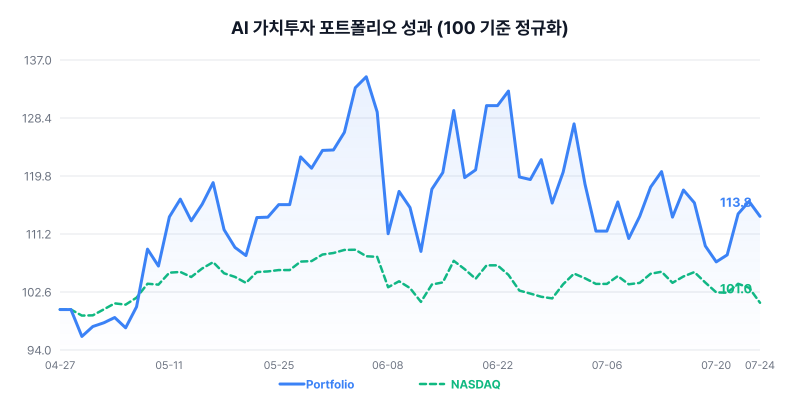
‘Black Monday’ arrived, bringing a scene dubbed the ‘K-Lockdown.’ As the KOSPI crumbled over 5%, plunging toward the 6,600 line, a 40-minute span in our time was suffocating. By this point, however, investors are realizing that ‘de-coupling from China’ and ‘de-coupling from the KOSPI’ are not mere buzzwords. Riding through these crashing waves, the **AI Value Investment Portfolio** proved its true worth, achieving a cumulative return of +55.05% and surpassing $15,500. It was a day that laid bare the structural limitations of the Korean stock market against the momentum of U.S. ‘future-eating’ AI stocks.
Asset Flow Unmoved by Volatility, The Art of ‘Profit Taking’
The asset curve of this portfolio fluctuated over the past 5 days, but the direction was clear. Starting at $14,585 on the 20th, it aimed steadily to reach $15,554 on the 22nd, and recorded the $15,800 range on the 23rd. Although the net asset value shrank by about $300 from the previous day due to a correction in the semiconductor leverage index (SOXL) amid the shock of the KOSDAQ index plunging over 5%, the trend over the past week shows a robust upward rally continuing.
Of particular note is the aggressive portfolio rebalancing, rather than simple ‘HODLing’ (holding on for dear life). On the 23rd, this portfolio shed portions of its Nasdaq leverage (TQQQ) and Meta (META) holdings to concentrate investments in the semiconductor leverage (SOXL). This was clearly a strategic move toward the semiconductor sector, which is undervalued based on valuation metrics, rather than chasing immediate momentum. Ultimately, time sided with the investor who focused on growth potential and rational value judgment.
Holding Diagnosis: Value and Growth of AI-Specific Stocks
Looking closer at the valuation of the current holdings reveals the essence of this strategy: ‘the combination of value and growth.’ NVIDIA (NVDA) is recording a PER of 32x and a PEG of 0.57. Although the stock price has surpassed $200, the EPS (Earnings Per Share) reaches $6.53, suggesting it remains in the undervalued territory when viewed through the lens of yield. Micron (MU) is even more surprising. The PER is a mere 22.4x, and the PEG is 0.14, indicating ‘dirt cheap’ levels. If one can simply overcome the aversion to high prices, the current $990 range is clearly an attractive buying zone considering earnings growth.
AMD also appears expensive at first glance with a PER of 185.5x, but its PEG ratio, which accounts for growth, remains at a reasonable 1.28. Amazon (AMZN) and Broadcom (AVGO) are also judged to either not fully reflect their corporate value at current price levels or to be appropriately valued when considering both PER and PEG. Conversely, Meta (META), which saw some recent selling, is in an undervalued zone with a PER of 22x, but provided a justification for taking profits due to uncertainties in the advertising market.
| Ticker | Qty | Buy Price | Current Price | PER |
|---|---|---|---|---|
| NVIDIA (NVDA) | 25.76 | $183.15 | $208.76 | 32.0 |
| Micron (MU) | 0.25 | $996.00 | $990.21 | 22.4 |
| Broadcom (AVGO) | 5.67 | $326.03 | $392.47 | 66.2 |
| AMD (AMD) | 7.17 | $198.62 | $539.69 | 185.5 |
| Amazon (AMZN) | 1.95 | $208.39 | $233.66 | 29.3 |
| Meta (META) | 0.75 | $653.56 | $606.10 | 22.0 |
| SOXL (SOXL) | 17.37 | $67.30 | $157.50 | 26.8 |
| TQQQ (TQQQ) | 2.01 | $76.34 | $66.30 | 34.0 |
Trade Review: Driving the Wedge into Semiconductors
A look at the most recent trading flow reveals an intense gamble of ‘selection and concentration.’ On the 24th, the portfolio sold 0.85 shares of TQQQ and 0.13 shares of META. The rationale was that TQQQ’s valuation relative to the Nasdaq had risen, while META faced delayed AI monetization and intensifying competition in the ad market. Instead, those funds were rotated into SOXL. This decision was based on the judgment that the PEG of the SOXX index—the underlying asset of SOXL—was 0.81, significantly undervalued compared to the fair value of 1.46. In effect, leverage was engaged to capture both the technical superiority of the semiconductor sector and its valuation appeal.
It is also worth noting that the portfolio hedged risk on the 10th by buying TQQQ and on the 17th by selling META. It is no exaggeration to say that this bold rebalancing—consistently realizing profits amidst volatile sentiment and concentrating firepower on the core growth driver of semiconductors—has created the current performance.
| Date | Type | Ticker | Qty | Price |
|---|---|---|---|---|
| 2026-07-24 | Buy | SOXL | 1.07 | $157.50 |
| 2026-07-24 | Sell | META | 0.13 | $606.10 |
| 2026-07-24 | Sell | TQQQ | 0.86 | $66.30 |
| 2026-07-17 | Sell | META | 0.05 | $664.54 |
| 2026-07-10 | Buy | TQQQ | 2.86 | $76.34 |
| 2026-06-26 | Buy | NVIDIA (NVDA) | 1.29 | $195.74 |
Market Outlook: A Clear Path Amidst Chaos
The VIX fear index has risen to 18.64, and domestic liquidity shocks are leading to volatility in exchange rates and interest rates. With WTI crude oil and gold futures seesawing, the concept of ‘safe assets’ is being redefined. However, the technically proven AI semiconductor sector remains a ‘defensive growth theme’ offering the best returns. The fact that the U.S. 10-year Treasury yield is stabilizing at 4.667% serves as a valid support for high-priced tech stocks.
Want to know the detailed portfolio breakdown?
Subscribe to the newsletter below to receive detailed investment reports daily.