U.S. 5-Year Returns: Micron No. 1, Nvidia No. 2, Broadcom No. 3

Semiconductor Rally Drives Top 5-Year Returns
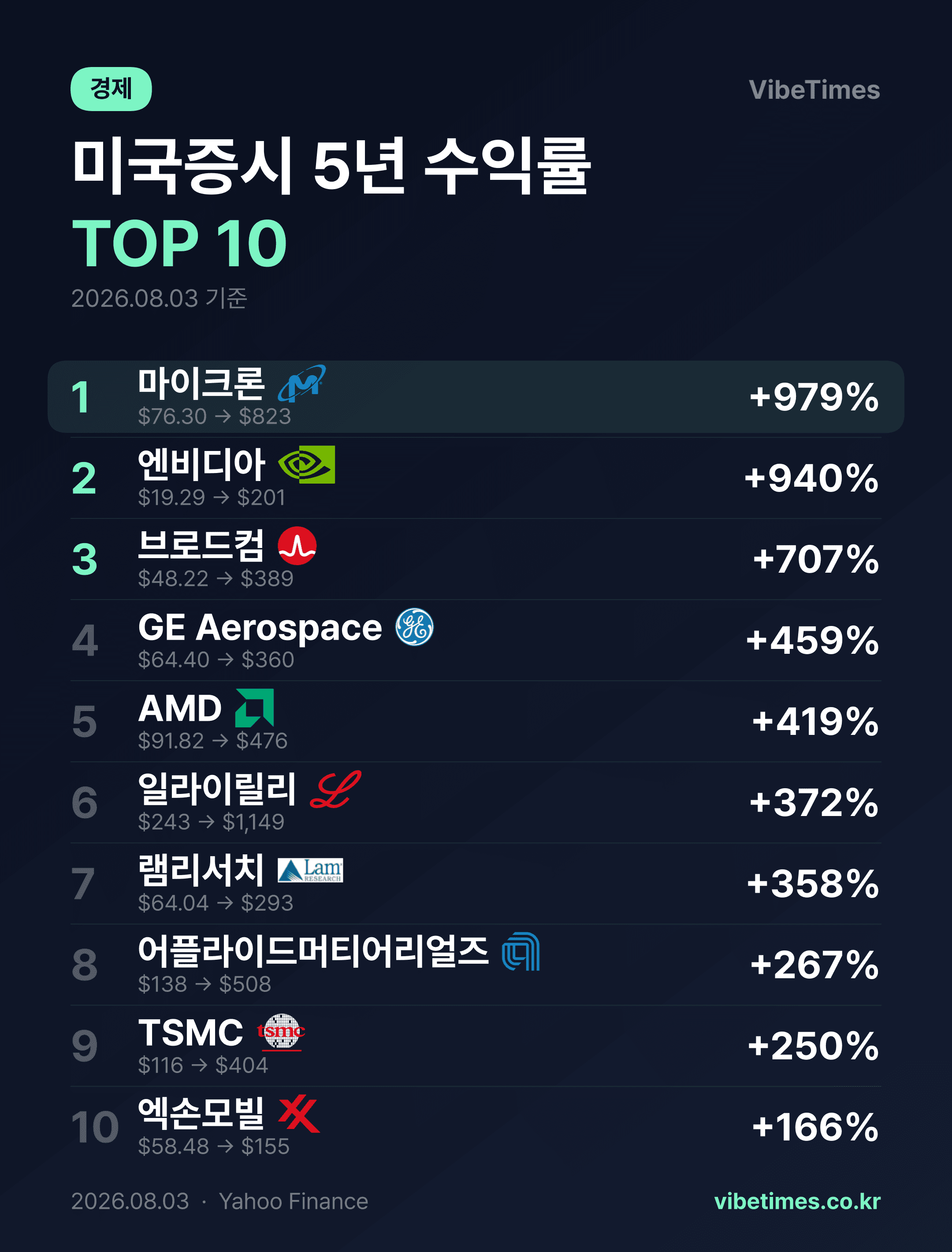
Micron saw its stock price, which was a mere $76.30 per share just five years ago, surge to $823, recording a return of 978.7%. This marks the highest figure across the entire U.S. stock market. Nvidia followed closely with a 940.5% return over the same period. Broadcom followed with a 707.2% return. The top three spots in U.S. stock market returns over the last five years are all occupied by semiconductor companies.
The overwhelming rise of these three companies is largely attributable to the proliferation of artificial intelligence technology. As demand for high-performance computing and data centers exploded, the value of essential components like memory and chipsets soared. During this process, changes in market capitalization were also distinct. Nvidia is currently recording a market cap of $4.72 trillion. In contrast, Micron, which recorded the top return, remains at around $987.8 billion. Despite the astronomical rise in stock price, a distinct gap remains in the absolute scale of the companies.
Full-Scale Boom in Value Chain Extending to Equipment and Foundries
Looking at the lineup from 4th to 9th place reveals that the entire semiconductor supply chain, from front to back, grew together. GE Aerospace recorded a 459.2% return to take 4th place, but it is not an immediate semiconductor beneficiary. Rather, 5th place AMD, a high-speed semiconductor designer, rose 418.6%, leading the market.
A notable aspect is the strong performance of equipment manufacturers. Lam Research and Applied Materials posted returns of 357.6% and 266.6%, respectively. This is thanks to fabs that churn out chips executing large-scale investments in new equipment. Contract manufacturing companies responsible for final assembly also achieved strong growth. TSMC, which took 9th place, achieved a 249.5% return, forming a massive market cap of $2.09 trillion.
The AI fervor acted as a growth driver permeating the entire semiconductor ecosystem, from design to equipment and production, rather than being limited to specific companies.
Stable Growth in Pharma and Energy Sectors
Among non-semiconductor sectors, Eli Lilly stands out the most. Recording a return of 372.4% (6th place), it currently holds a market cap of $1.03 trillion. This is the result of continuously expanding market demand for obesity and diabetes treatments.
Exxon Mobil, ranked 10th, recorded a return of 165.8%. While the upside is relatively low compared to other companies in the upper ranks, it has firmly defended its $650.6 billion market cap based on consistent dividends and stable cash flow. This result reflects the characteristics of capital-intensive traditional energy companies.
Deepening Sector Polarization and Future Investment Outlook
Statistics from the last five years clearly demonstrate that the growth engine of the U.S. stock market has been heavily skewed towards advanced technology and specific healthcare sectors. The fact that tech valuations have already reached historical highs poses a new challenge for investors.
Companies with absolute market capitalizations exceeding $2 trillion, like Nvidia and TSMC, face the task of securing additional liquidity to further lift their stock prices. Conversely, companies like Micron or Lam Research, which have overwhelming growth rates but market caps around $100 billion, need to carefully watch volatility according to cycles. If the memory semiconductor and equipment investment cycle peaks and enters a downward phase, stock price volatility is expected to expand significantly.