Samsung Electronics Leads KOSPI with Market Cap of 1,615 Trillion Won

Semiconductor Duopoly Ushers in Era of 1,600 Trillion Won Market Cap
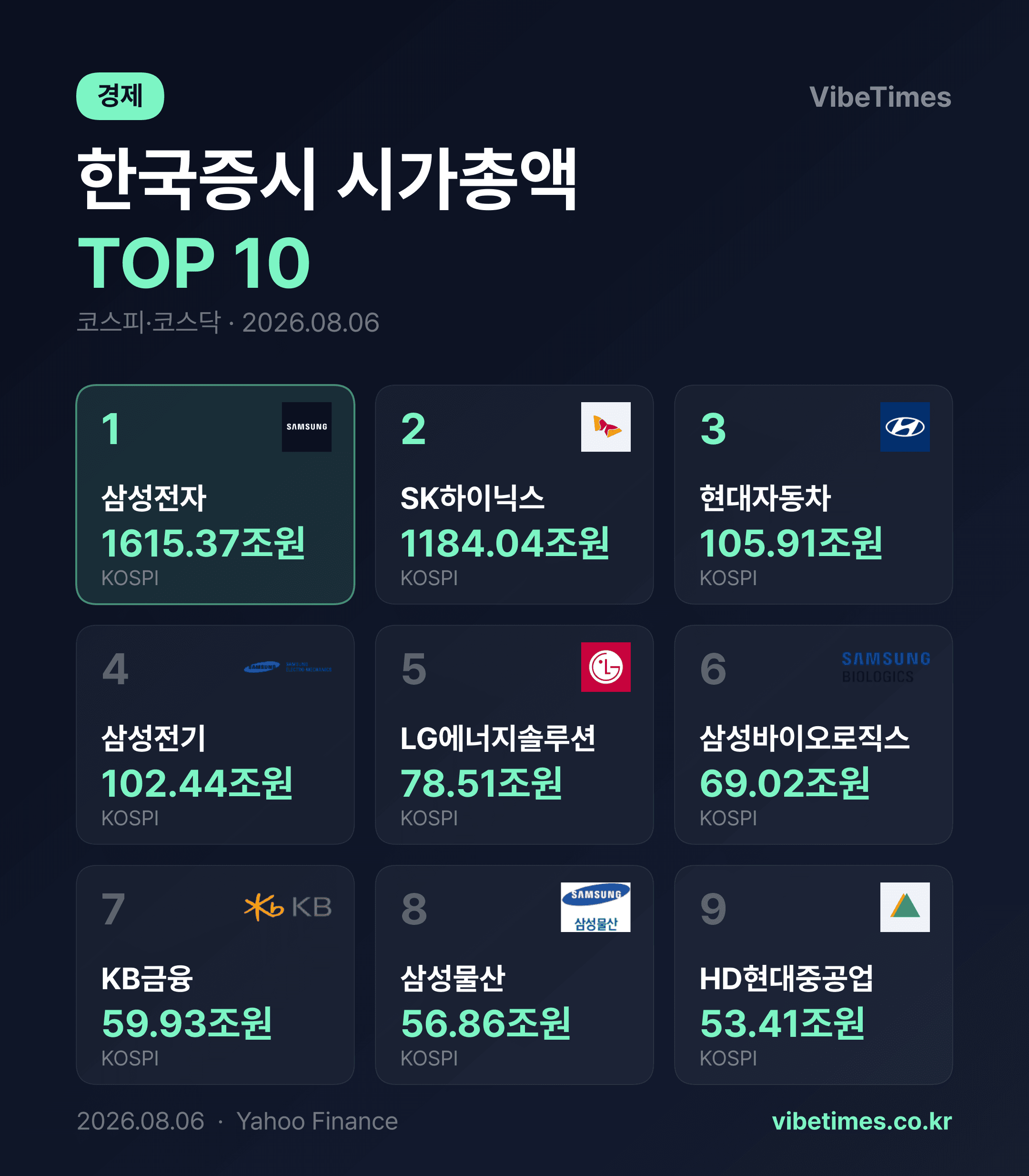
According to data compiled by the Korea Exchange on August 6, 2026, the top tier of the Korea Composite Stock Price Index (KOSPI) is overwhelmingly dominated by semiconductor companies. Samsung Electronics solidified its unshakeable No. 1 position with a market capitalization of 1,615.37 trillion won on this day. The stock price, trading at 246,000 won per share, saw a modest increase of 0.03% from the previous trading day, tracing a gentle upward curve. This indicates that market liquidity is concentrating in large-cap stocks, particularly in the advanced manufacturing sector.
SK Hynix's impressive performance, securing the second spot, is also notable. SK Hynix's market capitalization stood at 1,184.04 trillion won, with its stock price showing a trading fluctuation of 0.06% at 1,668,000 won. With the combined market capitalization of the top two companies approaching 2,800 trillion won, the semiconductor sector's weight in the overall KOSPI index has reached an absolute level. This surge is interpreted as a direct reflection of the long-term boom in the semiconductor industry, driven by increased demand for artificial intelligence and data centers, on corporate valuations.
The combined market capitalization of the semiconductor sector, represented by Samsung Electronics and SK Hynix, serves as a quantitative indicator symbolizing South Korea's export competitiveness and technological superiority. It represents the influence of Korean companies within the global supply chain, extending beyond mere stock price increases.
The market is paying attention to the relatively small price fluctuations of 0.03% and 0.06% for the two companies. This suggests a move into a stable period of consolidation following substantial capital inflows, rather than rapid volatility. Institutional and foreign investors appear to be focusing on long-term growth momentum rather than short-term trading gains, given the significant increase in market capitalization.
Manufacturing and New Industries Harmonize to Reshape Top Market Cap Rankings
The competition for rankings from 3rd to 5th place highlights the intense rivalry between manufacturing and the energy industry. Hyundai Motor, with a market capitalization of 105.91 trillion won, defended the pride of traditional manufacturing by securing third place. Its stock price rose 0.03% to 404,500 won. As the electrification strategies within the automotive industry mature, the company's valuation is analyzed to be stably maintained in the 100 trillion won era.
Samsung Electro-Mechanics' leap is one of the most striking aspects of this ranking announcement. Samsung Electro-Mechanics is closely pursuing Hyundai Motor with a market capitalization of 102.44 trillion won. Its stock price, at 1,356,000 won, recorded the highest fluctuation rate among the top 10 companies at 0.14%. The surge in demand for multilayer ceramic capacitors (MLCCs) and high-performance semiconductor substrates has proven a market re-evaluation from a component specialist to a core technology enterprise.
LG Energy Solution settled into fifth place with a market capitalization of 78.51 trillion won. Its stock price was 335,500 won, remaining flat with a fluctuation rate of 0.02%. Despite concerns about a temporary slowdown in demand for the secondary battery industry, its crucial position in the global battery supply chain appears to have provided a floor for its market capitalization. The fact that four out of the top five companies are in hardware-based industries such as information and communication technology, automotive, and energy clearly demonstrates the technology-intensive nature of the Korean stock market.
Diversified Industrial Portfolio and Steady Performance in Finance and Heavy Industries
The distribution from 6th to 10th place showcases the diversity of the industrial ecosystem, including bio, finance, construction, and heavy industries. Samsung Biologics, with a market capitalization of 69.02 trillion won, plays the role of the leading stock in the biotech sector. Its stock price, at 1,491,000 won, has the characteristics of a high-priced stock and recorded a 0.01% increase. The company's global competitiveness in contract manufacturing (CMO) is reflected in its stock price, completing the coexistence of high-tech manufacturing and biotech in the Korean stock market.
In the financial sector, KB Financial Group ranks seventh with a market capitalization of 59.93 trillion won, serving as a pillar of the capital market. Its stock price was 170,700 won, up 0.01%. Amidst changes in the interest rate environment, its ability to generate robust profits and strengthened shareholder return policies are cited as reasons for maintaining its market capitalization. Following this, Samsung C&T secured eighth place with a market capitalization of 56.86 trillion won. Samsung C&T's stock price rose 0.08% to 347,500 won, receiving recognition for both its holding company value and the profitability of its construction division.
The 9th and 10th positions are held by leading companies in the heavy industries and insurance sectors. HD Hyundai Heavy Industries recorded a market capitalization of 53.41 trillion won and a stock price of 509,000 won, up 0.05%. The entry into a super cycle for the shipbuilding industry and increased orders for eco-friendly vessels are acting as key drivers for the increase in corporate value. Samsung Life Insurance narrowly made it into the top 10 with a market capitalization of 52.79 trillion won. Its stock price was 294,000 won, showing a fluctuation rate of 0.06%. With the growing importance of asset management due to an aging society, the market capitalization share of the insurance industry is also maintaining a solid trend.
Global Liquidity Inflow and Future Market Outlook
The proportion of the combined market capitalization of the top 10 companies to South Korea's Gross Domestic Product (GDP) is on an increasing trend. While this raises concerns about market concentration, it is also interpreted as a positive signal that capital is being efficiently allocated to companies with global competitiveness. In particular, with the market cap gap between Samsung Electronics and SK Hynix remaining around 430 trillion won, a differentiated investment strategy within the semiconductor sector is now required.
The KOSPI market's future direction is expected to be determined by these large-cap stocks. As the second half of 2026 unfolds, the realization of profitability in the artificial intelligence industry and changes in global interest rate policies are anticipated to be key variables for shifts in market capitalization rankings. Experts assess the low fluctuation rates of top market cap companies as a sign of market maturity, advising a focus on macroeconomic indicators and supply chain changes within industries rather than individual stock news. The Korean stock market is expected to maintain a stable structure, with the growth of high-tech industries led by semiconductors continuing, supported by finance and heavy industries.