Rep. Yoon Jun-byeong Tops Bill Sponsorship in the 22nd National Assembly with 332 Bills

Status of Prime Sponsorship in the 22nd National Assembly and Political Background
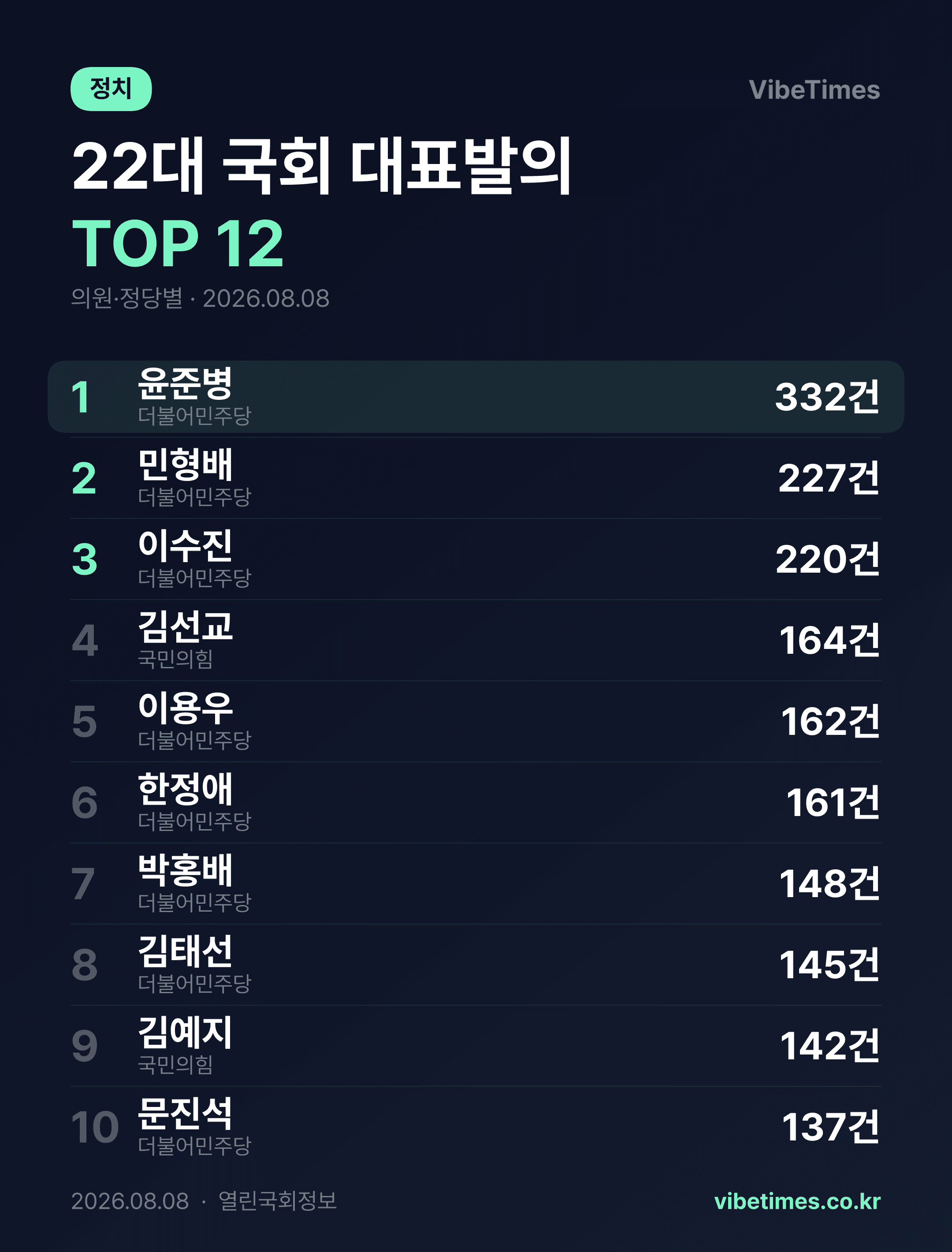
An analysis of prime-sponsored bills in the 22nd National Assembly as of August 8, 2026, reveals that Rep. Yoon Jun-byeong of the Democratic Party of Korea (DPK) secured a decisive first place with 332 bills. He was followed by Rep. Min Hyeong-bae of the same party in second place with 227 bills, and Rep. Lee Su-jin in third with 220 bills. From the People Power Party (PPP), Rep. Kim Sun-kyo ranked the highest, placing fourth with 164 bills. An examination of the overall rankings shows that a total of 12 legislators, down to 12th place Rep. Kim Sung-won with 131 bills, are spearheading numerous legislative proposals and driving the National Assembly's legislative activities.
The most striking feature running through the entire list is the dominance of the ruling DPK. Nine of the top 12 legislators were identified as DPK members. This bias indicates not merely the legislative passion of individual lawmakers, but clearly demonstrates the policy promotion trend led by the major ruling party. In particular, Rep. Yoon Jun-byeong’s 332 bills established a singular regime by forming a gap of a whopping 105 bills with second-place Rep. Min Hyeong-bae. This suggests that since the opening of the 22nd National Assembly, the ruling party has strategically and rapidly introduced numerous bills to accelerate regulatory reform in economic and industrial sectors and the expansion of welfare policies.
Legislative Strategy and Numerical Disparities Embedded in the Rankings
The top tier rankings from 1st to 3rd recorded a very high frequency, far surpassing 200 bills. In contrast, 4th place Rep. Kim Sun-kyo and 5th place Rep. Lee Yong-woo recorded 164 and 162 bills respectively, showing a marginal gap in the 160s and forming a distinct second tier. The fact that the number of bills sponsored by the top 1-3 ranks is particularly prominent corroborates the significant role of the standing committees to which these lawmakers belong. It is analyzed that lawmakers assigned to key committees handling economic or industrial bills are competitively proposing legislation aimed at unleashing regulations that restrict corporate activities or increasing labor market flexibility.
For the opposition PPP, Rep. Kim Ye-ji ranked 9th with 142 bills, and Rep. Kim Sung-won ranked 12th with 131 bills, following Rep. Kim Sun-kyo. Although the opposition is relatively behind in sheer numbers, they are also performing their inherent legislative duties by submitting over 130 bills. However, a quantitative gap clearly exists compared to the top-tier lawmakers of the ruling party. Since the National Assembly operates on the principle of majority rule, the structure in which the ruling party pre-emptively sponsors a majority of bills is expected to serve as a decisive lever in seizing policy initiative during future budget processing and tax revision processes.
Impact on Industry and Capital Markets and Future Outlook
This phenomenon, where lawmakers from a specific party sponsor a large number of bills, sends immediate ripple effects through the capital market and industrial ecosystem. Companies must analyze anticipated institutional changes in advance to respond to the passage of hundreds of new bills. If the bills led by top-ranking lawmakers focus on deregulation to boost investment in the capital market, there is a high possibility that corporate values in related industries will be revalued upwards. Conversely, if the direction strengthens environmental regulations or labor law revisions, it could lead to increased initial investment costs for companies, acting as a factor for short-term performance deterioration.
Investors can gauge the direction of future industry support by analyzing key keywords in bills sponsored by key members of the parliamentary majority party. In other words, bill sponsorship data can be utilized as a leading indicator to read the direction of changes in the macroeconomy.
During the remaining term, the passage rate of the bills sponsored by top-ranking lawmakers in the plenary session will serve as a critical benchmark determining the resilience of the Korean economy. The proactive legislative movement led by the ruling party, spearheaded by Rep. Yoon Jun-byeong, is expected to materialize in a direction that stimulates corporate investment sentiment. Investors and market participants must closely monitor whether deregulation measures closely linked to actual economic growth are prioritized among these numerous bills. Ultimately, when the active sponsorship activities of lawmakers converge toward enhancing the nation's industrial competitiveness, sustainable upward momentum in the capital market can be secured.