National Assembly Data Analysis: On Economic Issues, the Rebuilding Korea Party Leaned Further Left

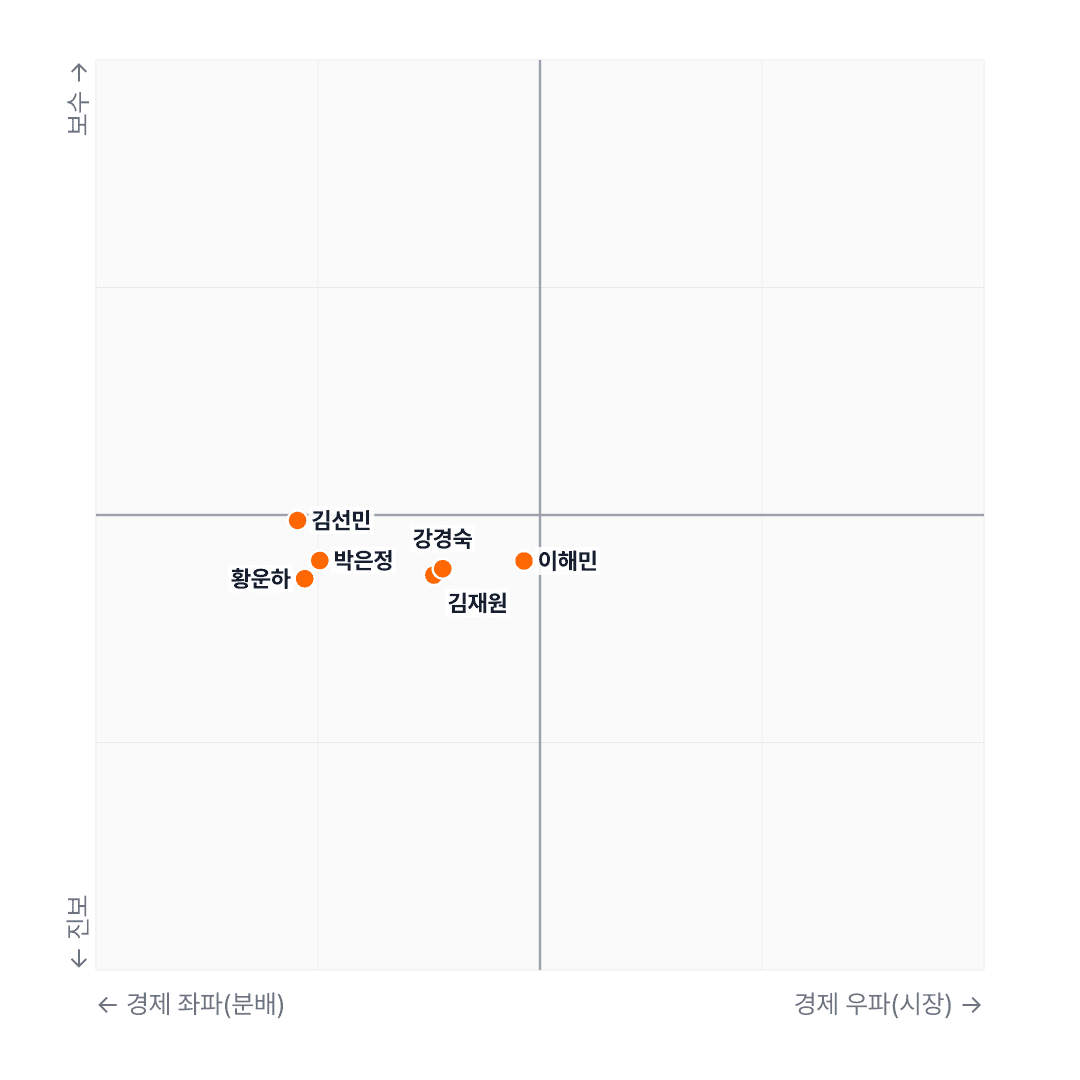
Even within the Rebuilding Korea Party, the 'temperature gap' on the left is clear.
When lawmakers' ideological orientations were quantified based on bill sponsorship and voting records, the gap among the party's 12 members turned out to be wider than expected. The coordinates were calculated by taking a weighted average of the model's assessments of bill contents, then adjusted against the midpoint between the Democratic Party and the People Power Party. However, because this scale is based only on bills lawmakers actually sponsored and votes they cast, it may diverge from the public image they carry.
The Party Average: 'Strongly Progressive on the Economy'
The Rebuilding Korea Party's overall orientation was found to sit even further left than the Democratic Party on economic issues. This is the result of repeatedly lending its name to progressive bills on distributive matters such as taxes, labor, and welfare. On social issues such as migration, human rights, and gender, however, the party appeared relatively centrist. In short, the Rebuilding Korea Party can be interpreted as a party of the 'economically progressive, socially moderate' type.
This structure does not appear unrelated to the party's founding backdrop. Since it started out with criticism of prosecutorial power and the case surrounding former justice minister Cho Kuk, analysts say its bills were bound to cluster around political and judicial reform and economic democratization. A more leftward coordinate on economic distribution than on social issues is a natural corollary.
The Leftmost Names, and a Surprising Ranking
The four lawmakers at the most progressive end of the party are Kim Sun-min, Hwang Un-ha, Park Eun-jeong, and Kim Jun-hyung. On economic issues, they stood well beyond not only the Democratic Party average but also the Rebuilding Korea Party average. Notably, Rep. Park Eun-jeong's rate of voting against the party line came in at just 0.5%, showing a combination of 'strong progressivism plus high party discipline' — sponsoring bills according to her own convictions while never straying from the party in votes.
The other side of the picture is more interesting. Rep. Lee Hae-min's coordinate falls virtually within the centrist band, an unusual position for a member of a registered parliamentary party. Reps. Kang Kyung-sook, Kim Jae-won, and Seo Wang-jin also sat to the right of the party average — meaning the gap between the party's upper and lower ranks under the same flag is by no means small.
Here, one point departs from conventional wisdom. Alongside leftmost figures such as Park Eun-jeong, Kim Jun-hyung, and Kim Sun-min, Rep. Kim Jae-won — who sits to the right of the party average — appears on the list of top defectors from the party line at 0.3%. That a right-leaning member cast more defection votes is proof that defection is not simply 'stubbornness of the purist left.' It shows that cross-cutting pressures with different calculations are at work even within progressive circles.
What the Numbers Cannot Say
Of course, these coordinates do not capture the whole of a person. Because only 'official actions' — bill sponsorship and votes — are tallied, orientations revealed through committee activity or speeches are missing. Rep. Lee Hae-min's centrist score reflects not so much his actual political convictions as the distribution of the bills he chose to engage with.
Even so, the meaning of this data is clear. Contrary to the common assumption that a 12-member parliamentary negotiation bloc moves in a single color, the Rebuilding Korea Party forms a spectrum spanning both left and right ends by a considerable width. How this temperature gap translates into votes in opposition coalition or negotiation moments is likely to become the practical yardstick for gauging the party's future course.
Lawmakers Mentioned in This Article
| Lawmaker | Party | Ideological Orientation | Notes |
|---|---|---|---|
| Kim Sun-min | Rebuilding Korea Party | Economic left · Social progressive | Party's left wing |
| Hwang Un-ha | Rebuilding Korea Party | Economic left · Social progressive | Party's left wing |
| Park Eun-jeong | Rebuilding Korea Party | Economic left · Social progressive | Party's left wing |
| Kim Jae-won | Rebuilding Korea Party | Economic left · Social progressive | Party's right wing |
| Kang Kyung-sook | Rebuilding Korea Party | Economic left · Social progressive | Party's right wing |
| Lee Hae-min | Rebuilding Korea Party | Economic left · Social progressive | Party's right wing |