President Lee Jae-myung declares war on drug smuggling via international mail: 'It's like surrendering'

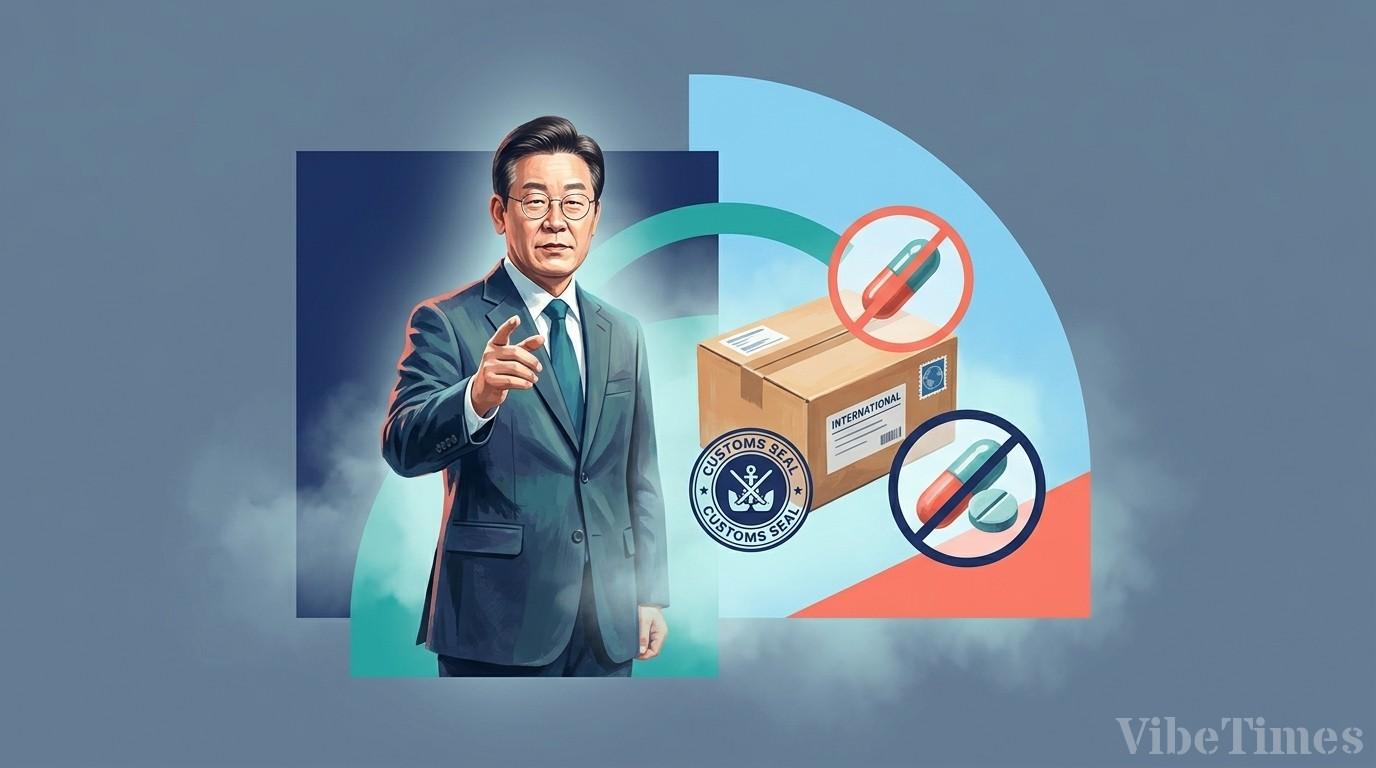
President Lee Jae-myung has characterized drug smuggling through international mail as "tantamount to surrender" and directly ordered its complete eradication.
The War on Drugs Targets Mail Parcels
The president made clear his view that drug smuggling entering through international mail channels constitutes a national security threat. Emphasizing that "drug smuggling via international mail is like surrendering" and that smugglers "will be caught without fail," he used the word 'surrender'—meaning giving up one's own defensive line—to frame the drug inflow problem not as mere crime but as a failure of the nation's defense system.
International mail has long been identified as a major vulnerability for drug smuggling due to its enormous inspection volumes and the difficulty of tracing senders. The 'ant export' method—splitting shipments into small parcels—makes it difficult to extend investigations to accomplice networks even after seizures. For smuggling organizations, it is a low-cost, low-risk experimental channel.
The directive carries particular significance as it came immediately after the president completed his five-night, seven-day trip to North and Central America. Having focused on diplomatic achievements during the trip—including a summit with the United States and a state visit to Mexico—the president named drug eradication as his top domestic priority right after returning home.
Linking Diplomatic Gains to Domestic Tasks
During the trip, the president attended the UN General Assembly and the South Korea-U.S. summit before moving on to Mexico, where he held talks covering cooperation on AI, critical minerals, and defense exports. The visit also carried the weight of being the first state visit by a South Korean president to Mexico in 16 years. However, the president's strong tone suggests his judgment that such external achievements would inevitably be dimmed if paired with holes in the domestic safety net.
In fact, drug inflows via international mail are a cross-border problem, making them inseparable from summit diplomacy. Without customs cooperation with drug origin and transit countries and logistics information sharing, domestic inspections alone have limits. Cooperation channels discussed with Mexico and others could well be extended into customs and investigative areas.
Notably, the president's approval rating has fallen to 30.6% in recent polls. With positive ratings stuck in the 30% range even among people in their 40s and 50s, surveys show signs of defection among middle-ground supporters. Accelerating action on livelihood and public safety issues with broad bipartisan consensus, such as drug eradication, reads as a strategy to not only consolidate his base but also win back centrist voters.
Firm Response Alongside Calls for Measured Pace
An interesting contrast also stands out. At a dinner meeting with Korean residents in Mexico, the president emphasized the need to adjust the pace and manner of reform, saying, "Moving too fast, too far, and too hastily invites backlash." While mentioning applying the brakes on structural reforms such as prosecutorial reform, he shifted firmly into gear on eradicating drug smuggling, declaring he would "catch them without fail." This is interpreted as a statement of priorities: moderating the pace of reform while responding immediately to matters concerning public safety.
The presidential office is expected to announce concrete implementation measures soon, including postal inspection personnel and equipment and international coordination among customs authorities. Given the nature of international mail, strengthened customs cooperation with the countries visited on the trip—such as the United States and Mexico—is highly likely to follow. Full inspection of all mail could produce side effects such as volume burdens and delivery delays, so a combination of technology-based screening and expanded information sharing is expected to be presented as the realistic alternative.
Eradicating drug smuggling is a task that rarely yields quick, visible results. However, each tangible achievement—released seizure figures, successful international cooperation—can improve public perceptions of public safety. Given the weight of a direct presidential directive, related ministries are expected to move faster on implementation.
On the other hand, tougher postal inspections risk triggering complaints from small business owners and consumers if they lead to higher logistics costs and delivery delays. Striking a balance between smuggling prevention and logistics burdens is likely to be the variable that determines the success of this directive.