National Assembly Data Analysis: Democratic Lawmakers Occupy Both Progressive and Conservative Extremes

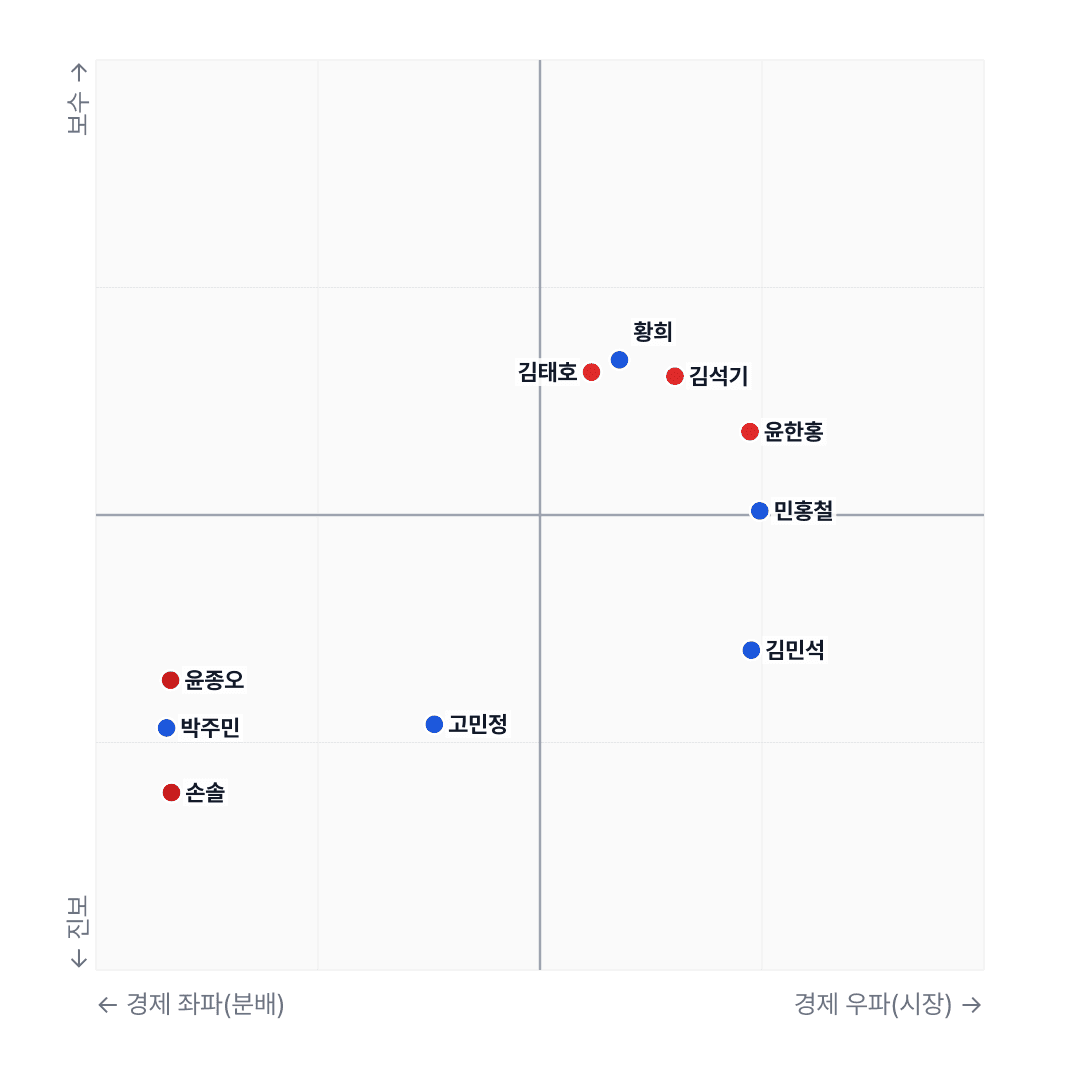
With the ideological gap between the most progressive and most conservative lawmakers on economic issues widening to a record high, analysis shows that a total of 56 lawmakers belong to these opposite extremes.
People at the Extremes
Based on a calculation of ideological leanings derived from bill sponsorship and voting records of the 20th National Assembly members, Rep. Park Joo-min of the Minjoo Party was identified as the most progressive on the economic axis. He was closely followed by Reps. Yoon Jong-oh and Son Sol of the Progressive Party, while Reps. Jong-duk Jeong and Hye-kyung Jung, also of the same party, were included in the most progressive group. Notably, four out of the five most progressive lawmakers belong to the Progressive Party. This is interpreted as a result reflecting the party's characteristics of concentrating on bills aimed at expanding labor and welfare.
The landscape is starkly different on the opposite end of the economic spectrum—the most conservative group. It was most unexpected to see Minjoo Party Reps. Min Hong-cheol and Kim Min-seok ranked in the top conservative tier. Their records show that, despite belonging to the ruling party, they frequently raised their hands in favor of deregulation and expanding corporate activity. The remaining three spots were occupied by People Power Party Reps. Yoon Hong-haeng, Lee Cheol-gyu, and Song Eon-seok. In short, while the Progressive Party and the People Power Party divide the two ends of the economic axis, Minjoo Party lawmakers are scattered fairly evenly across both sides.
Reversal on the Social-Cultural Axis
A similar pattern of polarization was confirmed on the social axis. Progressive Party Rep. Son Sol occupied the most progressive position, followed by Minjoo Party Reps. Park Joo-min, Ko Min-jung, Lee Yong-woo, and Kim Young-jin. Conversely, the top rank on the conservative side was Minjoo Party Rep. Hwang Hee. This means a ruling party lawmaker, rather than an opposition lawmaker, recorded the most conservative coordinates on the social-cultural axis. People Power Party Reps. Kim Tae-ho, Kim Seok-ki, and Jin Jong-oh, as well as independent Rep. Kim Byeong-gi, followed behind.
Here, an interesting pattern emerges. Within the Minjoo Party, Rep. Park Joo-min is positioned in the most progressive group on both the economic and social axes, whereas Reps. Min Hong-cheol, Kim Min-seok, and Hwang Hee stand at the conservative end of the economic and social axes, respectively. This implies that the legislative behavior of lawmakers from the same party is so split that it effectively resembles two different parties. In Rep. Park Joo-min's case, his frequent sponsorship of bills related to consumer protection and curbing large corporations is interpreted as the basis for his progressive coordinates.
Cross-Pressures and Misconceptions
A key point of interest in this analysis is the discrepancy between public image and legislative records. In media debates and political spectrum arguments, the figures frequently discussed do not always align with the map drawn by actual sponsorship and voting data. In particular, it is highly likely that economic conservatives within the ruling party accumulated coordinates by voting with the opposition party on industrial and corporate regulatory issues. This can be seen as the result of 'cross-pressures'—pressures to vote in a direction different from the party line—created by the economic structure of constituencies or activities in relevant standing committees.
However, these coordinates have the limitation of being mechanically converted values based solely on bill content and voting behavior. Since activities such as National Assembly audit questions or press statements are not reflected, the figures do not necessarily represent the lawmaker's entire political trajectory.
The Legislative Cost of Polarization
The fact that there are 56 lawmakers at the extremes is not a mere statistic. As the tendency for votes on key contentious bills to be pre-determined along party lines strengthens, the pool of lawmakers available for compromise in the middle thins out. The fact that the gap between the extremes on the economic axis is wider than on the social axis suggests a lower likelihood of consensus on 'livelihood' bills involving taxes, labor, and welfare.
Looking ahead, in future tax revisions and labor-related legislation, the extreme progressive bloc is expected to strongly push for enhanced distribution, while the extreme conservative bloc will push just as strongly for deregulation. Since both camps have built voting records favorable to rallying their support bases, they have little incentive to back down. During the latter half of the 20th National Assembly, whenever budget and reform legislation overlap, it is highly likely that these 56 individuals at the coordinate extremes will act as a 'wall' rather than a swing vote.
Lawmakers Mentioned in the Article
| Lawmaker | Party | Ideology | Notes |
|---|---|---|---|
| Park Joo-min | Minjoo Party | Economic Left · Social Progressive | Most Economic Left |
| Yoon Jong-oh | Progressive Party | Economic Left · Social Progressive | Most Economic Left |
| Son Sol | Progressive Party | Economic Left · Social Progressive | Most Economic Left |
| Yoon Hong-haeng | People Power Party | Economic Right · Social Conservative | Most Economic Right |
| Kim Min-seok | Minjoo Party | Economic Right · Social Progressive | Most Economic Right |
| Min Hong-cheol | Minjoo Party | Economic Right · Social Conservative | Most Economic Right |
| Ko Min-jung | Minjoo Party | Economic Left · Social Progressive | Most Social Progressive |
| Kim Seok-ki | People Power Party | Economic Right · Social Conservative | Most Social Conservative |
| Kim Tae-ho | People Power Party | Economic Right · Social Conservative | Most Social Conservative |
| Hwang Hee | Minjoo Party | Economic Right · Social Conservative | Most Social Conservative |