National Assembly Data Analysis: 7 Independents 'Left-Click' Past Opposition Party

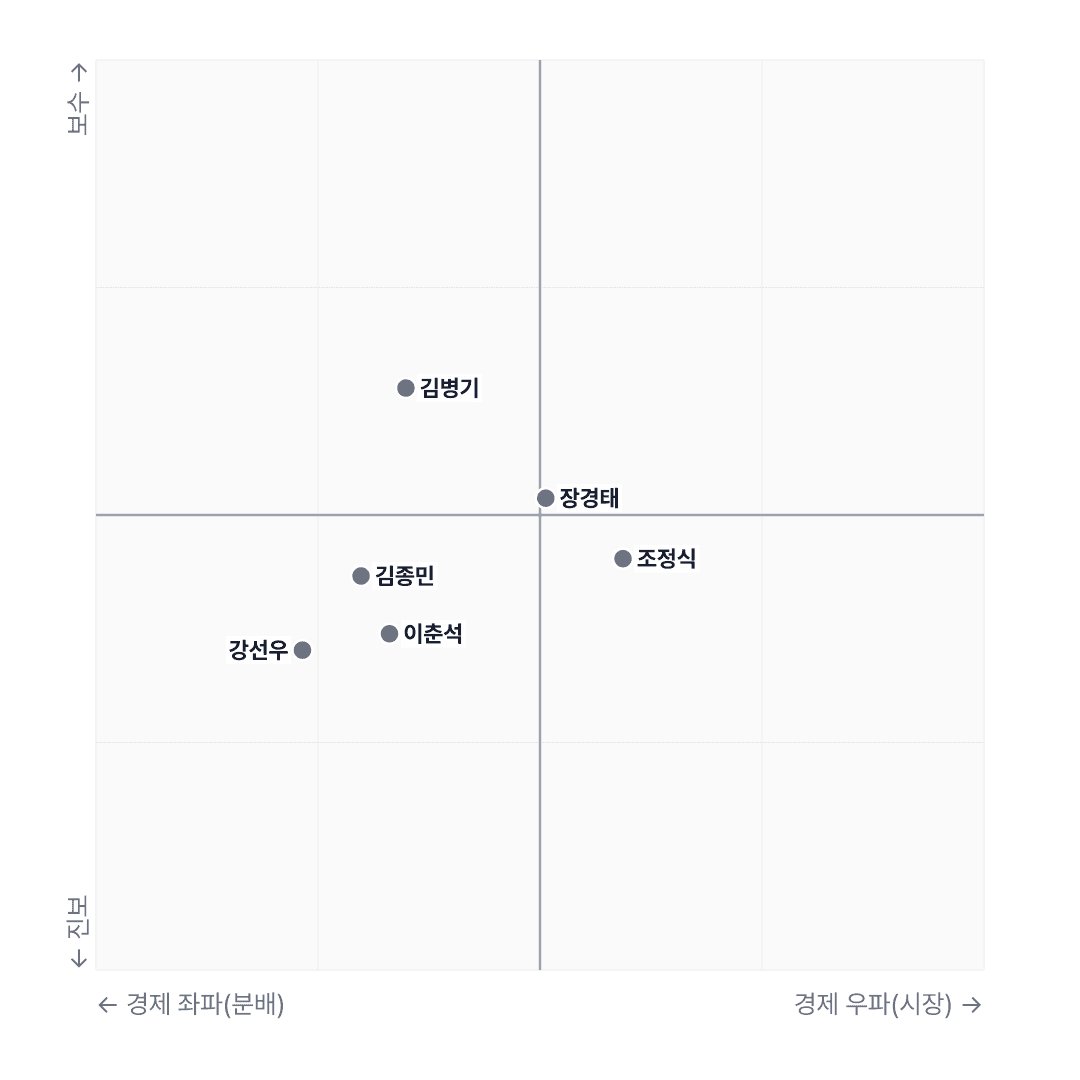
The economic orientation of the seven independent lawmakers places them on a more progressive trajectory than the major opposition party. A quantitative analysis of their legislative activities and voting records reveals a distribution skewed further left than the average National Assembly member across both economic and social domains. In particular, their progressive tendency in the economic sphere is more than twice as pronounced as in the social sphere, highlighting a strong policy focus on market regulation and redistribution. This suggests that their status as independents implies not merely a departure from party control but serves as a vehicle to implement a more distinct policy color.
Independent Lawmakers' 'Left-Click' Moves Emphasize Economic Distinction
Data indicates that the economic landscape of independent members lies further to the left than the average stance of the main opposition party. Among the seven, Rep. Kang Seon-woo exhibits the most progressive coloring in the economic sector. Rep. Kang prioritizes the strengthening of public nature and the protection of vulnerable classes in the process of proposing bills and voting, demonstrating the clearest left-wing tendency within the group. Following him, Rep. Kim Jong-min and Rep. Lee Choon-seok also displayed legislative conduct emphasizing economic equality and the role of the state, leading the independent bloc's progressive flow. Rep. Choi Hyuk-jin also aligns with this trajectory, maintaining a high level of progressiveness.
Conversely, relatively market-friendly or conservative voices exist even within the independent group. Rep. Jo Jeong-sik is the only one among the seven to show a right-leaning economic orientation, classifying him as the most right-wing figure among the independents. This implies that, unlike other independents, Rep. Jo has participated relatively more in legislative activities valuing corporate autonomy and market efficiency. Rep. Jang Gyeong-tae occupies a nearly centrist position in the economic realm, showing a tendency to make pragmatic choices depending on the issue. Rep. Kim Byeong-gi remains slightly left of center, striking a balance at the intersection of progressivism and conservatism.
This numerical distribution demonstrates that a gap may exist between the ideological image perceived by the public and the actual parliamentary activities of independent lawmakers. Substantive votes on bills and lists of proposed legislation explain their political identity more precisely than public popularity or the intensity of their remarks. The economic 'left-click' of the independent camp reinforces the possibility that they will act as a core dynamic supporting the opposition's hardline stance in future National Assembly budget reviews and tax policy discussions.
Policy Variables Created by Breaking from Party Lines and Charting Independent Courses
The presence of independent lawmakers becomes more distinct in the distance from party lines rather than in simple ideological coordinates. Freed from the binding force of political parties, these members dare to cast independent votes that go against the flow of the two major parties on specific issues, throwing variables into the market. The analysis shows that Rep. Choi Hyuk-jin recorded the highest rate of deviation from party lines, demonstrating the strongest independence among the independents. Reps. Lee Choon-seok and Jang Gyeong-tae also recorded high deviation rates, showing a strong tendency to make decisions based on personal convictions or constituency interests rather than party guidelines.
Rep. Kim Jong-min also recorded a significant level of party line deviation, proving the identity of the independent faction. Such deviant behavior is most prominent in economic bills where complex interests are intertwined. For instance, when conflicts arise between deregulation and regulation of specific industries, independent lawmakers tend to vote based on the values they uphold rather than the strategic calculations of their party. While this increases unpredictability for companies and investors, it also forces them to act as a casting vote that checks the unilateral dominance of the major parties.
However, such quantitative analysis has limitations as it is based on judgments derived from keywords contained in the titles and contents of bills, and thus may not reflect the actual political intent of the lawmakers 100%. It is a pure data indicator that does not consider the political situation or strategic choices at the time of voting. Nevertheless, repetitive voting behavior and tendencies in bill proposal provide the most reliable basis for reading the long-term policy direction pursued by the respective lawmaker.
Tangible Impact on Industrial Regulation and Legislative Risks
The progressive economic orientation of independent lawmakers is expected to act as a strong pressure factor in future legislation related to employment, welfare, and environmental regulations. In particular, if it is confirmed that a majority of independent lawmakers hold stocks in industries closely related to their standing committees or receive high donations from relevant sectors, there is a potential for conflict of interest controversies. This could not only cast doubt on the purity of the bills they propose but also translate into direct regulatory risks for related industries. The investment market must closely track these lawmakers' committee assignments and past voting records to prepare for policy changes.
A lawmaker's ideological coordinates are not a fixed entity but a dynamic result formed by the accumulation of the trajectory of each vote they cast. The leftward movement of independent lawmakers lends weight to the major opposition's policy drive while simultaneously leading to legislative attempts that go beyond party lines at times.
Moving forward, independent lawmakers are expected to reveal their presence by emphasizing their distinctiveness rather than forming a policy buffer zone between the two major parties. Their pronounced progressive tendency in the economic sector is likely to be expressed in strong voices on sensitive economic issues such as minimum wage, corporate tax, and carbon emission rights. Therefore, market participants need to observe the bill proposal patterns of individual independent lawmakers more meticulously than party-level analysis. Because their conscientious voting and independent legislation will serve as decisive variables determining the fate of key bills where success or failure hinges on a single vote or two.
Members Mentioned in Article
| Member | Party | Ideological Tendency | Remarks |
|---|---|---|---|
| Kang Seon-woo | Independent | Economic Leftist · Social Progressive | Intra-party Left |
| Kim Jong-min | Independent | Economic Leftist · Social Progressive | Intra-party Left |
| Lee Choon-seok | Independent | Economic Leftist · Social Progressive | Intra-party Left |
| Kim Byeong-gi | Independent | Economic Leftist · Social Conservative | Intra-party Right |
| Jang Gyeong-tae | Independent | Economic Rightist · Social Conservative | Intra-party Right |
| Jo Jeong-sik | Independent | Economic Rightist · Social Progressive | Intra-party Right |