Honeywell Tops Undervalued Large-Cap Blue Chips With a P/E of 8.0

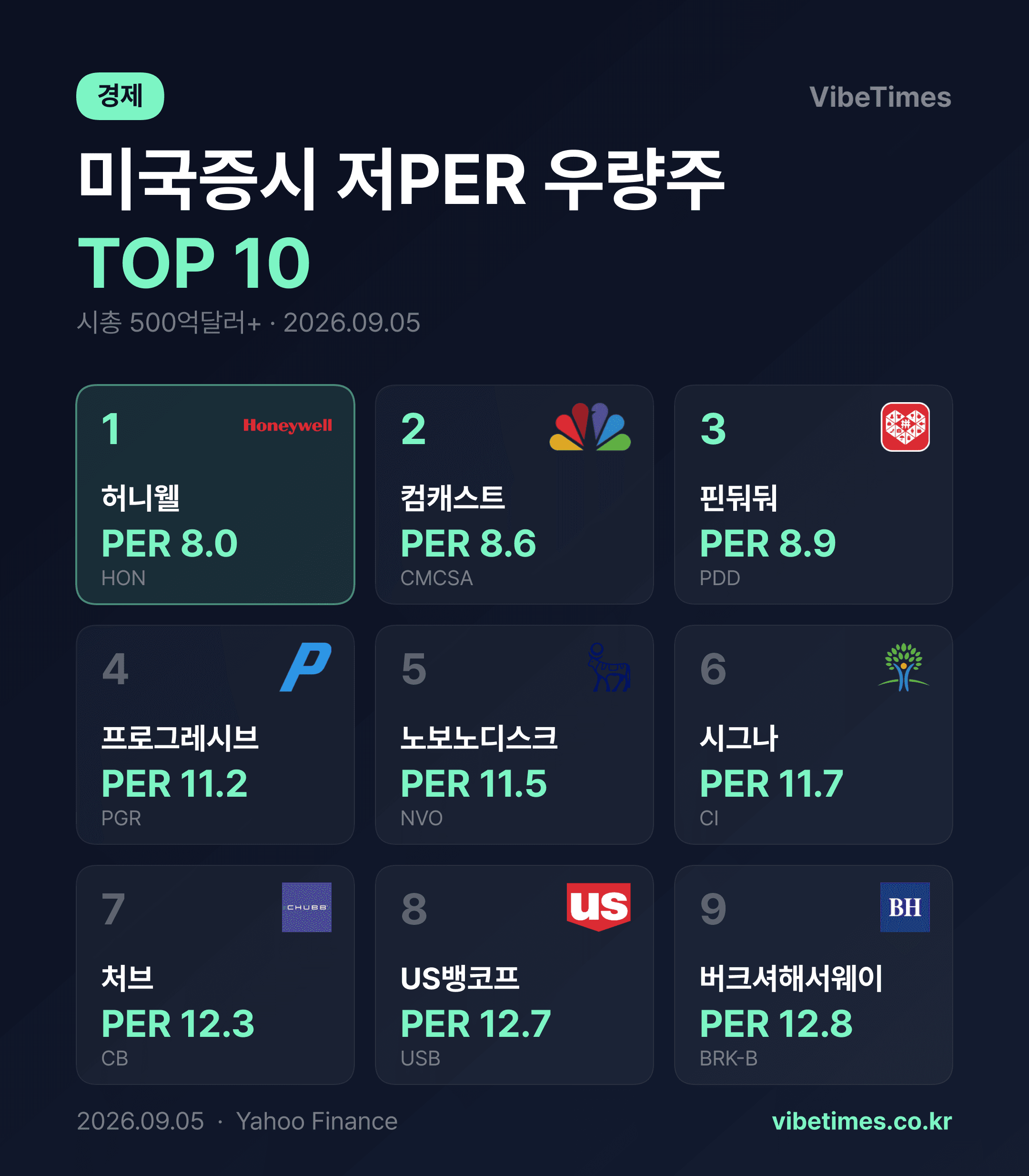
Honeywell posted the lowest P/E among U.S. large-cap blue chips at 8.0. In the ranking of low-P/E large caps on the U.S. market compiled as of Sept. 5, the company claimed the top spot with a market capitalization of $65.8 billion. A P/E of 8.0 — the share price divided by earnings per share — means that if current earnings hold, an investor could recoup the company's entire value with roughly eight years' worth of net profit. On the numbers alone, it is the blue chip the market has priced most conservatively.
Five of 10 Are Insurance and Financials… The Face of the List
Comcast (P/E 8.6, market cap of $94.6 billion) took second place, followed by Pinduoduo (P/E 8.9, market cap of $116.2 billion) in third. The sector makeup is the first defining feature of this list. Three insurers — Progressive, Cigna and Chubb — along with U.S. Bancorp and Berkshire Hathaway put financials at half of the 10 names. Berkshire, despite a market cap exceeding $1 trillion, placed ninth with a P/E of just 12.8. Accenture (P/E 15.0, market cap of $118.2 billion) fills the last seat at No. 10. The spread between first and 10th is 7.0 multiples, with the entire top 10 confined to a band running from single digits to the low teens. It is also worth noting that all 10 stocks moved within roughly ±0.03% — proof that the market was essentially standing still at the time the ranking was compiled.
The Same Discount, Different Reasons
The crux is that all three top names are clustered below a P/E of 9. Honeywell, Comcast and Pinduoduo are businesses of entirely different stripes, yet the market applied a similar discount to each. The reading is that Honeywell carries the structural discount typical of a conglomerate with multiple business units, Comcast reflects the low growth of a mature media business, and Pinduoduo bears the country-risk discount attached to Chinese consumer companies. The same number, in other words, encodes different reasons. Notably, Pinduoduo's market cap is 76% larger than Honeywell's, yet its multiple is 0.9 points higher — a textbook case of a company that cannot shake the discount regardless of its size.
Novo Nordisk's presence at No. 5 (P/E 11.5, market cap of $210 billion) also reveals the character of the list. That a company once treated as a premier growth stock amid the obesity-drug boom has fallen to a low-teens multiple suggests the market has likely priced in weakening growth momentum ahead of time. A low P/E is an opportunity if earnings back it up; if not, it remains a value trap that is cheap for a reason. The entire top 10, from 8.0 to 15.0, stands on this double-edged sword.
Re-Rating or Value Trap?
Viewed through an investment lens, the ranking offers two paths. One is the re-rating scenario. The lineup, half of it insurers, reads as a sign that the market does not yet believe the improvement in investment income from high rates will last. To the extent that skepticism fades, there is room for the multiples to recover. The other path is earnings. The single-digit P/E range is also a sensitive zone where even a slight wobble in the earnings outlook can flip an investment judgment. That large financial stocks are pinned at such low multiples is further evidence that institutional money remains crowded into growth stocks. Two variables — the path of interest rates and third-quarter earnings — are expected to determine how this ranking evolves.
“Don't be afraid to give up the good to go for the great.” — John D. Rockefeller
Rendered into the language of investing, Rockefeller's maxim says this: a low P/E is the price the market assigns to a company it sees as merely good today. Whether that discount amounts to a re-rating back toward greatness or a stagnation that is cheap for obvious reasons — sorting that out is the task that falls to investors reading this list.