Yoon Joon-byung Tops Assembly Bill Sponsorship With 347, but the Count Isn't the Achievement

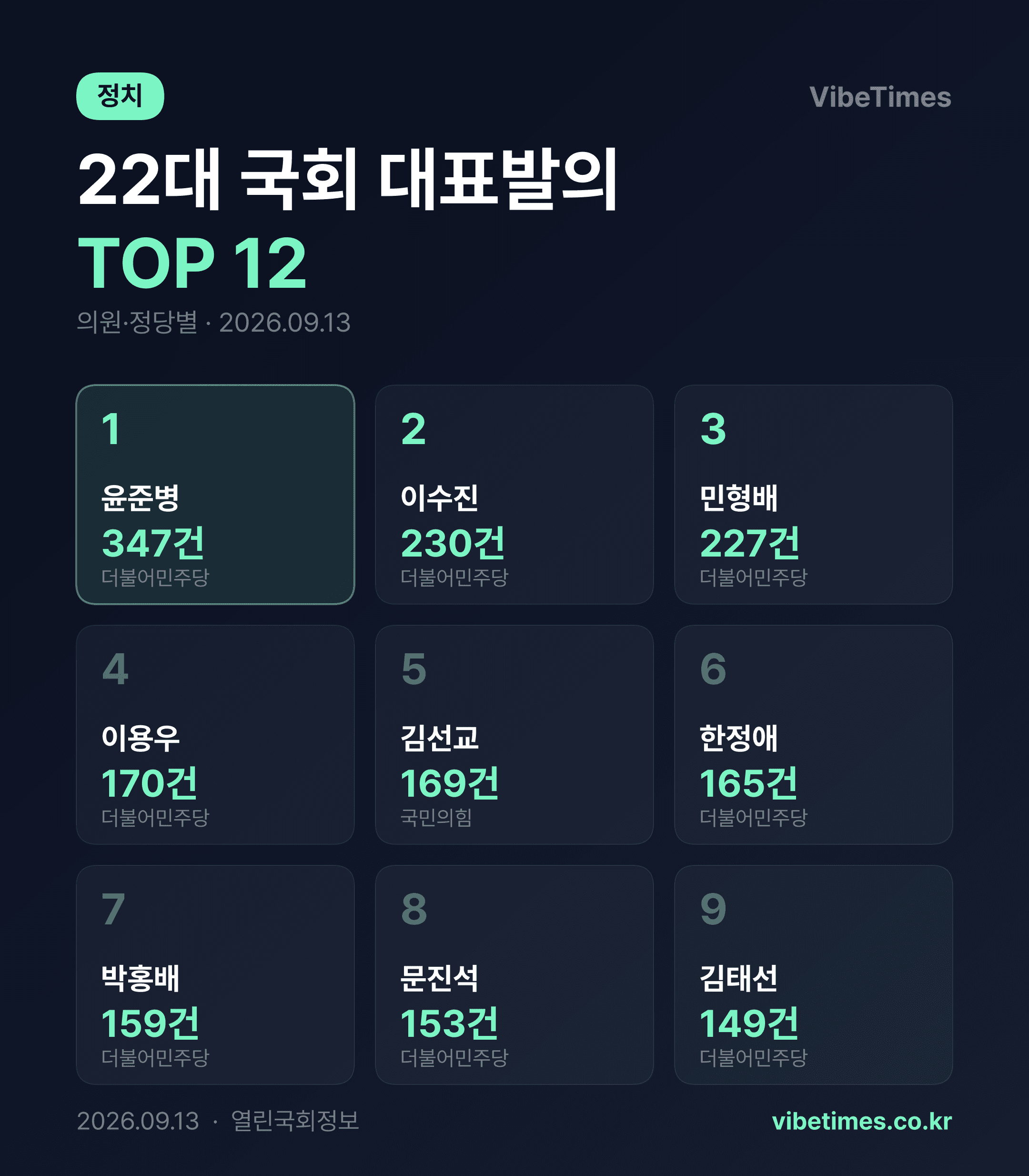
The figure of 347 is not a record but a question. In the 22nd National Assembly rankings for bills principally sponsored, compiled as of September 13, 2026, Democratic Party of Korea lawmaker Yoon Joon-byung sits at the top with 347. The problem is what that number actually proves, because sponsoring a bill is only the starting line of legislation, not a finish-line time.
Democrats Hold 9 of the Top 12 Spots
Data published on the National Assembly's bill information system shows the top of the rankings was swept by the Democratic Party. Yoon Joon-byung (347 bills), Lee Soo-jin (230) and Min Hyung-bae (227) gave the party a clean sweep of the top three, and nine of the 12 belong to the same party. Only three People Power Party lawmakers made the list: Kim Sun-kyo (fifth, 169 bills), Kim Ye-ji (10th, 143) and Kim Sung-won (12th, 138). The top three's combined total of 804 bills amounts to 36.7 percent of the 2,191 bills logged across all 12.
There is a structural reason behind the hierarchy. Lawmakers from the majority party, which commands more than half the seats, hold the advantage in standing committee assignments and agenda-setting, giving them far more opportunities to be listed as lead sponsors. Minority-party members, by contrast, must route their bills through cross-party consultations or coordination with government proposals, which caps their numbers. Even Kim Sun-kyo's 169 bills, the People Power Party's best, trail the leader by 178.
What a Bill Every Two Days Nails Down
Principal sponsorship means serving as lead sponsor — the first name in the signature line of a bill submitted jointly by several lawmakers. About 27 months have passed between the 22nd National Assembly's opening in June 2024 and this tally. Divide 347 bills across that span and it comes to roughly 13 a month, or one new bill every two days or so.
But speed guarantees nothing when it comes to passage. In past assemblies, a large share of bills that never cleared review were automatically scrapped when the session ended. The sponsorship rankings do not screen out those discarded bills. Reviving a bill that died in the previous session, or splitting a single issue into multiple bills, pads the tally all the same. That is why leading on volume does not translate directly into substantive legislative capability.
Truth often becomes a terrifying weapon. With truth alone, one can tell lies.
Apply psychologist Alfred Adler's warning to legislative statistics and this is what it reads: the fact of 347 bills is accurate. But declaring someone the most legislatively diligent lawmaker on that fact alone lets the truth of the number paper over a misreading. That said, sponsorship volume is not worthless. The ability to respond to every erupting issue with a bill on the spot is proof of legislative energy, and the 200-plus tallies of Lee Soo-jin and Min Hyung-bae reflect the same rhythm.
A Growing Backlog, and Ripples Beyond the Numbers
When sponsorship outpaces processing, the return is a legislative bottleneck. The top 12 alone have 2,191 bills queued for standing committee review, and the strain builds at final gateways such as the Legislation and Judiciary Committee. When bills bearing directly on business activity — regulation, taxation, labor — pile up on the pending list, industry, too, must shoulder the cost of reading where revisions are headed. This is not a statistic that ends at the rankings table.
The shape of the race is also coming into view. Lee Yong-woo of the Democratic Party has 170 bills and Kim Sun-kyo of the People Power Party has 169 — a gap of just one. That a minority-party lawmaker stands shoulder to shoulder with the majority's fourth-place finisher is read as a signal that he has built a co-sponsorship network that crosses party lines.
The Yardstick Shifts From Filing to Passage
About a year and eight months remain until the 22nd National Assembly's term expires. There is ample room for the rankings to shuffle, as the one-bill duel between fourth and fifth place shows. But as the term moves into its latter stages, the axis for judging individual lawmakers is expected to shift from bills filed to legislative results. Voters heading toward an election will ask not how many bills a lawmaker submitted, but how many were passed.
Whether Yoon Joon-byung's 347 bills become an asset or a liability will be settled by plenary votes. The National Assembly's report card, in the end, is likely to be graded not by stacks of paper but by the number of laws completed.