National Assembly Data Analysis: Two-Thirds of PPP Lawmakers Fall in Conservative Range

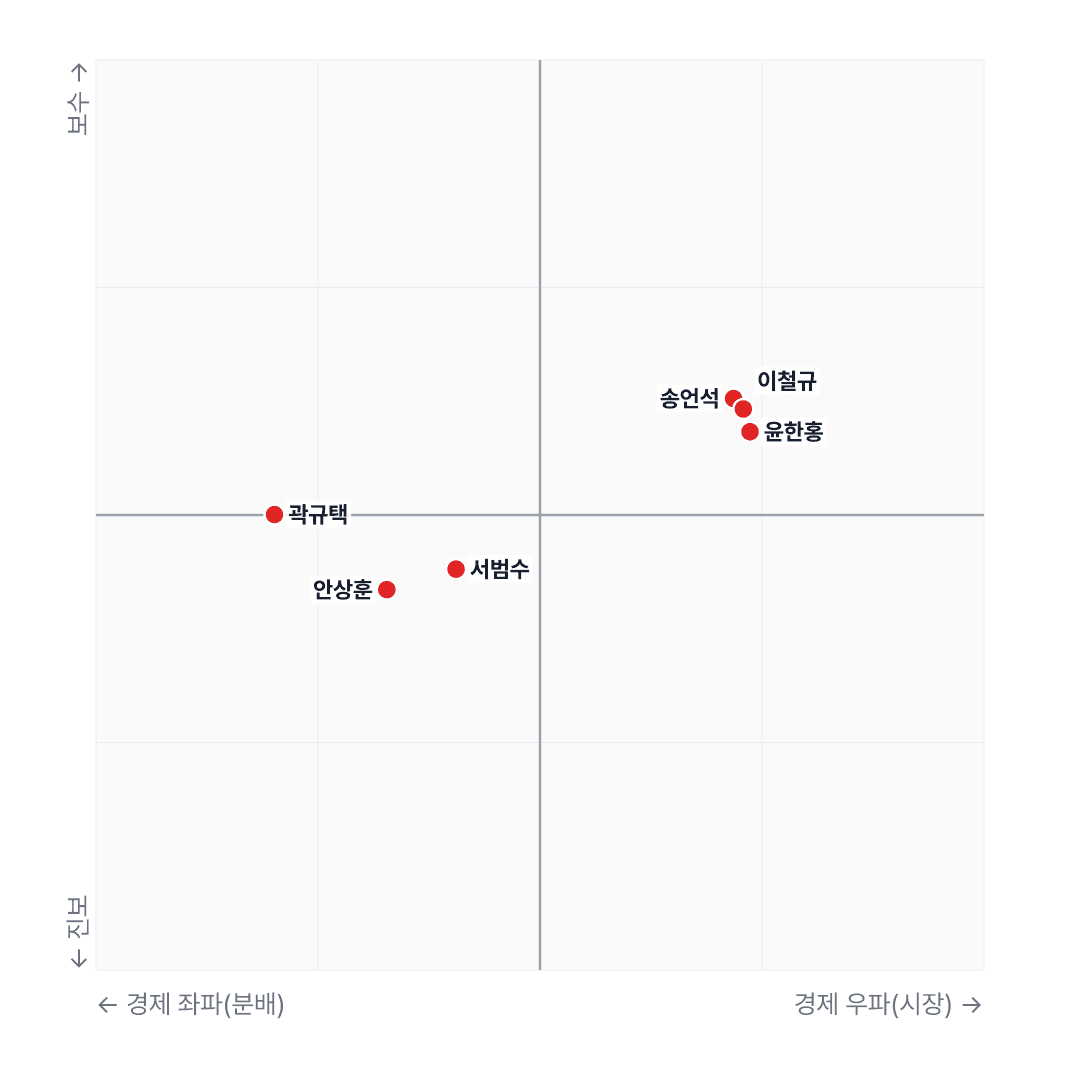
The Face of Yeouido's Conservative Party, Seen Through Data
Of the 105 members of the People Power Party (PPP), two-thirds cluster in the upper range of conservative ideology on the ideological spectrum. This is not a vague impression but the result of machine-analysis of bill sponsorships and voting records, quantifying each lawmaker's left-right orientation. While a politician's words may waver, signatures and button presses leave a permanent record — and digging into that record reveals an ideological landscape quite different from appearances.
The analysis works by having a model assess the content of each lawmaker's sponsored bills, calculating a weighted average, then calibrating it against the midpoint of the major ruling and opposition parties. In other words, a score of zero — neither left nor right — represents the exact center between the two main parties. On this scale, the PPP's overall average tilts conservative, i.e., rightward, on both economic and social dimensions, but the tilt is milder than one might expect. There is a gap between the intuition of a radically skewed party and what the data shows.
Three PPPs Within One Party
The most right-leaning members are Yoon Han-hong, Lee Chul-gyu, Song Eon-seok, and Kweon Seong-dong, in that order. This upper group sits on a considerably more conservative axis than the party average. The issue is that party seats are concentrated in this narrow upper tier. Roughly two-thirds of the 105 members are packed into the conservative band at or to the right of the party average. The party's center of gravity, in other words, sits well to the right of the middle.
The opposite end paints a different picture. Rep. Kwak Kyu-taek was measured squarely in left-wing territory — close to the opposition average. Reps. Ahn Sang-hoon, Seo Beom-su, and Shin Sung-beom also position slightly left of center. They are a minority, but they demonstrate that a party's strategy of targeting centrist voters in presidential and general elections does not always match its internal ideological reality. Within a single party exists a left-right spectrum that defies conventional assumptions.
What the List of Party-Line Defectors Reveals
Separate from the ideological coordinates, the list of highest party-line defection voting rates is also telling: Han Ki-ho at 3.4%, Kang Sun-young at 3.2%, Park Soo-young at 2.9%, and Kim Seung-soo at 2.6%. The percentages may look trivial, but in races where a ruling-party candidate's support hinges on decimal points, defections of around 3% are anything but small.
Notably, this list does not overlap with the left-leaning ideological list. Rep. Kwak Kyu-taek is the most left-wing member of his party ideologically, yet he does not appear among the top defectors. This may mean that while his bills carry progressive intent, he maintains party discipline when votes are called. It is evidence that the ideology expressed through sponsorship and the discipline upheld through voting are distinct behaviors. It also suggests that standing committee activity and voting patterns must be examined together — in other words, judging a lawmaker by a single metric yields significant error.
The Centrist Space Remains Empty
The implications of this landscape for the political market are clear. If voters are densely distributed at the center, a party structure in which two-thirds cluster in the conservative upper range could pose a structural constraint on expanding toward the middle. On the other hand, the moderate left flank occupied by Kwak Kyu-taek and Ahn Sang-hoon represents a centrist experiment the party has carved out for itself. Whether this space grows or is absorbed into the conservative upper bloc will be a key variable shaping the party's candidate strategy in upcoming general and presidential elections.
Of course, the limits of this analysis are clear. The coordinates are merely quantitative measures based on sponsorship and voting behavior; they cannot capture a politician's public image as perceived by voters, nor their commentary or media activities. Just as success can come down to a moment of seconds, a lawmaker's left-right orientation is ultimately the accumulated result of signatures and button presses cast session after session. The data has merely extracted that accumulated record into numbers for the first time.
Lawmakers Mentioned in the Article
| Lawmaker | Party | Ideological Orientation | Notes |
|---|---|---|---|
| Kwak Kyu-taek | People Power Party | Economic left · Social conservative | Party's left wing |
| Ahn Sang-hoon | People Power Party | Economic left · Social progressive | Party's left wing |
| Seo Beom-su | People Power Party | Economic left · Social progressive | Party's left wing |
| Song Eon-seok | People Power Party | Economic right · Social conservative | Party's right wing |
| Lee Chul-gyu | People Power Party | Economic right · Social conservative | Party's right wing |
| Yoon Han-hong | People Power Party | Economic right · Social conservative | Party's right wing |