Democratic Party Ranks First with 11,254 Bills Sponsored

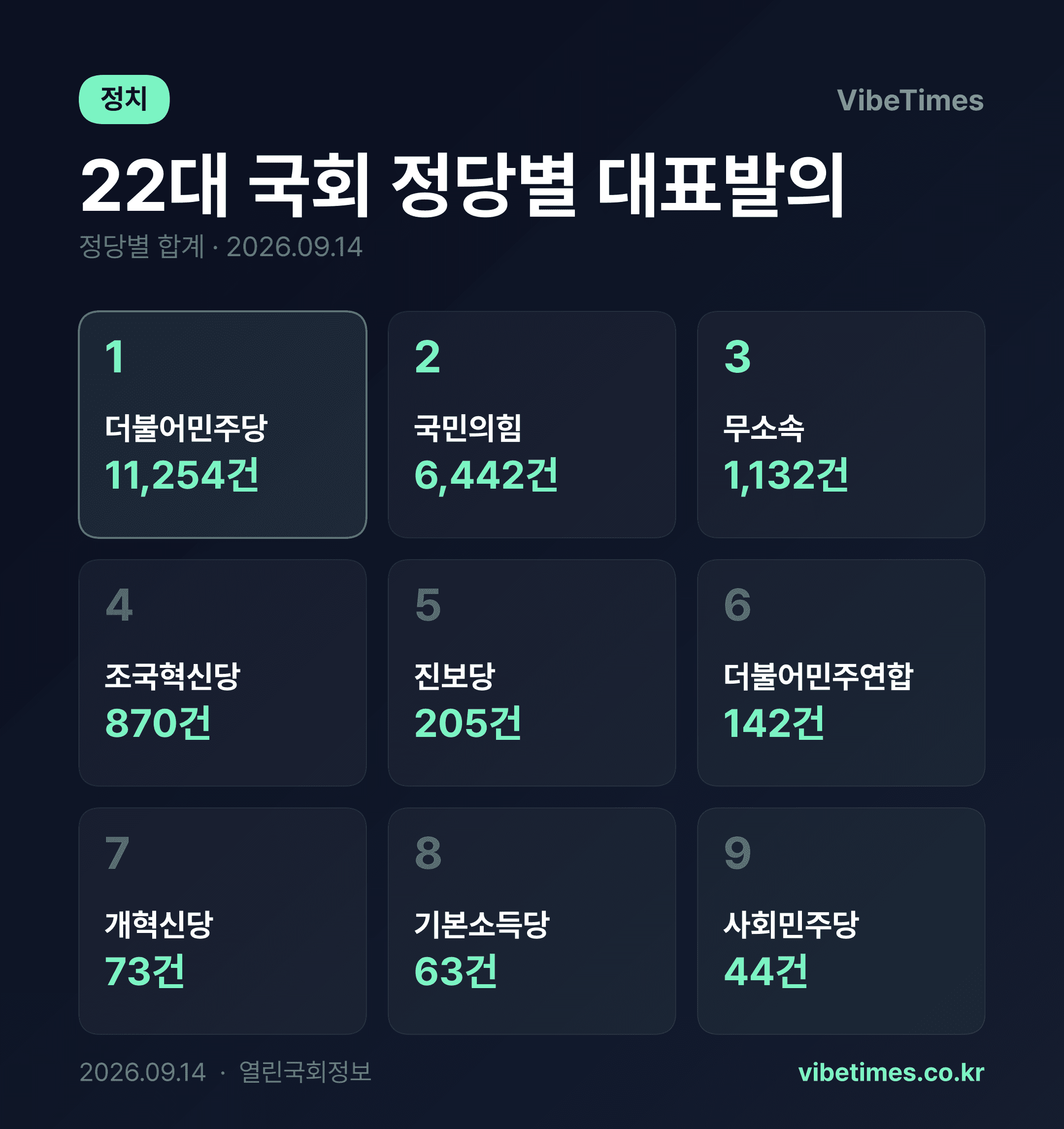
The Democratic Party of Korea has surpassed 10,000 bills sponsored as lead author in the National Assembly.
According to statistics on bill sponsorship by party compiled as of September 14, 2026, the Democratic Party recorded a total of 11,254 bills, opening a gap of 4,812 over the second-place People Power Party (6,442). In terms of the gap alone, that amounts to roughly 75 percent of the PPP's total. Benjamin Franklin once said that "half a truth is often a great lie," and sponsorship counts, too, are easily misread when only half the picture is seen. After all, the number of bills introduced is not the same as legislative achievement.
The Overwhelming Weight of the Two-Party Landscape
Combined, the top two parties account for 17,696 bills — about 91 percent of all bills introduced by the ten parties. The remaining eight parties together managed barely more than 2,200 bills. The structural reality of Korean politics revolving around two dominant parties is confirmed once again in the legislative statistics.
Looking down the rankings, even parties belonging to negotiating groups in the Assembly show little presence. The sixth-place Democratic Alliance of Korea (142 bills) and tenth-place People's Future Party (20) — given their nature as satellite proportional representation parties — are interpreted as having been driven less by actual legislative intent than by building political justification. The seventh-place Reform Party (73), eighth-place Basic Income Party (63), and ninth-place Social Democratic Party (44) all failed to reach triple digits.
What 1,132 Independent Bills Say
A notable point is the third-place finish of independents, with 1,132 bills. That lawmakers without party affiliation out-introduced the fourth-place Rebuilding Korea Party (870) is evidence of the weak legislative momentum of minor parties. When systematic bill production at the party level fails to materialize, a reversal occurs in which individual lawmakers' voluntary initiatives outpace party strength.
Still, the number of bills introduced is only the starting point of the legislative process. Real legislative capacity can only be judged by looking at plenary votes and passage rates alongside introductions. Active sponsorship reflects agenda-setting ability and policy competitiveness, but it can also signify a backlog of bills that failed to pass.
Volume Is Not the Same as Achievement
The Democratic Party's surpassing of the 10,000 mark means more than a confirmation of numerical superiority. It demonstrates that agenda control backed by a majority of seats operates just as powerfully in bill sponsorship. The PPP's 6,442 bills, meanwhile, can be read as the minimum level of activity needed for an opposition party to maintain its role of offering policy alternatives.
The key going forward will be not the numbers but the passage rate. How many of the bills introduced actually become law, and how much those laws improve citizens' daily lives, will be the yardstick for evaluating legislation in the latter half of the 21st National Assembly. As Diana Ackerman put it in her metaphor about sunshine, legislation only has value when it works — not when it is merely submitted.