The Biggest Wild Card in President Lee Jae-myung's Press Conference: A Constitutional Amendment for Reelection

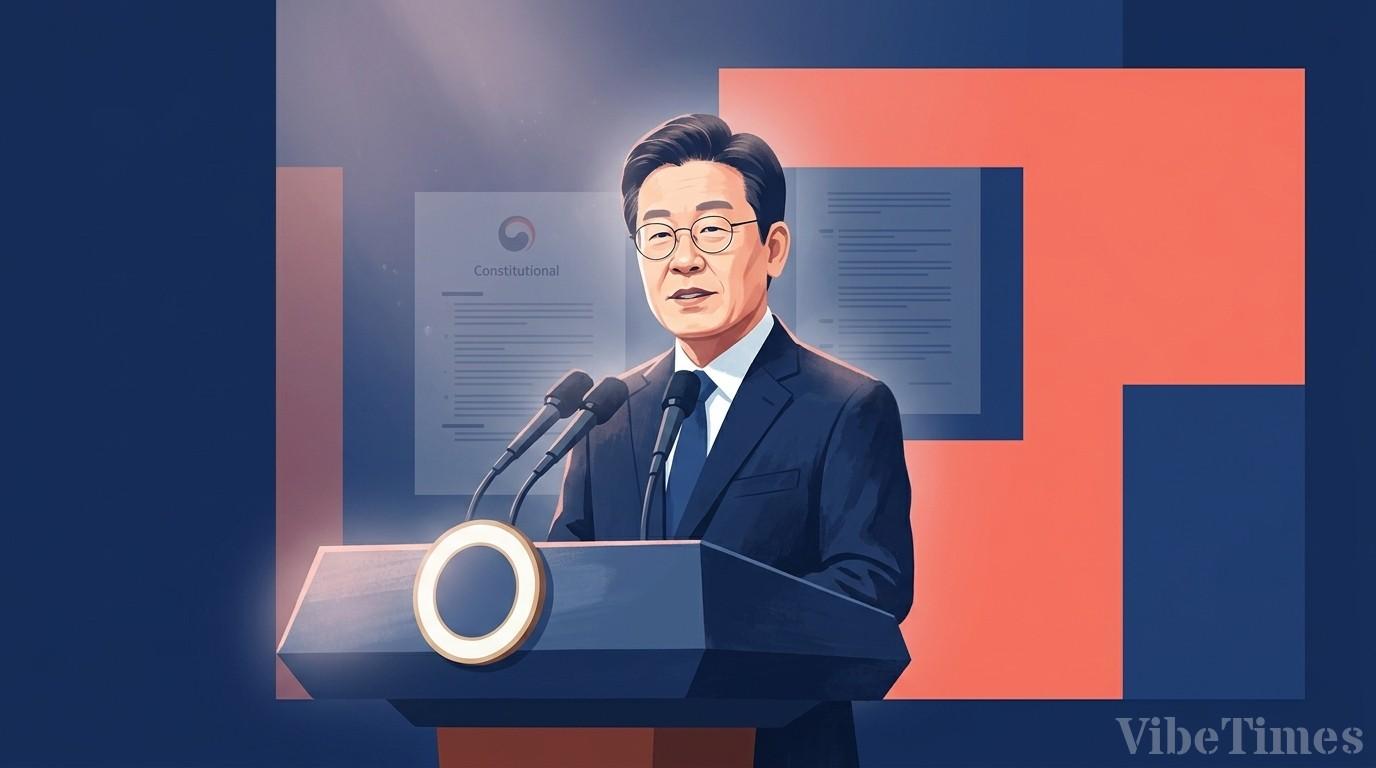
A constitutional amendment allowing reelection is the biggest variable at today's press conference.
President Lee Jae-myung will hold his seventh press conference since taking office at 10 a.m. on the 18th at the Yeongbin Hall of the Presidential Office. Sung Ki-hong, senior presidential secretary for public communication, previewed the event on the 15th, saying the president would "clearly state and explain his position and direction on major issues to the public." Constitutional amendment, personnel controversies, and the deployment to the Strait of Hormuz are all on the list of expected questions, but there is one topic on which both ruling and opposition parties are on high alert: the reelection amendment, which the People Power Party has denounced as "remarks that leave open the possibility of President Lee's reelection," and whether charges in cases involving the president will be dropped.
Why the Reelection Amendment Is an Issue
Under the current constitution, the president serves a single five-year term. Discussions of constitutional amendment are therefore not merely a matter of institutional design—they are directly tied to President Lee's political future. The issue became further entangled with judicial risk when Justice Minister nominee Kim Seung-won stated that he opposes granting a special prosecutor in cases involving President Lee the authority to withdraw indictments. As pressure from the ruling party on the judiciary grows, the People Power Party has continued its offensive, demanding that President Lee's trials resume.
Lee Chung-jae's column raised the question of the success threshold for "a president with three-quarters of his term remaining," examining the political standoff surrounding the confirmation hearing for nominee Kim Seung-won. The column assessed that Rep. Han Dong-hoon crossed a line when he said in a broadcast interview, "I am certain that if Kim Seung-won is appointed, President Lee will not finish his term." The interpretation is that the hearing has become a front line in the race for the next presidential election, given that the opposition party's mere statement of position can be read as a threat to the president's term.
The Backdrop Created by the Judicial Reform Sprint
On the 17th, the day before the press conference, the National Assembly passed 70 bills, including 51 follow-up measures related to the prosecution, driven by the ruling party. With the abolition of the Prosecutors' Office and the launch of the Serious Crimes Investigation Office and the Public Indictments Office set for the 2nd of next month, bills passed included an amendment to the Serious Crimes Investigation Office Act assigning it supplementary investigations into seven categories of crimes against vulnerable groups. President Lee had earlier ordered additional vetting of Serious Crimes Investigation Office chief nominee Kim Ji-yong, and had also directed revisions and improvements to the proposed organizational plan for the Public Indictments Office.
The problem is speed. The opposition blasted the overhaul as "patchwork judicial reform"—"eliminating investigative powers and slapping on exceptions." Voices are divided even within the ruling party. Rep. Lim Mi-ae noted in an interview that "Prime Minister Kim Min-seok should focus far more on unifying the party," hinting that the handling of allegations against President Lee could burden the party. Coupled with Rep. Lee Kwang-jae's description of the president's falling approval rating as "an orange light just before red," anxiety inside and outside the ruling camp is tightening the mood ahead of the conference.
What the President Must Address
Two things are key. First, whether to leave the reelection amendment door open or shut it. If the president does not draw a clear line against the opposition's interpretation of his "remarks leaving open the possibility of reelection," the amendment debate will remain a source of political friction throughout his term. Second, his stance on his own trials. With the ruling party's argument that withdrawing indictments would "destroy the system by allowing the judiciary to act unilaterally" clashing head-on with the opposition's demand to "resume the trials," which side the president leans toward will likely determine the direction of judicial reform.
Personnel issues will also be hard to avoid. The criticism that 18 of the 25 confirmation hearings for the Lee Jae-myung administration's Cabinet nominees proceeded with "zero witnesses" sits at the center of the Lim Sook controversy. Given the president's track record of wielding the whip—as when he ordered "strict accountability" over allegations that former Police Chief Seong Dong-seo used his official car for private purposes—questions are expected about the consistency of his standards when it comes to his own camp.
Outlook: A Single Sentence Could Open the Amendment Chapter
If President Lee makes clear his negative stance on the reelection amendment, the opposition's grounds for attack weaken; if he stays vague, the amendment debate will likely become the axis of the next political chapter. With three-quarters of his term remaining, the amendment issue is a factor that scatters the momentum needed to push his agenda forward. As Tori Birch said, there is no overnight success. Whether the president completes his term will likewise be decided not by a single sentence at today's press conference but by the accumulated persuasion and trust that follow. Even pressing policy issues such as the deployment to the Strait of Hormuz and real estate will set the temperature of the next phase depending on how persuasively they are handled at this conference.