Won-Dollar Exchange Rate Hits 1,542 Won, Then Swings Sharply Back to the 1,400-Won Range

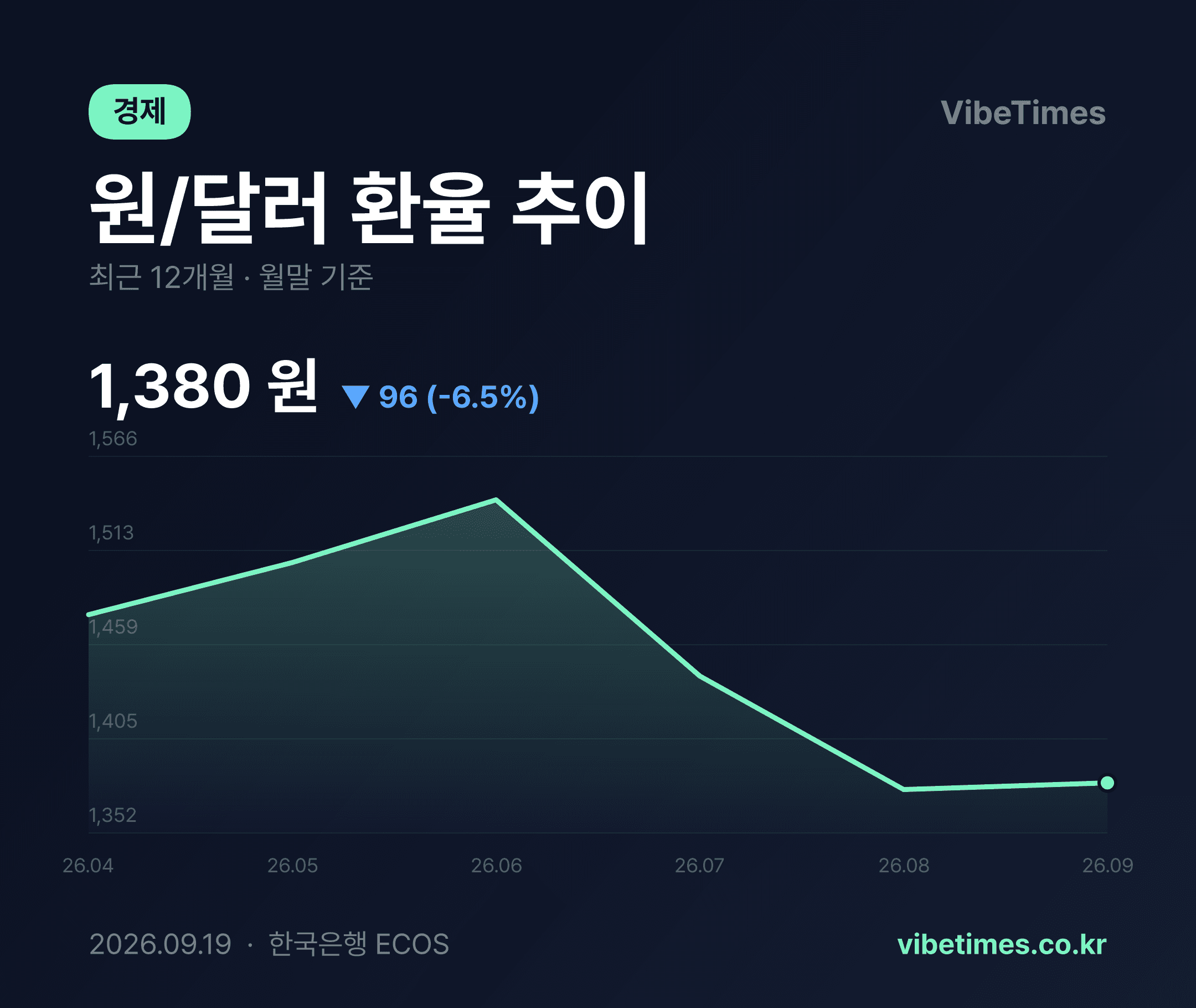
The won/dollar exchange rate peaked at 1,542 won in June, then staged a sharp reversal, falling 162 won to 1,380 won in just three months.
Measured by the Bank of Korea's month-end market average rate, the exchange rate traced a pronounced inverted V-curve over the past six months. After rising for three straight months — from 1,476 won in April to 1,506 won in May and 1,542 won in June — the rate turned lower in July to 1,441 won and dropped further to 1,377 won in August. It edged back up to 1,380 won in September, but remains essentially at a low level. Over the full period, that amounts to a 96-won decline, or roughly a 6.5% drop.
Why Did the Rate Hit 1,542 Won in June?
Behind the steep first-half climb was a combination of dollar strength and unstable domestic supply-demand conditions. Once the rate breaks above the 1,500-won mark, import prices rise and pressure to write down won-denominated assets mounts simultaneously, so the June month-end print of 1,542 won is interpreted as having moved within the currency authorities' intervention threshold. On paper, that is a 66-won rise in three months from April — a swing large enough to rank among the bigger moves seen in the foreign exchange market over multi-month stretches.
During periods when the rate climbs by roughly 20 won a month on average, corporate currency-hedging costs and selling pressure from foreign investors on won-denominated assets typically build in tandem. In fact, the longer the high-rate stretch lasted in the first half, the more likely it is that market participants' defensive responses intensified, creating a dynamic in which the rally ultimately braked itself.
What the 165-Won Drop in July and August Means
The period to watch is July and August. Over those two months, the rate fell 165 won from 1,542 won to 1,377 won — a larger decline than the 96-won drop over the entire period. In other words, once the downtrend began after June, it moved fast enough to erase the entire first-half gain in just two months.
Such abrupt declines usually occur when dollar weakness and improved won supply-demand conditions kick in at the same time. A typical pattern: rising expectations of U.S. rate cuts diminish the dollar's appeal, capital flows back into emerging markets, and the won strengthens. The August low of 1,377 won — a six-month low — reads as a signal that the exchange rate has shifted from an uptrend into a downtrend.
The 3-won rise to 1,380 won in September is more naturally interpreted as the trend entering a consolidation phase than as the downtrend ending. Even accounting for the fact that this is a month-end figure rather than an intra-month reading, a swing of just 3 won suggests the market is still feeling out a new direction.
What It Means for Exporters and Investors
A 6.5% decline in the exchange rate affects sectors very differently. For exporters, it translates into reduced won-denominated value of dollar-based revenues. Conversely, import-oriented industries such as airlines, energy, and overseas consumer goods can expect improved cost structures from the stronger won. With the rate now below 1,400 won, exporters face a point where hedging strategies need to be redrawn to protect margins.
For investors, the direction of the exchange rate is directly tied to capital flows in the domestic stock market. During periods of won strength, foreign capital inflows tend to continue, acting as a tailwind for won-denominated asset valuations. That said, as September's modest rebound shows, the downtrend will not move in a straight line.
Going forward, the exchange rate is expected to hinge on the direction of U.S. monetary policy, international oil prices, and fluctuations in Korean exports. Given that the recent three-month decline averaged around 80 won per month, the key line between stabilization and further volatility likely lies between 1,350 and 1,420 won. Looking back at the swings since April, a practical takeaway for investment strategy is that even when the rate moves in one direction, the trend can reverse within two to three months.