Han Ki-ho Tops National Assembly Conscience Voting Rankings with 3.4% Defection Rate
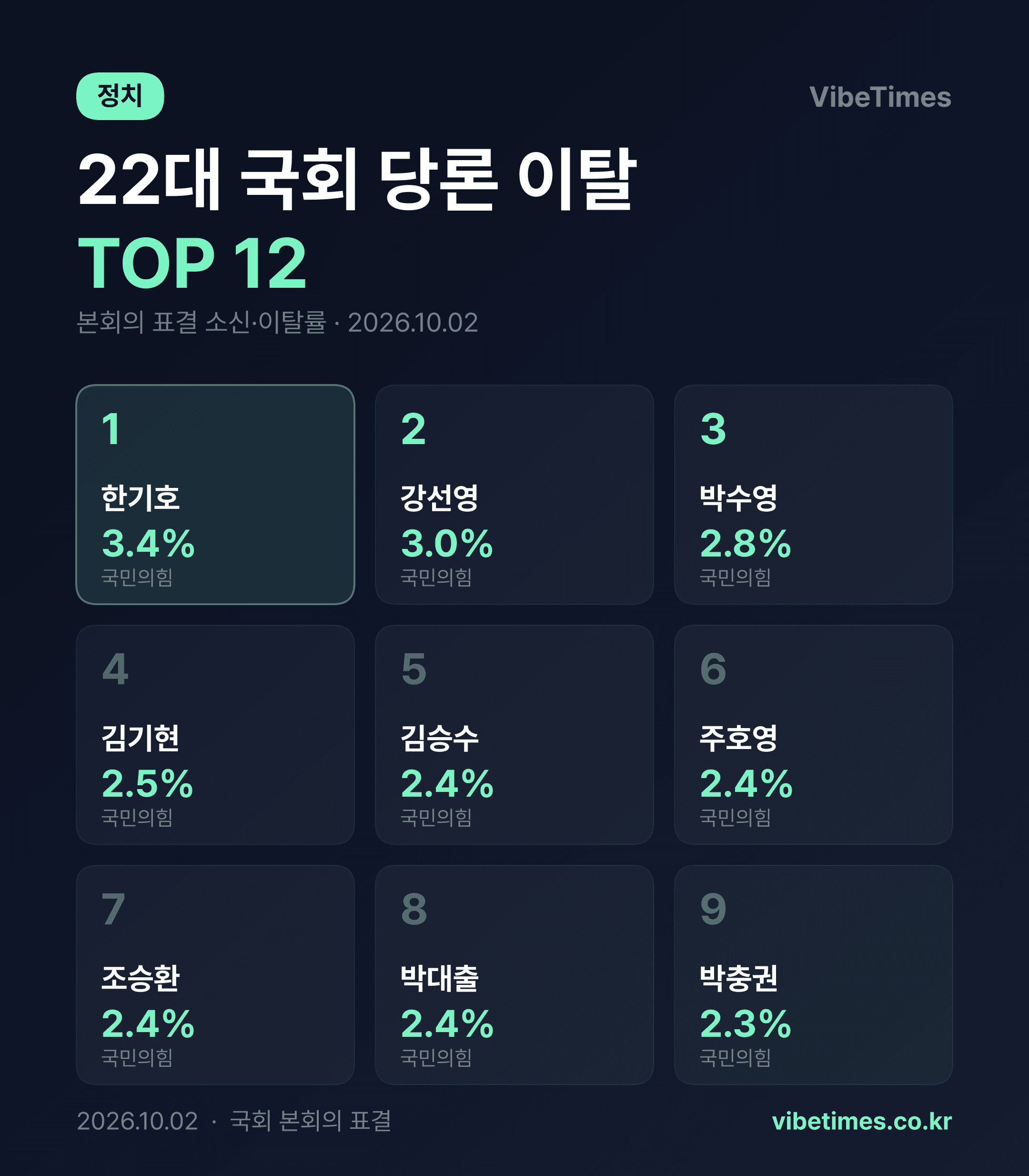
Rep. Han Ki-ho of the People Power Party has risen to the top of the National Assembly's conscience voting rankings with a party-line defection rate of 3.4%.
What a 3% Defection Rate Means
In South Korea's National Assembly, the party-line defection rate is a metric that rarely climbs very high. Party discipline is strict, and the leadership issues directives right up until floor votes, leaving most lawmakers with defection rates hovering around 1%. Against this backdrop, exceeding 3% means a lawmaker voted according to conscience on a substantial number of roll calls. Han Ki-ho's 3.4% is best understood in relative terms.
Second-place Rep. Kang Sun-young recorded 3.0%, and third-place Rep. Park Su-young 2.8%. From fourth-place Rep. Kim Ki-hyun onward, the figures drop below 2.5%, opening a slight gap with the top three. Ranks five through eight—Reps. Kim Seung-su, Joo Ho-young, Cho Seung-hwan, and Park Dae-chul—are tied at 2.4% apiece. Rep. Park Chung-kwon follows in ninth at 2.3%, Rep. Choi Su-jin in tenth at 2.2%, and Reps. Kim Jae-seop and Lee Jong-uk round out the bottom of the list at 2.1% each.
Dominance of the People Power Party at the Top
Structurally striking is the fact that all 12 spots in the ranking are held by People Power Party lawmakers. In Korean politics, where adherence to the party line is the default regardless of party, the concentration of dissent rankings in a single party suggests that internal disagreements there had more room to surface. Notably, the list includes seasoned leadership figures like Joo Ho-young and Kim Ki-hyun—a different tenor than rebellion from mere first-term lawmakers. It is hard to view this as a roster of members distant from the party leadership.
The reliability of a defection rate rises with the number of votes in the sample. The difference between 2.1% and 3.4% is only 1.3 percentage points in absolute terms, but spread across dozens of floor votes, it translates into several more instances of independent voting behavior. Small as the numbers are, the difference in the scope of action is anything but.
As the saying goes, the discovery of a new truth is a revolution against what was believed until then—a single conscience vote is a quiet defection from the order within the party.
Reading the Signals in the Political Market
Conscience voting cuts both ways in evaluating legislative performance. For voters, a record of standing by personal conviction rather than following party orders can become an asset of trust. For parties, however, it may factor negatively in nomination decisions and committee chair appointments. The question hanging over Han Ki-ho's first-place finish is which of these two yardsticks will prevail.
The strong showing of Kang Sun-young and Park Su-young also hints at the possibility of collective defection by a particular faction within the People Power Party. Whether their individual tendencies simply overlap, or whether it was a coordinated response to specific bills, will need to be verified against future voting records. Even so, this ranking alone suggests that dissenting votes recurred on the party's priority legislation.
If party discipline tightens further in the next Assembly, defection rates are likely to fall across the board. As compliance records carry more weight in nomination reviews, a 3% defection rate could become a considerable liability. Conversely, if image renewal becomes the party's task ahead of a general election, conscience voting could turn into a card that pays off at the ballot box.
Whether Han Ki-ho holds on to the top defection rate, or whether a return to discipline reshuffles the rankings, is the next point to watch. The lower the numbers on a metric, the more meaning small movements carry. This ranking shows that those small numbers are more than enough of a clue for reading the balance of power in the National Assembly.