National Assembly Data Analysis: The Economic Right Wing Inside the Democratic Party Emerges

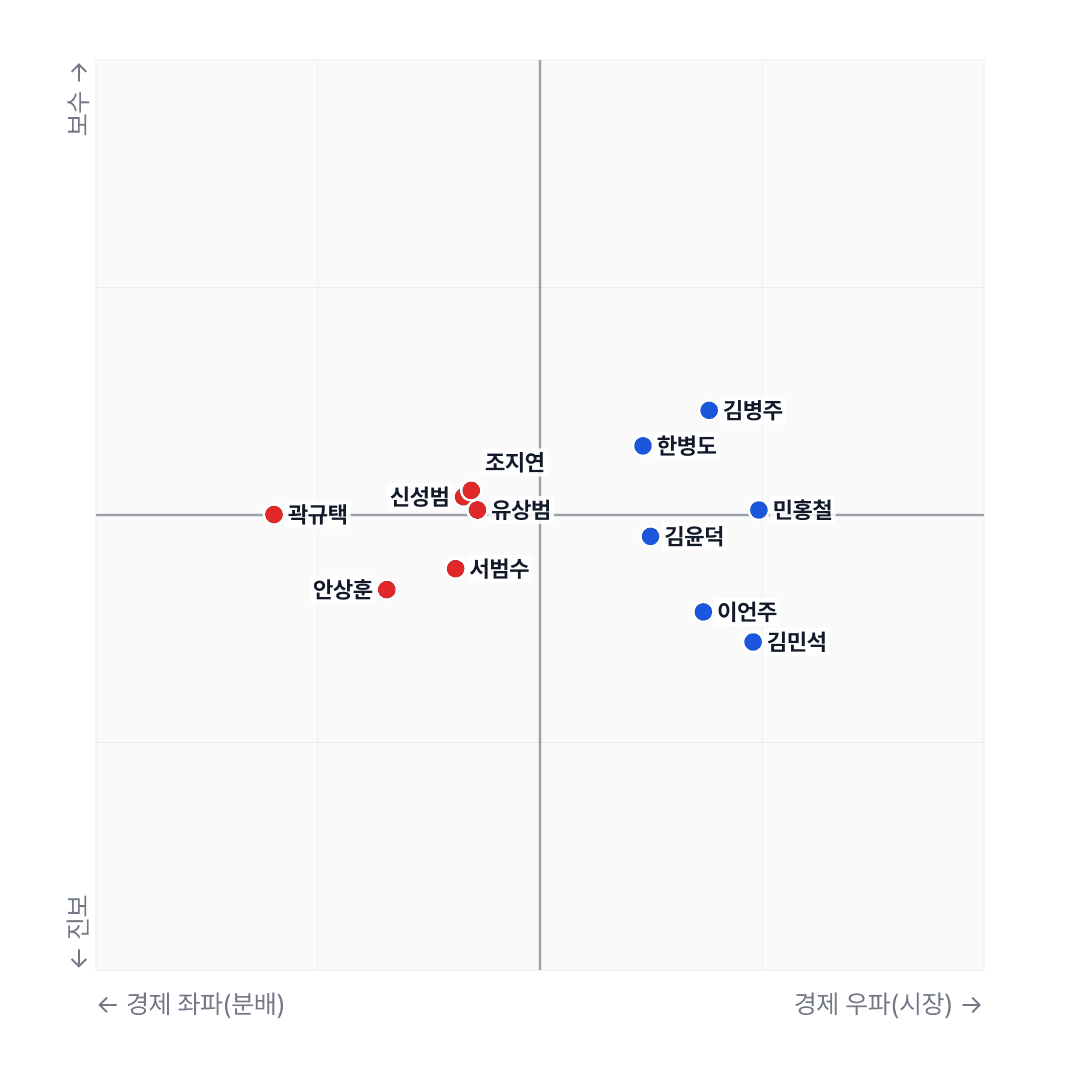
Ideological Coordinates That Defy Party Lines, as Told by Bill Sponsorship and Voting Records
Judging solely by bill sponsorship and voting records, a considerable number of lawmakers stray from their party's line. As Nietzsche said, facts look different depending on interpretation—but numbers are raw material before interpretation. The ideological coordinate data derived from analyzing bill content is not a record of a particular lawmaker's public image or media portrayal, but behavioral data documenting which bills they actually put their name to and which way they voted. What stands out in this data is the presence of so-called cross-pressured lawmakers who move in the opposite direction of their party's average.
The analytical framework is simple. Each lawmaker's economic and social ideological coordinates were calculated as weighted averages of judgments on bill content, then calibrated with the centers of the two major parties at the origin. More important than the coordinate numbers themselves is the gap from the average tendency of one's party. Lawmakers with large gaps find themselves in what political scientists call a cross-pressure state, forced to calculate differently every time they diverge from the party line.
The Economic Right Inside the Democratic Party, the Economic Left Inside the People Power Party
Several members of the Democratic Party of Korea stand clearly on the right in economic orientation. Rep. Min Hong-chul is socially close to the center but positioned significantly to the right of the Democratic Party average in the economic realm. Rep. Kim Min-seok shows right-wing economic tendencies while belonging to the conservative camp on social issues, diverging from the party average on both axes. In Rep. Lee Eon-ju's case, given her history with a conservative party, the data simply traces her political career as it is. Reps. Kim Byung-ju, Kim Yoon-deok, and Han Byung-do likewise show market-friendly tendencies bleeding through in their bill patterns along the economic axis.
The opposite pattern exists too. The most prominent figure in the People Power Party is Rep. Kwak Kyu-taek. His economic orientation is distinctly to the left—not only of the PPP average, but of the entire spectrum across both parties. Since his social orientation is neutral, he aligns with the opposition only on economic redistribution and regulation bills. Rep. Ahn Sang-hoon also stands to the left of his party's average on both economic and social axes, while Reps. Seo Beom-su, Shin Sung-beom, Cho Ji-yeon, and Yoo Sang-beom show a similar lean, though less pronounced. Notably, Rep. Shin Sung-beom is neutral on social issues but leans left only on economic bills, demonstrating voting behavior that splits by policy area.
Why Do These Gaps Arise?
The causes can be read in three broad categories. First is the economic structure of a district. The industrial interests of a particular region push voting toward practical benefit rather than party line. Second is the influence of the standing committee a lawmaker belongs to. When it comes to bills related to industries they oversee, there is strong incentive to make choices closer to industry logic than to party line. Third is an individual's political origins, with Rep. Lee Eon-ju serving as a representative example.
At this point, one factual matter needs to be flagged. If the public data shows cases where a lawmaker holds stocks in an industry overseen by their standing committee or received large donations from that sector, there is no basis to conclude that the lawmaker's economic bill votes are unrelated to those interests. However, since this analysis does not present specific stock holdings or donation records, this remains a next-stage question requiring verification. It is a matter of transparency, not of assessing legality.
The Data's Limits and Political Implications
Cross-pressured lawmakers are useful shock absorbers for party politics. The fact that roughly six such potential line-breakers were identified on each side of the aisle means that even in an era of polarized voting, variables for passing legislation still exist. It is also worth noting that the gap on the economic axis was larger than on the social axis. One interpretation is that defections from the party line occur more often over economic interests than identity politics.
Of course, the limits are clear. These coordinates are based on sponsorship and voting behavior, and may differ from images formed through media remarks or public speeches. If unexpected names appear, it is more likely a record of overlooked legislative activity than an error in the data. Numbers follow a lawmaker's actions, not their words.
Lawmakers Mentioned in This Article
| Lawmaker | Party | Ideological Orientation | Notes |
|---|---|---|---|
| Min Hong-chul | Democratic Party of Korea | Economic right · Social conservative | Against party line |
| Kim Min-seok | Democratic Party of Korea | Economic right · Social progressive | Against party line |
| Kim Byung-ju | Democratic Party of Korea | Economic right · Social conservative | Against party line |
| Lee Eon-ju | Democratic Party of Korea | Economic right · Social progressive | Against party line |
| Kim Yoon-deok | Democratic Party of Korea | Economic right · Social progressive | Against party line |
| Han Byung-do | Democratic Party of Korea | Economic right · Social conservative | Against party line |
| Kwak Kyu-taek | People Power Party | Economic left · Social conservative | Against party line |
| Ahn Sang-hoon | People Power Party | Economic left · Social progressive | Against party line |
| Seo Beom-su | People Power Party | Economic left · Social progressive | Against party line |
| Shin Sung-beom | People Power Party | Economic left · Social conservative | Against party line |
| Cho Ji-yeon | People Power Party | Economic left · Social conservative | Against party line |
| Yoo Sang-beom | People Power Party | Economic left · Social conservative | Against party line |