On a 30 Million Won Annual Salary, Take-Home Pay Is Just 2.2 Million Won a Month

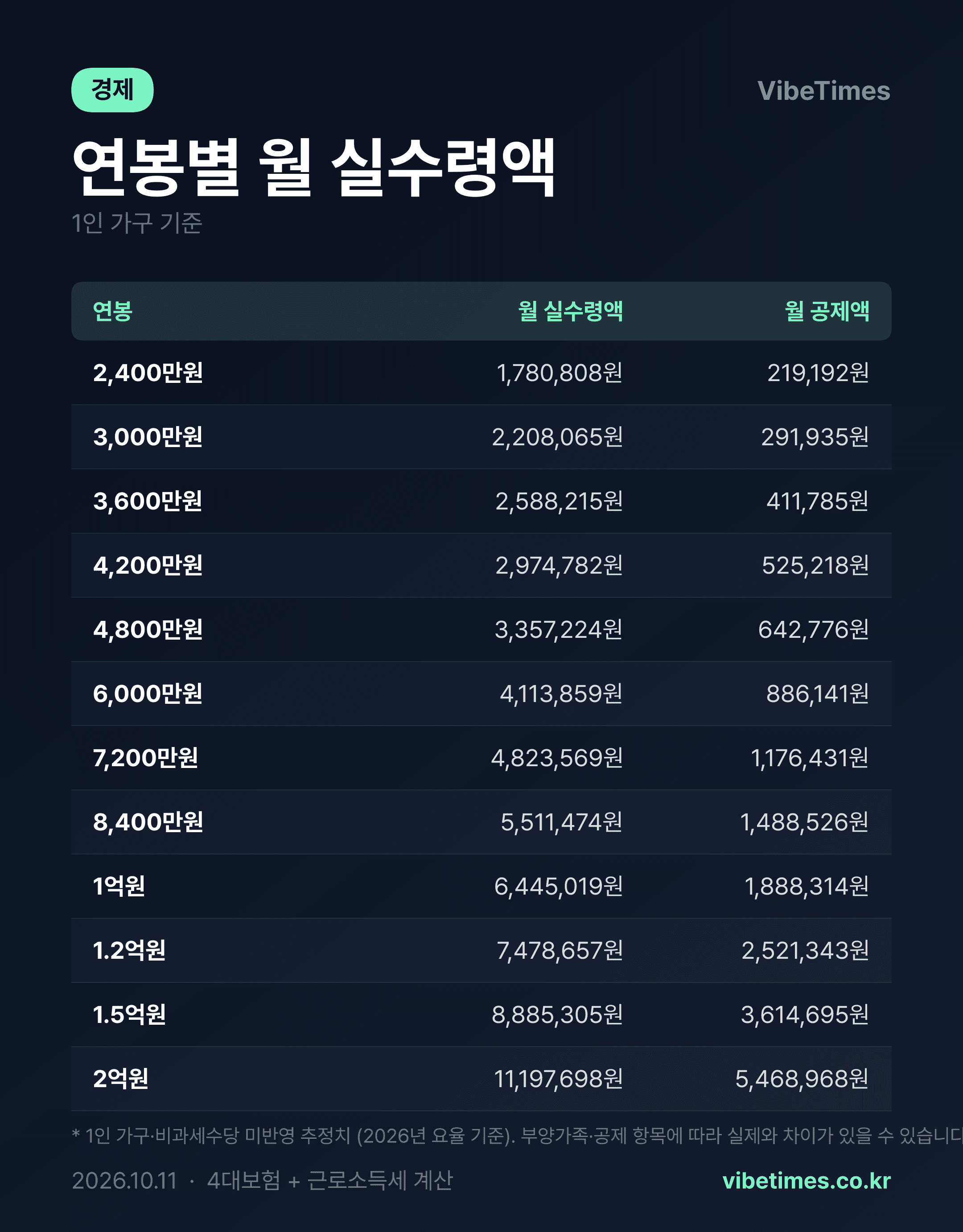
The monthly take-home pay on a 30 million won annual salary is 2,208,065 won. After deducting 235,102 won in the four major social insurance contributions and 56,833 won in taxes from gross pay, what lands in your pocket hovers around 2.2 million won. Tracing the take-home pay figures by salary bracket as of October 2026 clearly reveals the point at which the gap between headline pay and felt income widens the most.
Deduction Rates Steepen as Salaries Rise
Take the 24 million won salary bracket: out of a monthly gross of 2 million won, after 188,082 won in social insurance and 31,111 won in taxes, take-home pay comes to 1,780,808 won. Deductions account for only about 11 percent. But the picture changes at an annual salary of 150 million won. Even earning 12.5 million won a month, take-home pay is 8,885,305 won, pushing the effective deduction rate past 29 percent. On a 200 million won salary, of roughly 16.66 million won per month, taxes alone take 4,364,972 won, and with social insurance the total deductions reach about 5.46 million won, leaving a take-home of 11,197,698 won. Nearly one-third disappears before it ever reaches the bank account.
The most striking inflection begins at 36 million won. At a 30 million won salary, income tax and similar levies run 56,833 won a month; at 36 million won, that jumps more than twofold to 129,663 won. As tax breaks shrink and taxable income grows, the deduction burden climbs in a stair-step pattern even at lower salary levels. Social insurance premiums, by contrast, are levied at roughly fixed rates of income, staying at around 9.4 percent of salary up to about 72 million won.
The Insurance Ceiling Creates a Crossover Point
An interesting turning point appears at 84 million won. At this level, social insurance deductions come to 629,935 won, whereas a simple proportional rate would yield 658,285 won. With the caps on national pension and health insurance contributions kicking in, the pace of premium increases slows. Taxes then step in to fill the void. At 100 million won, monthly taxes reach 1,192,991 won, far outstripping premiums of 695,323 won, and by 200 million won the gap widens nearly fourfold. The higher the income, the more the burden shifts from insurance premiums to income tax and heavier comprehensive income tax structures.
Just as falling in love and staying in love are different things, earning a headline salary and keeping that money are entirely separate matters.
At the salary negotiation table, judging by headline numbers alone makes it easy to miss this structure. For example, moving from a 48 million won salary to 60 million won adds 12 million won on paper, but monthly take-home pay rises by only 756,635 won. Just 75 percent of the increase translates into actual disposable income. That is why you need to work backward from a post-tax target when negotiating a raise or a job change.
Financial Planning Should Be Based on Felt Income
The lesson here is clear: monthly spending plans should be built on take-home pay. An office worker reporting a 42 million won salary actually has 2,974,782 won in usable cash each month; on 30 million won, it is 2,208,065 won. Failing to account for the gap between the nominal figure people think of as their monthly salary and what they actually receive — anywhere from 10 to as much as 33 percent — means loan repayment plans or savings goals are off track from the start.
If income tax rates or the social insurance contribution caps change down the road, these figures will inevitably shift as well. But the broad pattern is likely to hold: deduction rates climb as salaries rise, and once premiums hit their ceilings, taxes become the dominant burden. On an individual level, the most effective approach appears to be setting a target salary by calculating in advance how much of a raise will actually reach your bank account, and reviewing earned income tax credits and year-end settlement items to lower your effective deduction rate.