Rep. Kim Tae-kyu Tops Lawmakers with 12.4% Rate of Defying Party Line
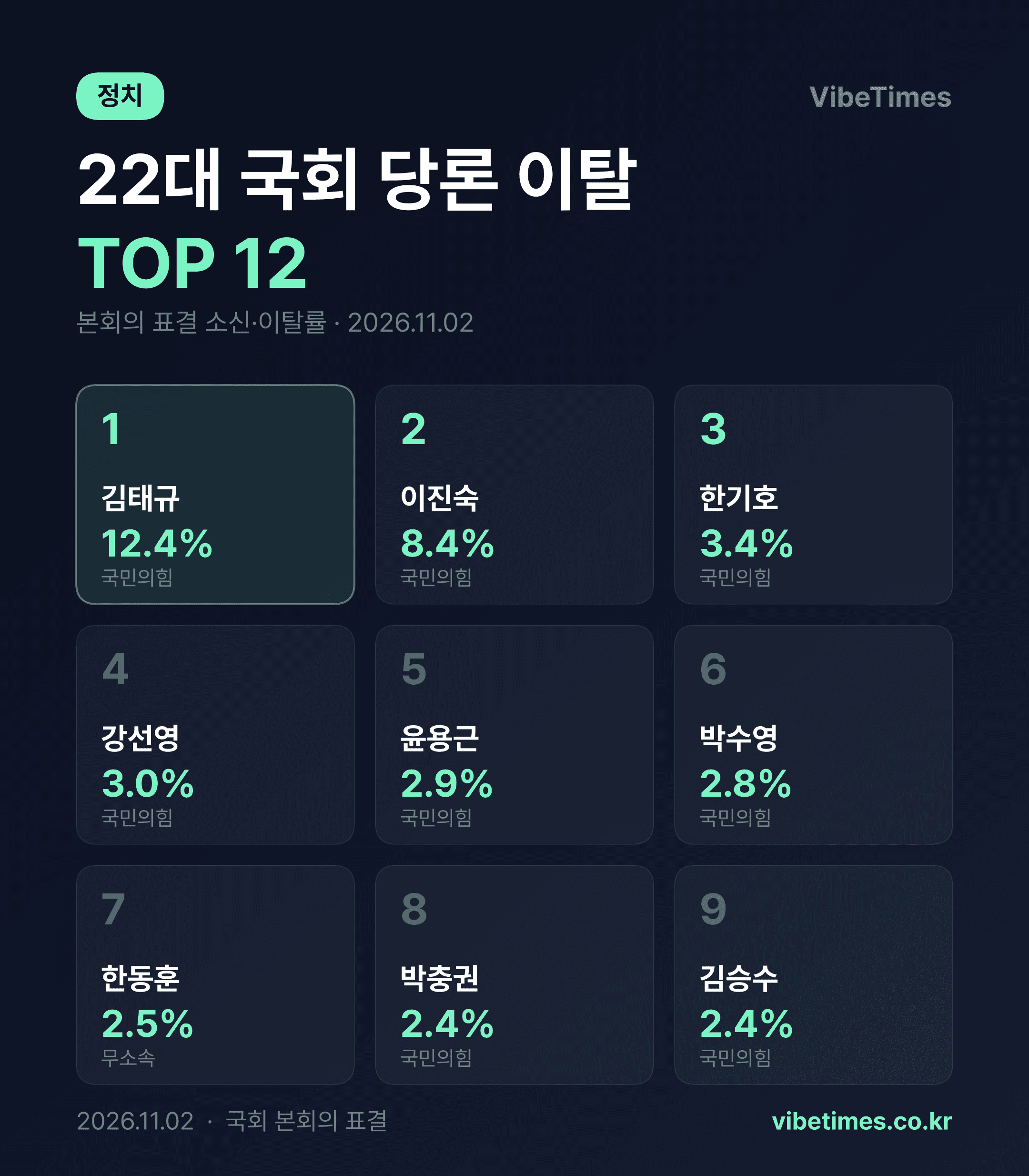
Rep. Kim Tae-kyu of the People Power Party recorded a 12.4% rate of voting against his party's line in plenary sessions, ranking first among all lawmakers.
What the Gap Between First and Second Place Reveals
Looking at the ranking data, the first thing that stands out is the overwhelming gap. Kim's 12.4% rate is 4.0 percentage points higher than that of second-place Rep. Lee Jin-sook (8.4%). Considering that third-place Rep. Han Ki-ho stands at 3.4%, the divide between the top two and the rest carries more significance than a mere difference in ranking. In effect, the upper tier of defection rates is split into two strata.
South Korean parties tend to enforce strict discipline against voting against the party line. Casting a ballot against the majority stance of one's party in a plenary vote can lead to tangible consequences, such as being denied a party nomination or losing assignment to standing committees. Within this structure, a defection rate exceeding 10% is close to a statistical anomaly. The fact that the remaining lawmakers in the top 10 cluster between 2.3% and 3.4% supports this point.
Concentration in the PPP and the Position of Independents
A look down the list to 12th place shows a lopsided distribution of party affiliation. Eleven of the 12 belong to the People Power Party, with the sole exception being independent Rep. Han Dong-hoon in seventh place (2.5%). Of course, this tally reflects voting patterns from a specific period, so interpretations tied to majority-opposition dynamics have their limits. Still, the data makes one fact clear: during this period, the gap between the party line and individual lawmakers' convictions within the PPP surfaced repeatedly.
For independents, the very benchmark of a party line is inherently loose, so Han's 2.5% is best read as selective defection in certain voting blocs. Given that it sits at a level similar to the top-ranked PPP lawmakers, the nature of the agenda items up for a vote, rather than party membership, may have driven the defection rates.
The Meaning Embedded in Low Numbers
Nowhere in the rankings does the defection rate exceed 12.4%, and most lawmakers stay in the 2% range. This underscores just how rare voting against the party line is in South Korea's National Assembly. The stronger party discipline is, the fewer conscience votes individual lawmakers cast, and as a result, even a handful of defections comes to be read as a political signal.
It is also intriguing that three lawmakers tied for eighth place at 2.4%. The fact that Reps. Park Chung-kwon, Kim Seung-su, and Joo Ho-young posted identical rates suggests a coordinated defection in a particular vote. This allows for the interpretation that defections often occur not as independent individual judgments but as collective breakaways around a specific issue. The figures for fourth-place Kang Sun-young (3.0%), fifth-place Yoon Yong-geun (2.9%), and sixth-place Park Soo-young (2.8%) can likewise be read as traces of a chain defection centered on a particular bill.
What to Watch in the Phases Ahead
The list of top defection rates serves in itself as a reference for gauging these lawmakers' political trajectories. In particular, for those like Kim Tae-kyu and Lee Jin-sook with rates approaching double digits, the key question is whether their pattern of distancing themselves from the party line will continue in major votes to come. Conversely, if such high-level defections are repeated, party leadership will have no choice but to consider tightening discipline.
Moreover, a low defection rate is a double-edged sword. As Hannah Arendt pointed out, most evil is committed by people who never make a decision between good and evil — a structure in which votes to simply follow the majority, withholding one's own judgment either way, go unmeasured by any index. A low defection rate in the 2% range is evidence that discipline is being upheld, but it also raises the question of how much individual lawmakers' independent judgment is actually reflected in votes. Whether the faces in the upper ranks of defection rates change in future tallies, or whether the same roster becomes entrenched, will make the landscape of conscience voting in the National Assembly clearer.