Micron Tops US Market With 5-Year Return of 1,112%

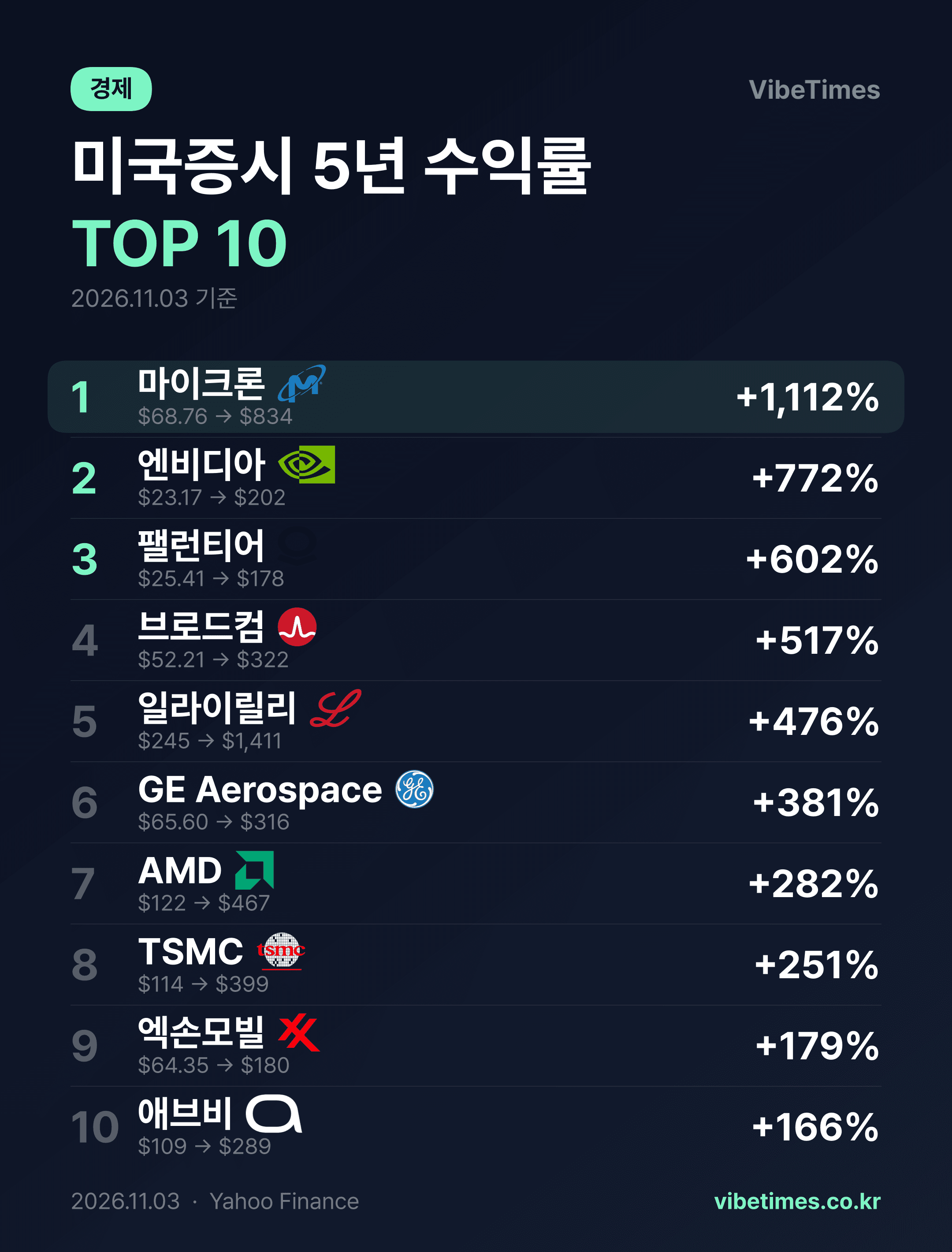
Micron has surged 1,112% over the past five years, claiming the top spot in US stock market return rankings.
During that period, its share price climbed from $68.76 to $834, and its market capitalization surpassed $1 trillion. Over the same span, Nvidia rose a comparatively modest 772.2%, followed by Palantir at 601.8%. The defining feature of this ranking is that semiconductor companies took three of the top four spots.
Why Micron Outpaced Nvidia
Inverting the ranking reveals the structure of the market. Nvidia, with a market cap of $4.94 trillion, is more than five times Micron's size — yet it trailed significantly in returns. The reason lies in the starting point. Nvidia was already recognized as the leading AI semiconductor stock by 2021, with much of that priced into its shares, while Micron was mired in a memory chip downturn at the time, having missed its golden window.
A low starting point became the foundation for high returns. As memory prices entered a recovery phase, Micron's earnings improved explosively, and the expansion of AI data centers lifted demand for high-bandwidth memory as well, giving direction to the stock's rebound. For a $68 stock to run toward $1,000, what was needed was not a new story but survival. As Pascal put it, great minds attend to the ordinary — and the winners of this ranking were likewise not dazzling newcomers but the ordinary powerhouses of existing industries.
Three Structural Lessons From the Top Tier
First is the dominance of semiconductors. Micron, Nvidia, Broadcom, AMD, and TSMC — five names within the top 10. TSMC gained 250.8% and reached a market cap of $2.11 trillion, while Broadcom climbed 517.2% to a $1.56 trillion valuation. The list shows that AI infrastructure investment lifted the entire semiconductor value chain simultaneously, from design to manufacturing to memory.
Second is the narrative of growth shares. Palantir, with a market cap of $442.4 billion, is the smallest in the top ranks yet ranks third in returns. It reads as a signal that software has outperformed hardware relative to its size.
Third is industrial diversification. Eli Lilly placed fifth at 475.8%, demonstrating the strength of pharmaceuticals, while GE Aerospace rose 381.3% since its spinoff, securing a reassessment of its jet engine business. Lower on the list, ExxonMobil and AbbVie managed only 179.2% and 166.2%, respectively. The gap between dividend-focused traditional blue chips and growth stocks has reached as much as 946 percentage points over five years.
What Investors Should Take Away
The lesson of this ranking is simple. Over a five-year horizon, the winner was determined not by sector but by entry price. Four of the top five stocks were semiconductor and pharmaceutical names languishing under pessimism in 2021. Meanwhile, previously beloved stocks delivered comparatively modest returns.
That said, past returns guarantee nothing about the future. Micron's 1,112% was the product of a recovery from a low base, and expecting a similar magnitude of gains from its current $834 share price is unrealistic. Having crossed the $1 trillion market cap threshold, the company is more likely transitioning into a phase of stable growth. Nvidia's $4.94 trillion scale, likewise, can no longer coexist with the explosive gains of the past.
The next five-year leaderboard will likely hinge on whether AI demand endures and how long the memory supercycle lasts. Whether semiconductors continue their solo run, or an undervalued sector outside the rankings claims the next Micron's throne, is the storyline to watch.
