Yoon Joon-byung Leads Bill Sponsorship with 360 Bills, Democrats Dominate

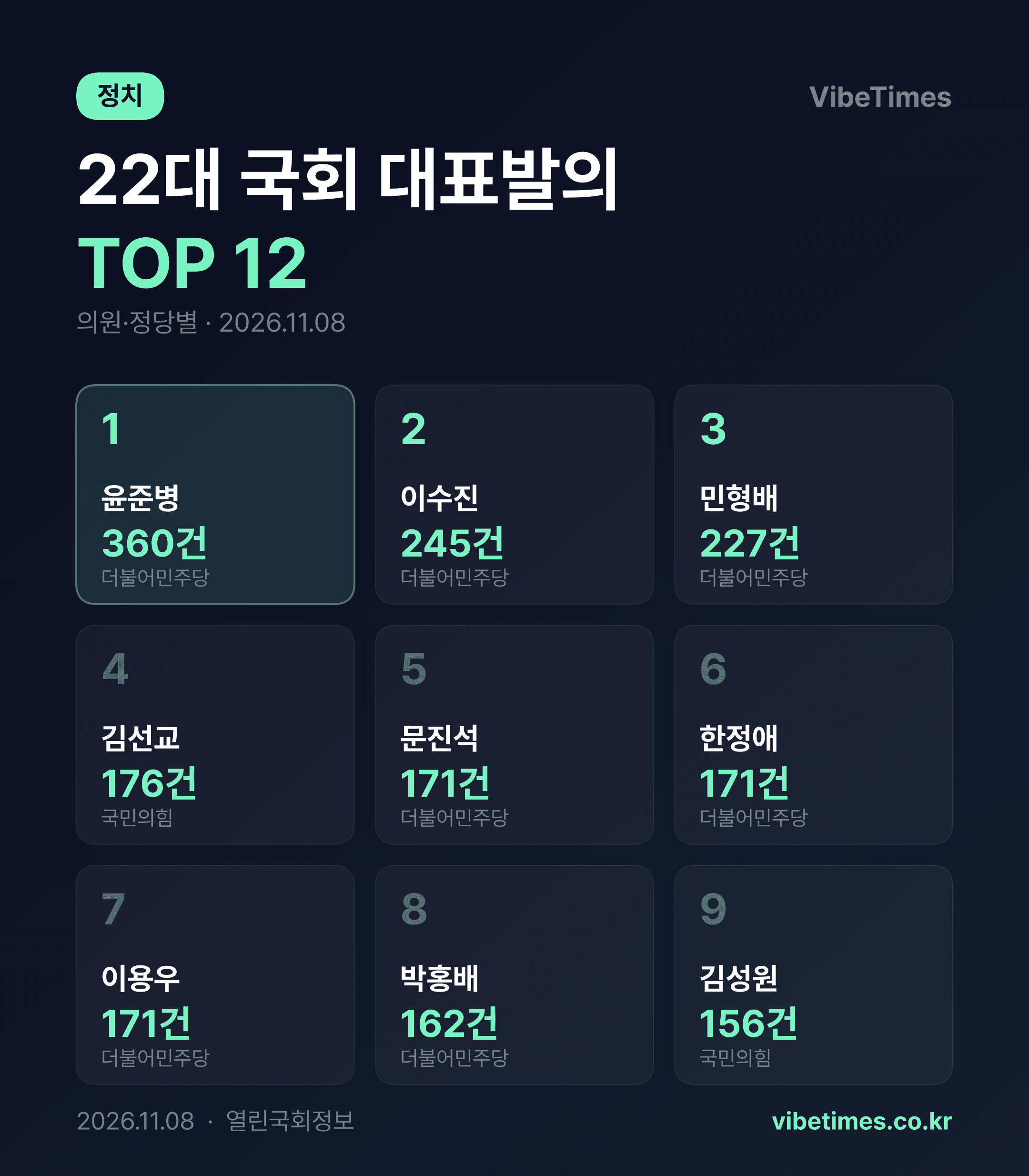
Rep. Yoon Joon-byung of the Democratic Party took an overwhelming first place in the bill sponsorship rankings of the 22nd National Assembly, with 360 bills.
That is a full 115 bills ahead of second-place Rep. Lee Soo-jin's 245. Nine of the top 12 belong to the Democratic Party, while the People Power Party counts just three: Kim Sun-gyo (176 bills, 4th), Kim Sung-won (156, 9th), and Kim Ye-ji (151, 12th).
What the Sponsorship Rankings Tell Us
Sponsoring a bill is the first step in lawmaking. When a lawmaker puts their name forward as the lead sponsor of a bill, it signals ownership of the proposal, so the count serves as a representative yardstick of legislative output. But quantity is not quality. A bill becomes law only after committee review and a plenary vote, so reading the numbers without also looking at passage rates risks taking the figures at face value.
Yoon's 360 bills come close to the combined total of the second- and third-place lawmakers at 472, meaning he sponsored more than one bill per day on average. Also notable are the three-way tie among Reps. Moon Jin-seok, Han Jeong-ae, and Lee Yong-woo, each with 171 bills at 5th through 7th place, and Kim Tae-sun and Kim Ye-ji matching at 151 bills in 11th and 12th. So many ties suggest that lawmakers from both parties are legislating at a similar pace around a certain threshold.
A 9–3 Split: Democrats vs. People Power Party
The political meaning of the rankings is clear. The numbers confirm that the Democratic Party, as the majority party, holds the legislative initiative. The majority party enjoys higher odds of passing bills, which structurally draws more fellow lawmakers to join as co-sponsors. For minority-party lawmakers, by contrast, attaching their names to bills with slim passage prospects carries a growing burden.
Even so, the People Power Party's Kim Sun-gyo reaching 4th place with 176 bills is meaningful. Standing alone at 4th ahead of ruling-party lawmakers, he is seen as striving to maintain legislative output despite the disadvantage of being in the minority. First-term lawmaker Kim Ye-ji's 151 bills, good enough for the top 12, also merits attention.
Why the Numbers Alone Are Not Enough
These rankings should not be reduced to a simple measure of diligence. Bill sponsorship bundles together constituency demands, responses to hot-button issues, and each party's legislative strategy. A high count means a lawmaker has offered legislative fixes to a wide range of issues, but the quality of each bill and whether it actually passes must be verified separately.
In 1763, Voltaire said we owe respect to the living and, to the dead, only truth. The same goes for legislative rankings. Not the glittering numbers, but what genuine change each bill brought to people's lives will be the final measure. The names on this list may change as the 22nd National Assembly's term runs on, but the question of balancing quantity and quality will not.
