Lee Jae-myung's Approval Rating Rebounds to 41%, Recovering the 40% Threshold After 8 Weeks

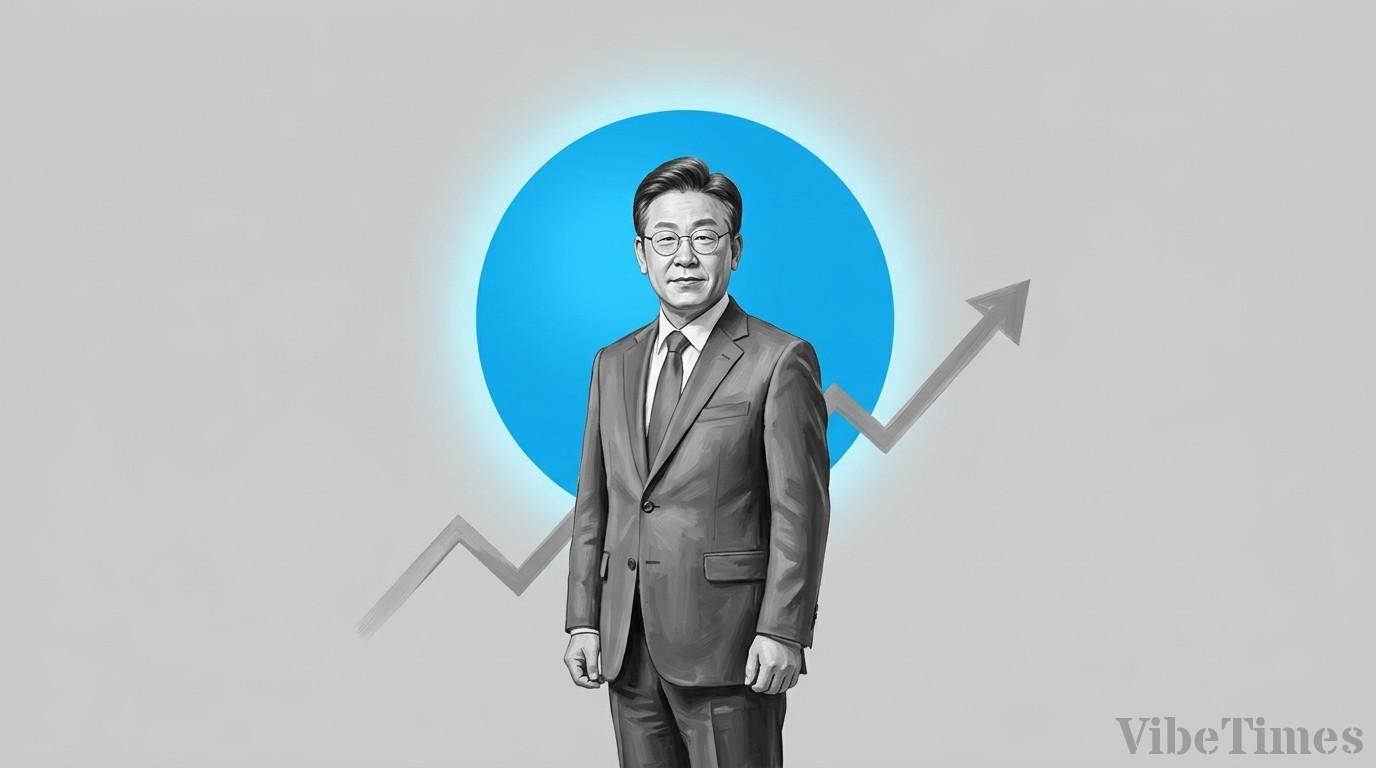
President Lee Jae-myung's approval rating has rebounded to 41%.
That is a 2-percentage-point rise. The figure comes from opinion polling. Despite the various risks that have emerged since his administration took office, public sentiment has turned from a verdict on his government to renewed trust — which gives this number a different weight. The ruling Democratic Party's approval rating stood at 36%, while the People Power Party registered 28%, meaning the gap between the ruling and opposition camps is in the double digits.
The Backdrop to the Rebound
This uptick must be seen in context. The approval rating had earlier dipped below 40% before recovering after eight weeks. Within a stretch of repeated declines and rebounds, 41% can be read as a recovery toward the upper range. Notably, the rebound coincides with the National Assembly's passage of the special counsel act on the fabricated-prosecution case. President Lee has been personally indicted in six confirmed cases, while the special counsel investigation targets 12 related cases. A paradox thus holds: his approval rose at a moment when political pressure could have mounted.
Despite the People Power Party's filibuster, the bill passed under the ruling party's leadership — proof that the opposition's resistance did not translate into a drop in approval. Analysis suggests that the "uncovering the truth about fabricated investigations" frame gained more persuasive power with the public than the conservative camp's backlash framing.
The Political Meaning of Recovering 40%
In South Korean politics, 40% is a symbolic threshold. While short of a majority, it is widely regarded as the minimum for a stable governing coalition. Reclaiming this figure after eight weeks shows that the foundation of the Lee Jae-myung government has not collapsed. The gap between the ruling party's 36% and the People Power Party's 28% is 8 percentage points — meaning that, with local elections ahead, the balance of power between the ruling and opposition camps has hardened decisively.
The government's performance messaging appears to have played a role as well. President Lee named economic recovery — rising exports and a growing trade surplus — as what has brought him the greatest joy since taking office. The more tangible economic indicators are felt on the ground, the weaker the downward pressure on his approval becomes. Yet a shadow hangs over the rebound: in the Lee government's first year, Seoul apartment prices rose 11%, the steepest climb of any administration since the 2000s. If housing cost burdens accumulate, even his own support base could begin to show signs of drift.
The Opposition's Options Narrow
People Power Party leader Jang Dong-hyuk formally proposed an end-game debate with President Lee over the 162-trillion-won "Future Response Fund." Over the nomination of Justice Minister nominee Lee Yong-chul, the party also voiced fierce objections, calling it "the completion of the Lee Jae-myung jailbreak project." Supreme Council member Kim Min-soo interpreted the appointment as part of the "Seongnam line" and a signal of an outreach to the pro-No faction. But no matter how intense the attacks, if public opinion does not follow, the wall of the party's 28% approval will be hard to break.
The problem is the efficiency of those attacks. During the debate over the special counsel act, the opposition stalled with marathon speeches and a filibuster — only for the bill to pass the National Assembly. The data confirms that procedural resistance failed to serve as a means of defending approval ratings. Where the opposition can actually gain traction, rather, is at moments when fractures within the broader ruling camp surface — such as when lawmaker Kwak Sang-eon cast a dissenting vote and Lee So-young abstained on a bill to abolish prosecutors' investigative powers. Whenever ruling-party unity wavers, the 8-point gap may no longer hold.
Whether the rebound continues hinges on two variables. The first is the direction of the special counsel investigation. With the six trials involving Lee and the special counsel probe proceeding simultaneously, if fabrication is proven, his approval could climb further; if not, the rebound may well be reversed. The other is the case in which the President's eldest son, Lee Dong-ho, sued lawmaker Chu Jin-woo for defamation. The Seoul Metropolitan Police Agency's broad investigation unit has launched a probe, and Chu's side has announced a counter-complaint. If family-related issues drag on, they could collide with the President's pledge to maintain the special inspector system, magnifying political friction.
Steve Jobs once said, "Life doesn't just happen to you; it's all connected." Approval ratings are no different. This rebound was no accident — it was the product of an economic recovery message and a victorious investigative framing. If 41% holds into the next quarter, the Lee Jae-myung government can set its own pace, whether on constitutional reform or the budget. For the opposition, by contrast, the path ahead may arrive faster than generational change: finding a new justification amid the judiciary overhaul, as seen in the evenly split opinion on impeaching Chief Justice Jo Hee-de. The numbers have already pointed the direction. What remains is how to read them.