Doksan-dong: The Frontline of Regional Imbalance Created by AI

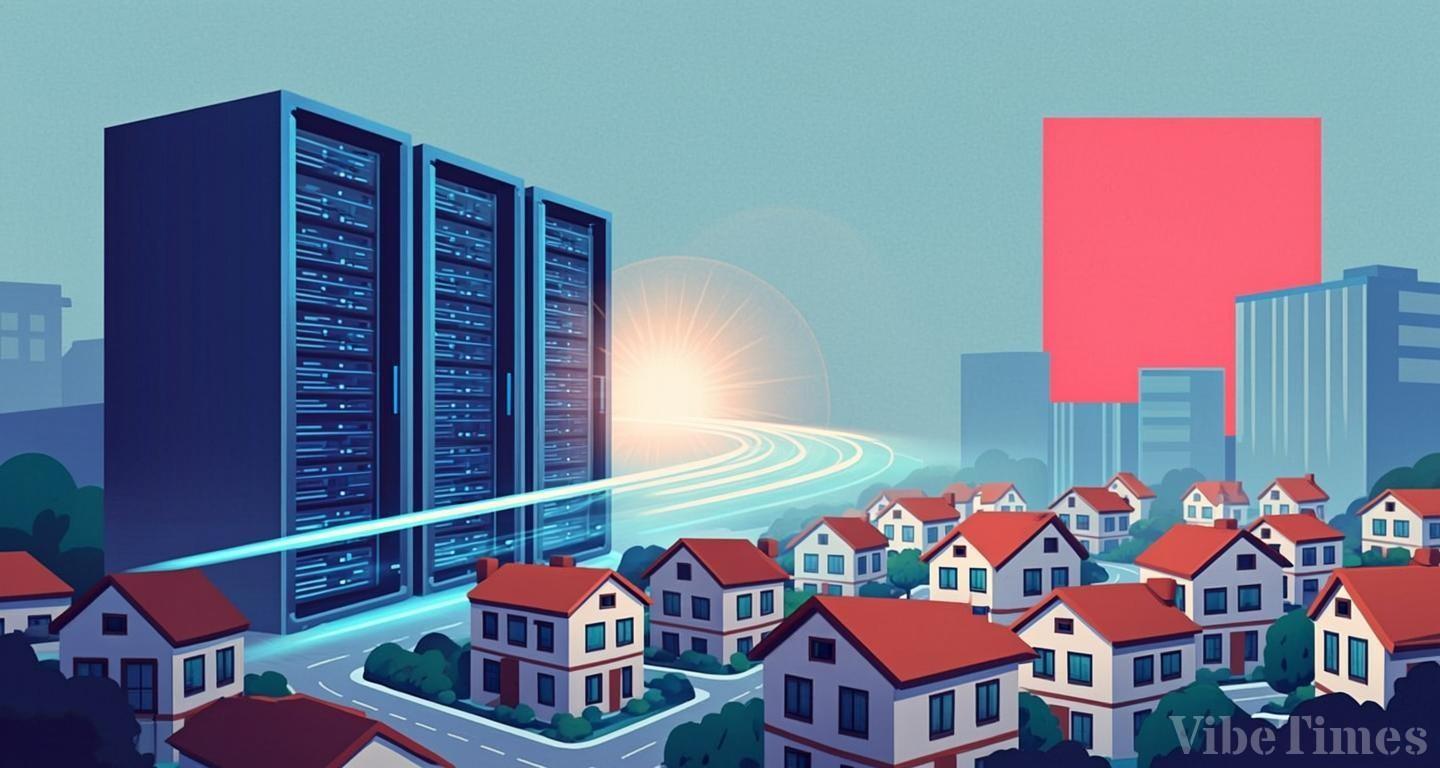
A data center rises next to an apartment complex, leaving residents anxious
Doksan-dong, Geumcheon-gu, Seoul, on the 9th. A massive tower crane loomed over the construction site of a data center — a facility that stores and processes large volumes of information — beside an apartment complex. While such facilities are essential to the growth of the AI industry, nearby residents have pushed back, citing concerns over fire hazards, noise, and vibration. A data center with an electricity receiving capacity of 4.98MW is being built at 724-4 Doksan-dong, and construction was temporarily halted earlier this year amid resident opposition. Two more facilities, rated at 9MW and 9.9MW, are also being planned on nearby land around 151 Doksan-dong. The changes unfolding in this data-center-concentrated area illustrate how regional imbalance manifests in the AI era.
The reason data center construction keeps cropping up near residential areas in Seoul, despite resident opposition, comes down to location and economics. Data centers require large-scale power and telecommunications networks, and their main customers — enterprises and cloud providers — are concentrated in the metropolitan area. To reduce data transmission latency, proximity to customers is advantageous. Lee Seong-yeop, a professor at the Graduate School of Technology and Innovation Management at Korea University, explained that because the population and businesses are densely concentrated in the capital region and securing sites is difficult, locational conflicts arise near residential areas.
The concentration in the metropolitan area is also confirmed by statistics. According to data submitted by Korea Electric Power Corporation to Rep. Choi Ki-sang of the Democratic Party of Korea, of the 89 electricity usage applications for data centers nationwide from January to August this year, 72 (80.9%) were in the metropolitan area. Applications in Seoul rose from 11 last year to 51 by August this year. Of the 95 applications under 10MW in the metropolitan area, 70 were concentrated at 9.5MW or above.
Institutionally, too, the structure allows such projects to proceed. Under the current Building Act, data centers are classified as broadcasting and telecommunications facilities and can receive building permits as long as they meet land-use and construction and safety standards. Consent from nearby residents is not a blanket mandatory requirement. The two project sites around 151 Doksan-dong are also semi-industrial zones, where data center construction is administratively permitted.
However, of the 27 projects in the metropolitan area that underwent power grid impact assessments, 19 (70.4%) failed to pass, leading to a string of project setbacks. Data center development projects are structured around long-term lease contracts and project financing (PF), making it difficult to halt them once construction begins. Lack of resident acceptance and unfavorable power conditions are feeding into conflict and investment risk. As demand for AI infrastructure expands, in Seoul's Geumcheon-gu Doksan-dong, securing the power grid and winning resident acceptance have emerged as the key sticking points in the data center siting process.
