Elderly Population Exceeds 20% as South Korea Enters Super-Aged Society

South Korea has officially entered a super-aged society, with the proportion of people aged 65 and over surpassing 20%.
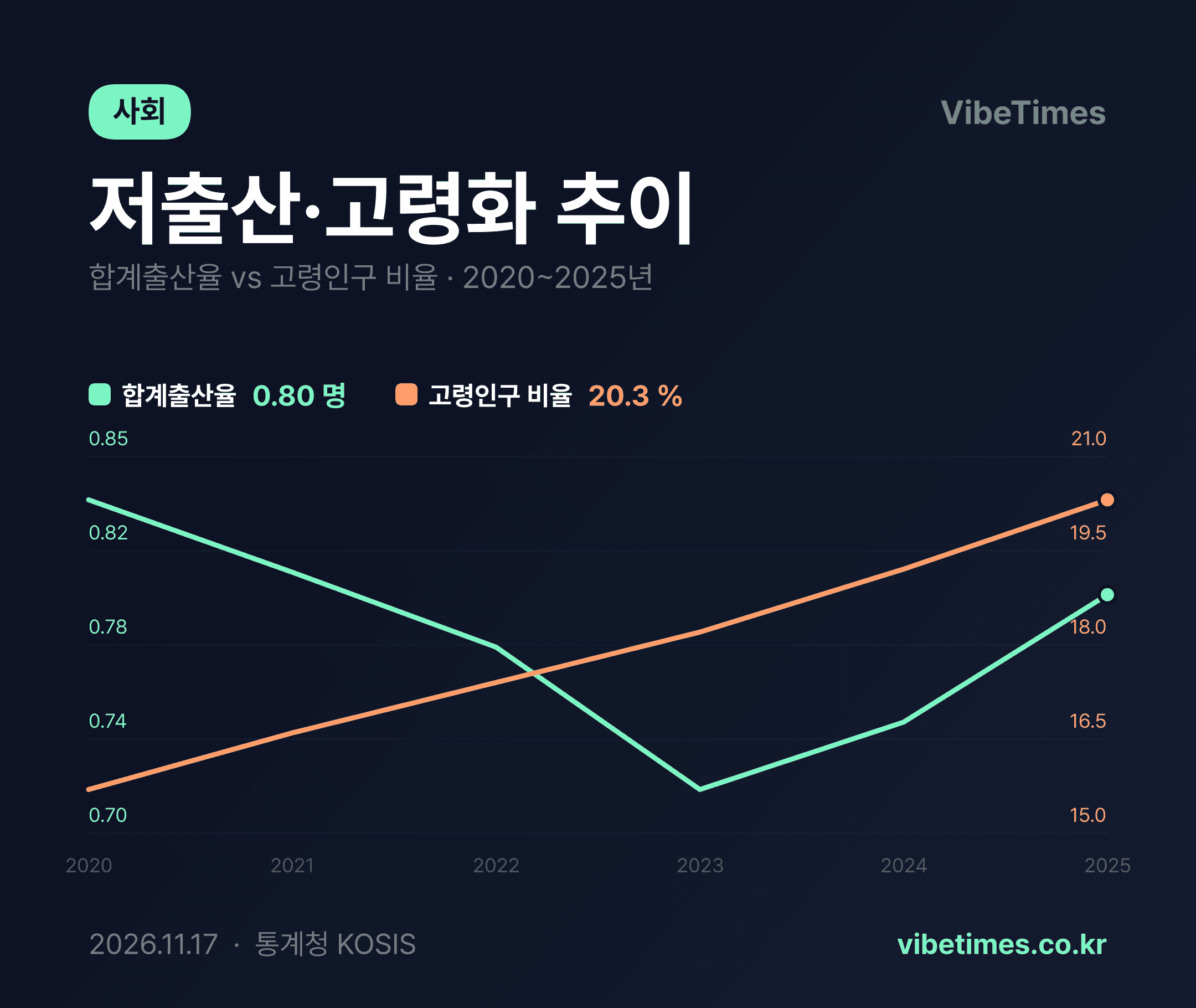
According to Statistics Korea's population trends data, the elderly population ratio rose by roughly one percentage point each year—from 15.7% in 2020 to 16.6% in 2021, 17.4% in 2022, 18.2% in 2023, and 19.2% in 2024. In 2025, it reached 20.3%, an increase of 4.6 percentage points over five years. With a total population of 51,117,378 (as of 2025), the number of elderly people now exceeds 10 million.
Birth Rate Rebound Meets Shifting Demographics
A notable development is the trajectory of the total fertility rate. After falling from 0.837 in 2020 to 0.808 in 2021, 0.778 in 2022, and 0.721 in 2023, the rate rebounded to 0.748 in 2024 and reached 0.799 in 2025—rising for two consecutive years and recovering 0.078 from the 2023 low.
However, this rebound cannot immediately reverse the aging of the population structure. Even at 0.799, the fertility rate falls short of half the 2.1 needed to sustain the population. Due to the generational structure built up by years of low birth rates, the working-age population will inevitably continue to shrink and the elderly ratio will rise for decades to come. Slowing the pace of aging is a different matter from reversing it.
The Dual Structure Reflected in Income Gaps
Income indicators also reveal structural features. As of the second quarter of 2026, the top 20% of households by income—the fifth quintile—earned an average monthly disposable income of 11,150,363 won. At over 11 million won a month, the gap with lower-income brackets suggests a potential polarization in household consumption and asset accumulation.
When the entry into an aged society overlaps with income polarization, the economic burden grows heavier. As the number of low-income elderly increases, demand for pension, health care, and long-term care funding rises, while the working-age population—the tax base—shrinks, creating a double squeeze. Tax and social insurance burdens are inevitably concentrated on the relatively younger generation.
Lingering Challenges for Markets and Industry
On the industrial side, the expansion of the silver economy is unavoidable. An elderly population of 20% reshapes the demand landscape across health care, nursing, housing, and finance. Markets for health management, chronic disease treatment, care services, and senior-tailored financial products are expected to have significant room to grow.
Labor market pressures are also set to intensify. The shrinking working-age population is likely to fuel wage pressures and increased investment in automation and robotics. For companies, investing in technology to replace labor shortages is likely to become a condition of survival rather than a choice.
Fiscal policy also requires fresh thinking. As age-related spending rises structurally, a weakening revenue base would heighten fiscal sustainability risks. The core policy challenge going forward is a two-pronged strategy: sustaining the rebound in the fertility rate while expanding economic participation and income sources for the elderly. Whether the 2025 fertility rate of 0.799 proves a temporary rebound or a turning point in the trend will be determined by the data of the next two to three years.